
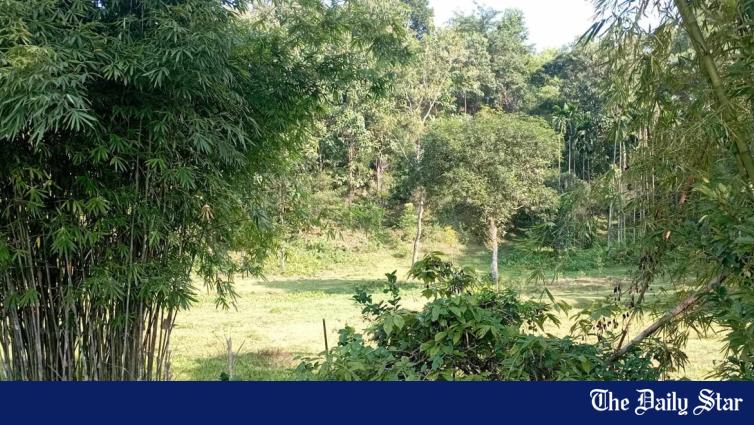
On June 7, 2008, Syeda Rizwana Hasan, then the director of the Bangladesh Environmental Lawyers Association (BELA), wrote a strong piece in The Daily Star. In that article, she highlighted the failure of the previous governments to formulate a village forest rule under the Bangladesh Forest Act, 1927. That rule, if formulated, was supposed to describe which piece of a reserved forest would be allocated to a village community as a “village forest,” and how the community would enjoy forest products or pasture, and protect and improve the forest. The rule, however, was also not materialised in the next 16 years, at the end of which Syeda Rizwana Hasan became the environment advisor of Bangladesh following the July uprising. On January 28, 2025, she declared the interim government’s plan to enact the village forest rule. One year on, it remains elusive. This shows that, in Bangladesh, despite having the authority, one may not succeed in doing what they advocated for a long time.
Nevertheless, the stories of success still exist. In November 2025, the interim updated the 31-year-old forest policy as the National Forest Policy, 2025, which I support for three reasons. First, it extensively upholds inclusive and participatory management of forests and protected areas, appreciating Bangladesh’s 30-year experience of community-based natural resource management, which involves forest-dependent local communities and Indigenous peoples. Second, by focusing on an expansion of coastal forests and marine protected areas (MPAs), the new forest policy expects to actively contribute to the blue economy. Third, the policy also expects to explore carbon trading to channel funds for ecosystem conservation and management. All these highlight that the new forest policy is very advanced.
December 2025 saw some important developments in enacting two forestry-related ordinances: the Forest and Tree Conservation Ordinance, 2025 and the Wildlife (Conservation and Security) Ordinance, 2025. If gazetted before February 12, 2026, these ordinances could become two environmental milestones for Bangladesh. The new wildlife ordinance is supposed to fill in certain gaps in the Wildlife (Conservation and Security) Act, 2012, by including several new and updated provisions. I want to touch upon two issues based on the publicly available draft version of November 16, 2025.
First, the ordinance authorises the government to establish a Wildlife Trust Fund for wildlife conservation. The Ecologically Critical Area Management Rules, 2016, the Protected Area Management Rules, 2017, and the Bangladesh Biodiversity Act, 2017, all already have provisions to create separate conservation funds. Since none of these has been materialised, there was no reason to be optimistic about the new fund. Second, like the Wildlife Act of 2012, the new wildlife ordinance includes the provision of declaring MPAs. The Marine Fisheries Act, 2020, also has detailed provisions for the same. The tension between the Forest Department and the Department of Fisheries over declaring MPAs has been going on for a long time. The Swatch-of-No-Ground (2014) and the St Martin’s Island (2022) MPAs were declared under the Wildlife Act, whereas the Middle Ground and South Patches Marine Reserve (2000, now an MPA), the Nijhum Dwip (2019), and the Naf (2024) MPAs were declared under the Fisheries Ordinance/Act. The new wildlife ordinance doesn’t indicate any resolution of the inter-ministerial conflicts over MPAs.
Despite these legal progresses, the Bangladesh government is still inadequate in conservation actions. The 20-year-long Bangladesh Wildlife Conservation Master Plan has remained on paper since 2015. The same fate is looming for the National Conservation Strategy (2021-2036), which took Bangladesh an excruciating 40 years to prepare. There are many national species conservation and management plans, namely for the vulture (2016-2025), the gharial (2016-2025), the elephant (2018-2027), the tiger (2018-2027), the dolphin (2021-2030), and the sharks and rays (2023-2033). Indeed, some planned actions were implemented, and impacts have been seen. The Bengal tiger number, for example, increased from 106 (in 2015) to 125 (in 2024) due to several projects in the Sundarbans involving local people, researchers, and law enforcement agencies. A vulture rescue centre has been in operation in Singra National Park, Dinajpur, since 2016. In April 2025, the country’s first gharial breeding centre was opened in Rajshahi. From sporadic media coverage, we also learn about some commendable conservation initiatives by national NGOs, local groups, and individuals. But, do we really have any idea where we stand in terms of implementing the long-term conservation plans, especially since some plans’ timelines have already expired or will expire soon?
With the upcoming parliamentary election, I wonder how many of Bangladesh’s political parties are talking about nature conservation in their manifestos. How many are going to put the unfinished conservation actions on their priority list? Will we vote for a rejuvenated Bangladesh with healthy, resilient ecosystems, or without?
Dr Haseeb Md. Irfanullah is an independent environment and climate change consultant and visiting research fellow at the University of Liberal Arts Bangladesh (ULAB). He can be reached at [email protected].
Views expressed in this article are the author’s own.
Follow The Daily Star Opinion on Facebook for the latest opinions, commentaries, and analyses by experts and professionals. To contribute your article or letter to The Daily Star Opinion, see our guidelines for submission.