
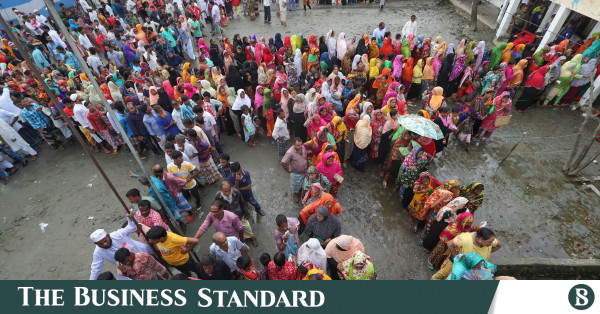
Can you answer when Bangladesh last witnessed a credible election? I guess for this generation of voters, the idea of a “free and fair” election has been nothing but a myth, a fantasy. In this political situation, many have forgotten how genuine competition works — how a candidate earns trust and how a community negotiates its demands.
Does a political manifesto or policy debate even matter to rural people — to a farmer for example, whose ballot is cast? The answer is ‘No’.
In rural Bangladesh, the elections are decided by long-standing relationships, memories of favours, and unwritten social contracts. If we are to understand the state of democracy in Bangladesh today, we must begin by understanding how elections are won — and lost — at the village level.

I remember a story from my childhood, just after Cyclone Sidr hit in 2007. In our village, the Union Parishad member suddenly passed away, and his responsibilities were temporarily handed over to a man who had never been involved in politics. He was a mechanic — someone who fixed water pumps and power tillers for villagers. He didn’t wear the badge of leadership, but through his daily work, everyone knew him by name. Since he had a shop in the local market and mostly remained open for a day, he was a perfect choice.
When the next election came around, something extraordinary happened. The villagers didn’t just support him — they insisted he conpete. He hadn’t spent a single penny to buy votes or campaign in the conventional sense. Yet he won by a landslide. Why?
I remember how he went door to door informing families when the relief trucks would arrive. And for those too old or sick to collect relief themselves, he would bring it back for them while collecting his share — because he too was not privileged or elite. That’s what made him different. People believed he was one of us and that’s all that mattered.
The rural vote decides it all
Despite rapid urbanisation, the political future of Bangladesh is still mostly dependent on its villages, given that the rural constituencies make up the majority of electoral seats. The point to be noted here is that the culture of voting in rural Bangladesh is extremely interpersonal. The elections in the villages are not decided merely on party allegiance; rather, it’s about memory, relationships, and perceived loyalty.
In these areas, voters keep mental scorecards.
To give examples, they remember who helped manage a government job for their nephew who otherwise would have ended just being a farmer like them, who paid the registration fees for their children’s board exam or else they would have to take this money as a loan, who came to participate in their father’s Janaza, who donated a big amount during their daughters’ marriages, who paid for building the roof of their mosques, who sent them aid during floods, who joined Eid prayers with villagers, who supported local sports tournaments, who donated lungis and sarees, who stood beside a family during a medical emergency, who funded for the roads which have been overlooked by many others for years and they thought this would never be done, who helped them when a fake case was filed because of some sort of land dispute.
Promises also matter to them if they were kept at all. A candidate who pledged a road and delivered it five years later will be remembered. One who promised a government job and failed but explained honestly why might still retain respect.
Here, ballots for the candidates are decided not based on the political rhetoric but by their history of service — often in the form of informal promises, small acts of generosity, or local intervention. Here campaigns in the forms of political manifestos, posters, and slogans do not seem to work at all. Winning an election is more about proving that you’ve been there — visible, helpful, and dependable.
In rural Bangladesh, the elections are not about jargon. It’s all about trust, and trust is built on relationships at a time. One does not earn it just one week before the election.
Barriers for newcomers
Given the rural political context, it is no surprise that the newcomers would struggle to break through, particularly the new student-led political party — NCP. A fresh graduate with excellent political thoughts and bold ideas about future policy reform may appear impressive on social media, but on the ground, rural voters will ask, “Who is he? How old is he? Does he have muscle powers to protect me when I need him? Did he attend our funerals? Did he stand with us when others disappeared?”
For the newcomers, this must be frustrating since many of them are sincere, politically aware, and eager to serve the country. Yet they find themselves far away from the rural political field, which does not reward the vision but history. Newcomers can break in, but only if they are patient enough to build their innings like a test match in cricket.
The long game of democracy
I begin the article by questioning when the last free and fair election happened in Bangladesh. The answer would vary but it would be the kind of answer that, probably in the last two decades, we haven’t seen one. But yet it does not mean that all political logic has disappeared.
Beneath the surface of manipulated ballots and authoritarian control, in rural Bangladesh, an older system of democracies still exists. Voters may not get to choose freely, but they still know what kind of person they want: someone who shows up, stands by them and delivers in times of need.
For newcomers, this should not be discouraging at all. This situation would not change overnight just by throwing around some slogans. It would require presence and patience. It would take a willingness to play a long game, building trust one gesture, one prayer, and one visit at a time.
Md Sohrab Hossen is a Senior Officer at Inquiry, Brac. He can be reached by email: [email protected].
Disclaimer: The views and opinions expressed in this article are those of the author and do not necessarily reflect the opinions and views of The Business Standard.