
Aquaculture, or farming in water, is growing in leaps and bounds. It’s the fastest-growing food production system in the world, producing fish, seaweed, shellfish and other invertebrates. And we now eat more farmed than wild-caught seafood.
While some parts of aquaculture, such as growing seaweed and shellfish, can be highly sustainable and even benefit marine environments, others are often not. Salmon farming can spur a number of problems, for example, from rampant pollution and greenhouse gas emissions to disease.
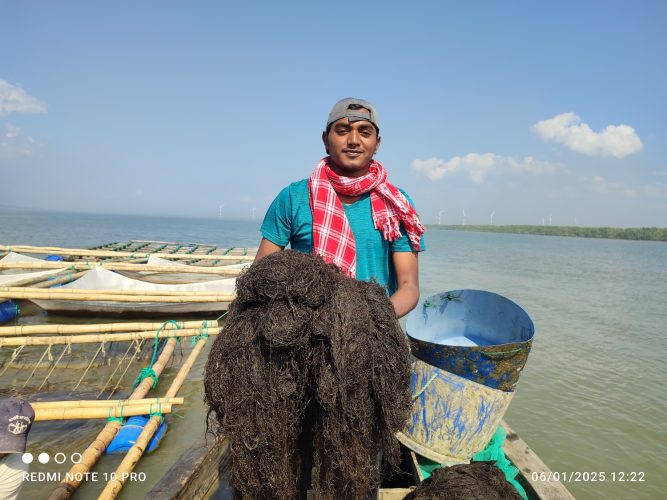
In Bangladesh, farmers are turning to a new solution: growing two or more aquatic species at different levels of the food chain together to reduce pollution and even benefit the ecosystem. Led by the nonprofit WorldFish, aquaculture researchers at Chattogram Veterinary and Animal Science University and other partners, this initiative has trained over 100 farmers so far. They’re raising a variety of species — including finfish like long whisker catfish and Asian sea bass, crustaceans like shrimp and green mussels, and seaweed and aquatic vegetables — in ponds and marine environments.
To date, the project has yielded promising results for both the environment and the farmers. Could this style of farming, called integrated multi-trophic aquaculture, hold the keys to a more sustainable and economically viable industry?

Aquaculture afflictions
Bangladesh is a prime target for this project, with about 12 percent of the population employed in aquaculture. Fish is a common and inexpensive source of protein for Bangladeshis.
“In Bangladesh, this country produces almost 5 million metric tons of fish per year,” said Md. Nahiduzzaman, a fisheries scientist at WorldFish.
The abundance of marine fish along Bangladesh’s coast has declined since the 1970s due to overfishing. Consequently, around 60 percent of the country’s fish production comes from aquaculture, Nahiduzzaman said.
Despite the industry’s prominence, it’s still plagued by its own set of problems, including disease, poor management and growing antibiotic resistance. For instance, fish are kept at unnaturally high densities in aquaculture, often allowing disease and parasites to proliferate. Typically, this problem is controlled with harsh chemicals or antibiotics, which can lead to antibiotic resistance if overused. Fish food, excrement and wastewater from farming operations can also pollute the surrounding environment.
Integrated multi-trophic aquaculture sets out to fix some of these problems. In this farming system, species higher on the food chain, like fish, are raised along with lower-level species, like plants and invertebrates.
“You’ll hear a lot that it’s more harmonious,” said David Love, a research professor at Johns Hopkins Center for a Livable Future. “And it looks more like what nature looks like.”
Species like plants and invertebrates consume uneaten feed and waste from the larger species they’re grown with, enhancing resource use, reducing pollution and chemical use, and increasing profits if they are sold. Research has found that this style of aquaculture can improve water quality while also increasing production.
“There are lots of environmental benefits for the multi-trophic and integrated aquaculture,” Love said. “It’s just they don’t tend to work using industrial methods, and that frustrates people. With the industrial methods, it’s still mainly a single crop.”
Currently, integrated multi-trophic aquaculture is only found on a small scale, but it’s growing in popularity.

Coastal aquaculture in Bangladesh
One such case is in Bangladesh, where the aquaculture pilot program is part of a broader initiative by WorldFish.
“The Asia-Africa BlueTech Superhighway is a flagship project of WorldFish,” Nahiduzzaman said. “It is a seven-year initiative to transform aquatic food systems in Africa and Asia. This is a South-South collaboration to solve the challenges of climate change and other problems in the aquatic ecosystem.”
Through this larger project, WorldFish aims to increase food security, incomes for women and youth and the sustainable management of coastal regions by 2030. While the Bangladesh program is still undergoing testing, the team has noted several benefits so far.
For instance, nutrient uptake by green mussels and algae has improved the water quality, and finfish are experiencing higher growth and survival rates. Fish feed is also converted into biomass more efficiently in the Bangladeshi trials, which is a major source of aquaculture’s costs and greenhouse gas emissions. And the system allows farmers to diversify their incomes, reducing their reliance on one product.
That’s particularly important for fishing communities in coastal Bangladesh, which often rely entirely on the industry for income. Research has shown that integrated multi-trophic aquaculture systems are more economically viable than monoculture systems, generating high profits and a quicker return of their initial investments.
Despite these positive results, ultimately, multi-trophic aquaculture systems can still pollute the environment because they don’t successfully absorb all the nutrients produced from the farming operation, Love said. Still, the practice offers a variety of other perks depending on the species grown.
“Seaweed actually sequesters carbon and reduces the carbon footprint,” Nahiduzzaman said. Shellfish, such as mussels, can also sequester carbon. This reduces ocean acidification, a growing problem in the Bay of Bengal along Bangladesh’s coast.
Rough waters ahead
Implementing integrated multi-trophic aquaculture is not all smooth sailing. “We are trying to solve some backward and forward market problems [with the supply chain],” Nahiduzzaman said. “For example, unfortunately, for seaweed, green mussels and oysters, the local demand is very low.”
To tackle this problem, the project team is engaging the private sector with products like seaweed and green mussels and educating Bangladeshi women about their nutritional benefits. But filter feeders, like mussels, can be unsafe to eat when they accumulate heavy metals and bacteria from the water, Nahiduzzaman said. So, the team is collaborating with the Bangladesh Fisheries Research Institute to develop a protocol for removing these contaminants, along with a certification process to ensure a safe food supply.

In contrast to organic farming, there really isn’t a comparable label for aquaculture to let consumers know that a product is more valuable and sustainable, Love said. While there have been efforts to create one, they’re not well established.
Initial profits can also be a stumbling block for adopting this style of aquaculture.
“There’s a transition point, if you’re trying to convince a farmer who’s doing monoculture to go to polyculture,” Love said. “There is a period of time when production is going to dip … But you also have diversified markets, diversified species and you’re building more resilience into your system. There’s a little bit of an upfront cost to doing that.”
While this corner of the aquaculture world is still growing, the industry is worth nearly $313 billion globally. And it’s predicted to grow by 5 percent annually by 2030, providing a valuable source of protein and nutrients.
Scaling up aquaculture often exacerbates its problems. But systems like integrated multi-trophic aquaculture offer a more sustainable and resilient path, especially for countries reliant on seafood. By diving into these innovative farming systems, WorldFish is setting lofty goals for a better future.
