
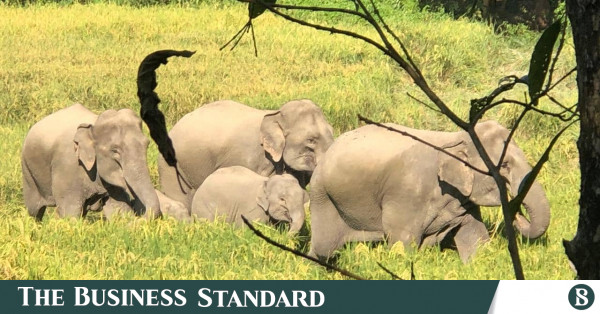
Under the project, six cameras are expected to be operational within the protected forest by the end of this year, according to officials
File photo of a herd of wild elephants/Mohammad Minhaj Uddin/TBS
“>

File photo of a herd of wild elephants/Mohammad Minhaj Uddin/TBS
Highlights:
- Bangladesh Railway invests Tk40 crore in AI camera system
- Cameras detect elephants, trigger warning lights to stop trains
- Wildlife accidents common despite underpasses, overpasses, fencing, and reforestation
- Baby elephant killed in 2024; another near-collision in 2025
- Experts criticize railway through elephant corridors, call infrastructure insufficient
- Six AI cameras expected operational in forests by year-end
Bangladesh Railway plans to invest Tk40 crore to install AI-powered robotic and sensor cameras along the Dohazari-Cox’s Bazar railway line in Chattogram’s protected forest areas to prevent accidents involving elephants and other wildlife.
Under the project, six cameras are expected to be operational within the protected forest by the end of this year, according to officials.

Wildlife accidents, especially involving elephants, are common on this rail track. In October 2024, a baby elephant was fatally hit near Chunati Wildlife Sanctuary, and in July 2025, a train narrowly avoided a collision at night.
The 103-kilometre railway line connecting Dohazari in Chattogram to Cox’s Bazar, constructed at Tk11,000 crore, passes through 27 kilometres of protected forests, including the Chunati, Fasiakhali, and Medhakachhapia in Lohagara. To build the line, 207 acres of protected forest land were declassified.
Infograph: TBS
“>

Infograph: TBS
Despite the construction of underpasses and overpasses to facilitate the safe movement of wildlife along this rail line, incidents of elephants entering tracks continue to occur.
Md Sabuktagin, project director and general manager of Eastern Railway, told TBS, “Currently, eight trains operate on this route, and the number is expected to increase in the future. Initially, the plan was to install the cameras on train engines, but a decision was taken to install the cameras alongside the railway tracks instead.”
He added that the camera system was designed by international consultants and installation is expected to be completed within this year, with the necessary equipment already procured.
The Railway has already contracted a Hong Kong-based company to supply the six AI-enabled cameras, signal lights, and related equipment. The cameras, imported from the US, will be installed on reactive powder concrete (RPC) poles inside the forest.
The cameras can detect the presence and shape of elephants. When an elephant or herd is detected on the tracks, the system sends an alert image signal that triggers red warning lights beside the railway line. The lights can be seen by train drivers (locomasters) from 500–700 metres away, allowing sufficient time to stop the train, which can be halted within 220 metres. Train drivers and guards have already undergone training on the new safety protocol.
Train services on Dohazari-Cox’s Bazar officially started on 1 December 2023. Currently, four pairs of trains run on the route day and night.
Less than a year after the railway line became operational, a baby elephant was fatally struck by a train on 13 October 2024 near the northern side of the elephant overpass within the Chunati Wildlife Sanctuary. The elephant succumbed two days after the collision. In response, an official order issued on 23 October 2024 set a maximum train speed limit of 20 km/h within wildlife sanctuary and national park areas.
On 22 July 2025, a train driver in the sanctuary spotted an elephant on the track at night and managed to stop the train just in time by applying emergency brakes. However, repeated train whistles agitated the herd, causing one elephant to strike the last carriage of the stationary train. Fortunately, no damage occurred, and the train resumed its journey.
According to the Wildlife Management and Nature Conservation Division, the Chunati Wildlife Sanctuary spans 19,185 acres across Lohagara and Banshkhali upazilas in Chattogram and Chakaria upazila in Cox’s Bazar.
Once dominated by garjan trees, the forest now retains only a few of these. The sanctuary hosts notable wildlife, including an estimated 40 to 50 Asian elephants. The herds regularly move through the forests of Lohagara, Banshkhali, and Chakaria, necessitating crossings over the railway tracks.
Underpass-overpass failed to prevent wildlife accidents
During the construction of the rail line, the railway authorities agreed to build two overpasses and two underpasses specifically for elephant movement. However, only one overpass has been completed, and one of the two underpasses is currently non-functional. Sound barriers have also not been installed. Although 240,000 trees were cut during the project, 720,000 trees have been planted in reforestation efforts. Experts argue that the existing infrastructure remains inadequate and limited in scope.
Monirul Hasan Khan, an elephant researcher and a zoology professor at Jahangirnagar University, criticised the decision to construct the railway through elephant corridors, stating, “This has endangered elephant movement and increased the risk of fatal accidents. The infrastructure is insufficient, although the planned camera installation may help mitigate risks.”
Talking to TBS, Wildlife and Biodiversity Conservation Officer Nur Jahan said elephants have not used the overpass for the past six months, likely due to new directional signboards installed along the main road following a previous accident. “The overpass remains suitable for elephants, but of the two underpasses, only one is currently in use while the other is too narrow.”
She added, “The Railway has built culverts for water drainage that are being considered for conversion into elephant pathways.”
Project Director Engr Md Sabuktagin disputed some concerns, citing CCTV footage showing regular elephant movement. “We provide saltwater in six enclosures where elephants come to drink and bathe regularly. Reinforced cement concrete (RCC) fencing has been installed on both sides of the railway line, but a one-metre gap was left open at the Forest Department’s request for animal passage – this gap was the site of the fatal accident,” he explained.
He added, “Asian elephants are typically about three metres tall, and we’ve designed the underpasses to exceed five metres in height — so they cannot be considered narrow. The overpass connects two hills, enabling elephant passage.”
Additionally, three culverts have been adapted for elephant movement, the project director added.