
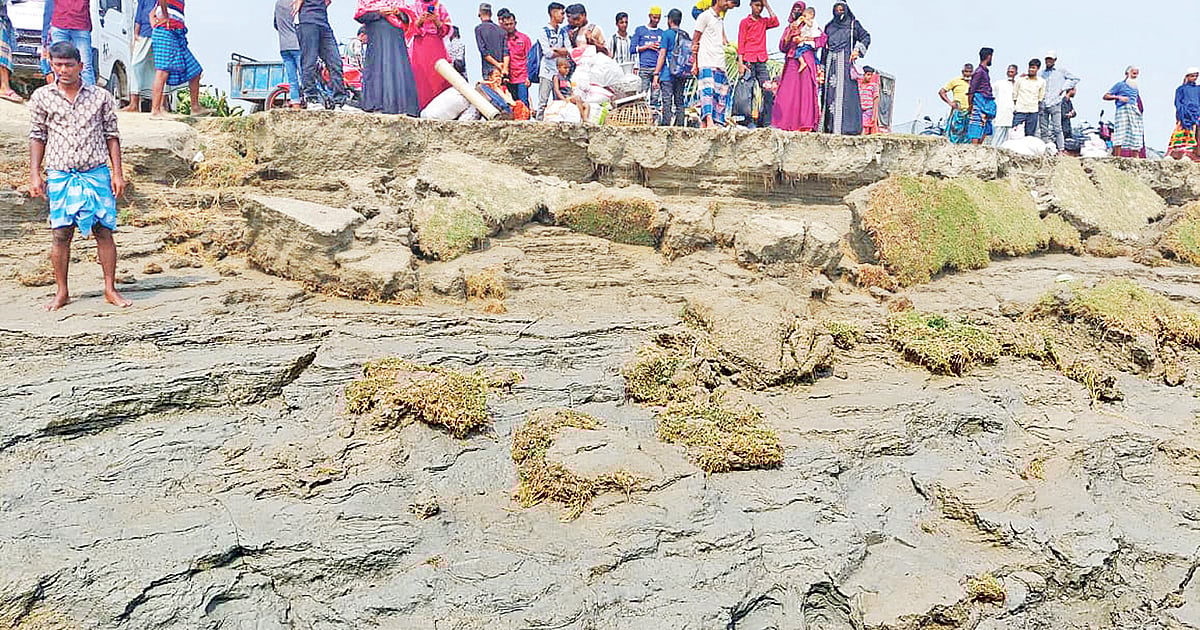
According to the State Acquisition and Tenancy Act of 1950, khas land (government-owned land) is allocated for settlement. Article 143 of the Constitution defines the state’s authority in this regard. Under the Khas Land Management and Settlement Guidelines of 1987, the largest portion of khas land was allocated to the landless. This guideline was partially revised in 1997, dividing khas land into agricultural and non-agricultural categories. Agricultural khas land is generally meant for settlement of the landless.
In the government’s priority list for the landless, the poorest families of freedom fighters are first, followed by river-eroded families like the residents of Urir Char. The law requires that to obtain khas land, a landless person must submit two attested photographs certified by the relevant ward member or chairman along with a citizenship certificate issued by the local UP chairman.
However, Prothom Alo’s investigation reveals that in Urir Char, people outside the definition of landless, some with substantial property and not local residents, are being granted land allocations.
To receive land across the boundary pillars, officials of the Char Development and Settlement Project (CDSP) have issued orders to change the voter area of Sandwip voters. Yet, the law does not allow voter area changes to obtain khas land. This directive, however, applies only to Sandwip voters; they can be registered in the new area if they choose. Voters from Bhola, Lakshmipur, and Noakhali cannot change their voter area even if they want to.
Moreover, those receiving land allocations are not all getting the same amount of land. Locals allege that the size of the land depends on the amount of bribe paid. Some paid 10,000 BDT, others 20,000 BDT. Md. Islam, 45, from Kamal Market said he paid 75,000 BDT as bribe but did not receive any land. When asked whom he gave the bribe to, he said it was someone accompanying the Assistant Commissioner (Land), whom he did not personally know well.
The law concerning voter area changes requires submission of certain documents. Most river-eroded people, however, do not have these documents. In char households with no electricity, there is no possibility of having other utility bills either. A selection commission official, speaking on condition of anonymity, said there are no special provisions for these people, and a separate arrangement is needed for river-eroded victims.
Regarding voter area changes, the UNO of Companiganj said that a former district commissioner had issued such directives. When asked why they are following it, he said the decision was made in a revenue meeting. When asked whether there is any document recording such a decision, he referred further inquiries to the district commissioner.
The District Commissioner of Noakhali, Khandkar Estiaque Ahmed, could not meet due to being in Dhaka. After multiple phone attempts, he eventually spoke and referred inquiries back to the UNO.
The Land Reform Ordinance of 1984 was repealed and replaced by the Land Reform Act of 2023, which clarified the definition of khas land. It also included river- or sea-emerged chars and land acquired through excess acquisition as khas land. Urir Char is one such land, and the law specifies priority for the landless. Yet, due to various bureaucratic complications, the land rights of thousands of people continue to be violated.