
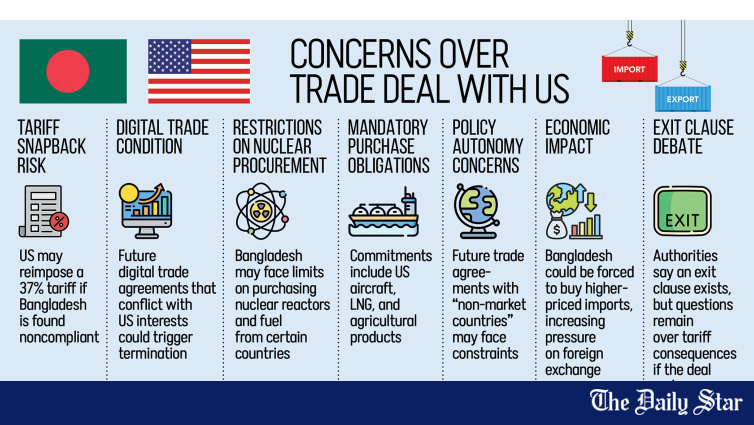
The reciprocal trade deal signed by the interim government with the United States has raised questions regarding the economic sovereignty of Bangladesh, especially in decisions on trade, energy and security.
Critics point to several binding and conditional clauses that allow Washington to terminate the agreement and restore steep tariffs if its concerns are not addressed.
For example, take the digital trade facilitation provision in the deal.
The agreement says that if Bangladesh signs a new digital trade deal with any country that jeopardises essential US interests, Washington may terminate the pact and reimpose the 37 percent reciprocal tariff on Bangladeshi exports.
That was the tariff rate the US had proposed in April 2025.
The same condition applies if Bangladesh enters into a new bilateral free trade or preferential agreement with what the US terms “a non-market country” — nations it does not recognise as market economies.
The agreement says that if consultations with Bangladesh fail to resolve American concerns, the United States may withdraw from the deal and reinstate the 37 percent tariff.
The rate is high enough to sharply reduce Bangladesh’s exports to the US, a costly prospect given that the country earns roughly one-fifth of its export revenue from garments and other goods sold to American buyers.
The deal, signed on February 9 between the interim government and the Trump administration, also restricts Bangladesh from purchasing “any nuclear reactors, fuel rods, or enriched uranium from a country that jeopardises essential US interests”.
An exception applies to “the procurement of proprietary materials for which there are no alternative suppliers or technologies, or materials contracted prior to the entry into force of this agreement required for existing reactors”.
This suggests that supplies for the Rooppur Nuclear Power Plant, built with Russian technical and financial support through Russian state corporation Rosatom, may continue.
But any future nuclear project could fall under tighter scrutiny.
Citing the section on economic and national security, BRAC Executive Director Asif Saleh, in a Facebook post, said, “This is the most important and controversial part of the agreement, as it raises questions about ‘sovereignty’.”
The section adds, “The United States shall work with Bangladesh to streamline and enhance defence trade.”
On the nuclear restriction, Saleh said, “This could create risks for Bangladesh’s energy security.”
The deal also opens the door for US direct investment to “explore, mine, extract, refine, process, transport, distribute and export critical mineral resources”.
In addition, Bangladesh is required to purchase $3.5 billion worth of American agricultural products. This includes at least 700,000 tonnes of wheat annually for five years, at least $1.25 billion or 2.6 million tonnes of soy and soy products, and cotton.
Bangladesh shall also need to buy 14 Boeing aircraft initially and $15 billion worth of liquefied natural gas (LNG) over 15 years, apart from increased purchases of US military equipment and limits on defence equipment purchases from certain countries.
“It appears more like an imposed purchasing obligation than free trade,” said Saleh. “Regardless of Bangladesh’s actual needs or capacity, it effectively ensures profits for US companies.”
Mustafizur Rahman, distinguished fellow at local think tank Centre for Policy Dialogue (CPD), said bulk commodities in Bangladesh are usually imported by private sector businesses, not the government.
If traders can source goods more cheaply elsewhere, he asked, why would they buy from the United States?
In that case, Rahman said the government may have to offer incentives to persuade private importers to purchase American products, adding to fiscal pressure.
In an interview with The Daily Star last week, Professor Selim Raihan, executive director of the South Asian Network on Economic Modeling (Sanem), said that Bangladesh could be compelled to buy more expensive goods even when cheaper alternatives are available.
“If we find a cheaper source elsewhere, we may not be able to choose it,” he said. “This will put additional pressure on our foreign exchange.”
“How are we going to finance aircraft purchases and energy imports? There is a risk of increased reliance on foreign loans,” Raihan said.
Anwar-ul Alam Chowdhury (Parvez), president of the Bangladesh Chamber of Industries, said the agreement indicates that Bangladesh should reduce its dependence on China for raw materials.
The deal also contains a provision on Rules of Origin. It says that if the benefits of the agreement accrue substantially to third countries or their nationals, either party may establish Rules of Origin to reflect the intention of the agreement.
Parvez said the third country clause should have been defined more clearly.
The agreement has not been made public, with officials citing a non-disclosure provision. Amid growing concern, the Chief Adviser’s Office said in a statement that it had inserted “an exit clause” into the deal.
“There was no scope for any country to terminate the agreement,” it added. The statement did not clarify whether Bangladesh exports would again face a 37 percent tariff, up from 19 percent, if the agreement were terminated.