
When I was younger, I would go to great lengths to explain how similar Bangladeshi society was to Canadian society. In my mind, that was how I was supposed to assimilate. Life in Canada was supposed to look like it did in the TV shows that played as I did homework. I despised aspects of my life that were defined by my Bengali culture. It was always about trying to make my Bengali identity more Canadian, never the other way around. I thought I could clear similarities by making comparisons. I fell into a habit of making Bangladesh and Bangladeshi culture more palatable for people whom I didn’t need to cater toward.
Looking back, my bad.
The two cultures are different; they’re supposed to be. The question was never about whether Bangladeshi culture was different — I knew it was, I just didn’t want it to be. The question was whether the culture was as different, destitute and coarse as the media painted it to be.
It wasn’t.
During a recent trip home, I decided to take portraits and pictures of people and places around my neighborhood in Chittagong, Bangladesh, taking my time to talk to those I photographed. We simply talked, not about anything in particular, but I caught onto snippets about aspects of their lives they decided were worth sharing with me.
I am from Chittagong, Bangladesh. Through these pictures, I am intentionally showcasing life in Bangladesh through my eyes, not trying to represent a whole culture, country or community. It is me, showcasing a singular moment of time, through a singular person’s eyes, not necessarily telling other people’s stories but providing a space for the lives they decided to showcase when talking to me. I am merely translating.
With that being said, here are the pictures. As you go through them, note that the pictures are not meant to be a series of generalizations. They are meant to provide an opportunity to understand the intricacies of the people and livelihood in Bangladesh.

Rahim was the first person I met on my walk. My conversation with Rahim was short. His son worked at the garments factory down the road –– he spoke of him with great pride. “My son works at the factory down the road, he asked me if I wanted to join. I said no.” I asked him why. “Well, I like it here. I’ve been doing this all my life.” He then talked about his welding work, asked me if I knew how it worked and proceeded to show me. I compared it to glass welding, which he also knew how to do.

Chittagong is known for its greenery, a beautiful place to witness it all is D.C. Hill Park, which is where I met Rubel. He worked alongside his dad in the park. “This is my father’s business. I just come here on the weekends,” Rubel said. I asked him if he liked working with his dad. “Yeah, for the most part, the machine breaks down time to time though. I can fix it most days.” We talked about the number of people that visit the park each day, both agreeing that the crowd can get overwhelming. The park remains his favorite part of the city, though.

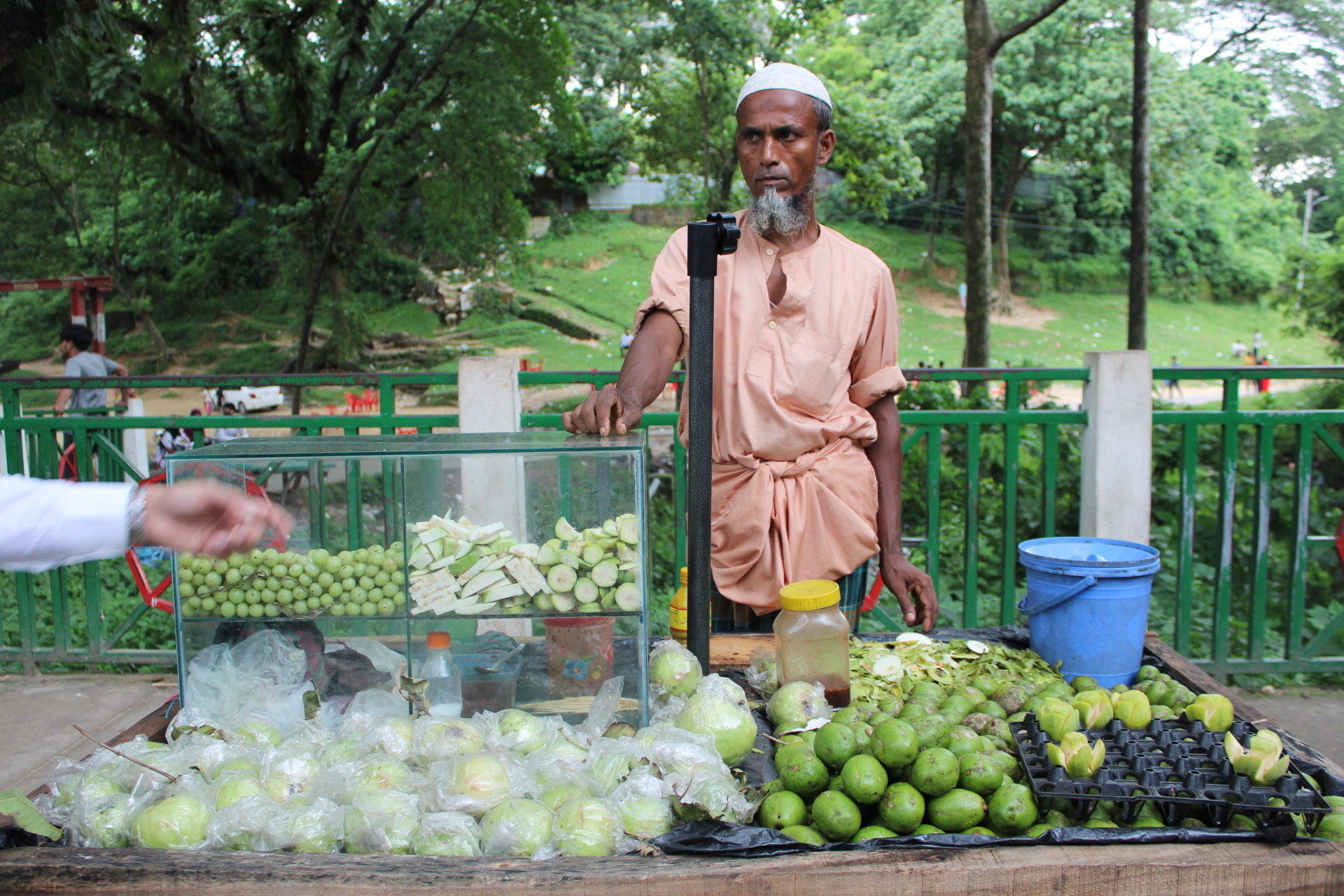
D.C. Hill Park is filled with food carts. Vendors fill the sidewalks and the lines for food can get pretty long. The fruit carts are my favorite. Summers in Bangladesh are synonymous with the gondhoraj lebu.

I met Shaheed in the park right after I met Rubel and right before I left the park. We didn’t talk much; I just asked him when the park was closing. “The park closes in an hour, but I’m packing up early today though.” I asked why he was leaving early. “It’s too hot today.” He was in a rush to get home, and he was right, it was hot.

A few miles away from the park is Chittagong’s famous port. Chittagong is a port city, the industrial capital of the nation. I met Abdul there; he was selling sugarcane. He said they were from his village, four hours away. Abdul and I talked about the port behind him. We both spoke of it with a sense of pride. “The port is a Chittagong staple,” he said. “It’s why I set up shop here.”


The streets of Chittagong are teeming with three-wheeled cycle rickshaws. On my way home, I took pictures of a few.

Kashem was the last person I photographed that day. He was also on his way home. When I asked him if I could take a picture, he asked me why and I answered honestly — I said I wasn’t sure. Maybe just for memories. “That’s good enough reason,” he said. And he was right, it was reason enough for me to take these pictures just to remember. To remember my people in my beautiful city.
MiC Columnist Alifa Chowdhury can be reached at alifac@umich.edu.