
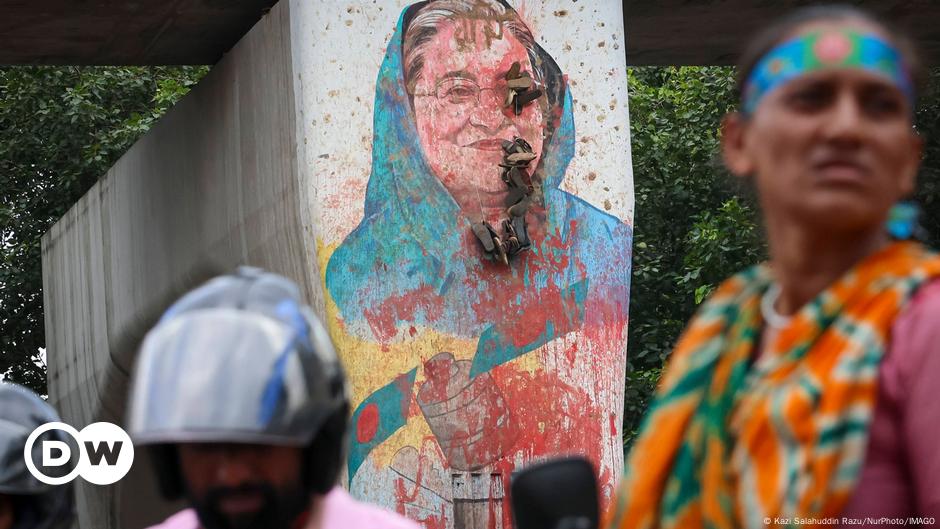
Sheikh Hasina resigned as Bangladesh’s long-serving prime minister and fled to India in August. Her ouster came after weeks of deadly protests that started over a controversial quota system for government jobs, but morphed into a wider anti-government movement.
During the unrest in July and August, hundreds of protesters were killed and thousands injured.
This included many students who were shot by security forces loyal to Hasina in what became one of the deadliest crackdowns on demonstrations in Bangladesh’s recent history.
An interim government headed by Nobel Peace laureate Muhammad Yunus, which includes two student leaders in senior positions, now runs the country.
The former office of Hasina’s Awami League in a Dhaka suburb lies deserted.
Other party buildings have been vandalized and set ablaze following the fall of her government.
While Bangladesh saw economic development during her 15-year tenure, Hasina has also been accused of severe human rights violations, including extrajudicial killings and enforced disappearances targeting the opponents of her government.
Since the Awami League disappeared from the political scene, dozens of party members have been accused of culpability in the police killing of protesters.
Calls grow for Hasina’s extradition from India
Bangladesh’s International Crimes Tribunal (ICT) has received several complaints against Hasina and her loyalists, accusing them of murder and crimes against humanity. The ICT has initiated investigations into these allegations.
Students who led the uprising have demanded that Hasina be returned to Bangladesh to face trial.
Jasmin Lorch, a senior researcher at the German Institute of Development and Sustainability, said Hasina’s government engaged in “large-scale human rights violations, extrajudicial killings and oppression of political opponents, which must be investigated and tried.”
“Given the close relations between India and the Awami League, it seems unlikely that the Indian government will extradite Sheikh Hasina. But that does not mean that investigations cannot proceed,” she told DW.
“The current UN fact-finding mission, for instance, is a good start, because of its impartiality and its aim to also identify the structures that enabled abuses,” Lorch added.
The fact-finding mission under the UN Human Rights Office was deployed to Bangladesh to look into allegations of excessive force used by security forces, along with other abuses, during the crackdown.
“To ensure justice and prevent rights violations in the future, it is important to also investigate the roles that the police, the elite force RAB, and the military played in the repression and human rights violations under Sheikh Hasina,” said Lorch.
Awami League leaders in hiding
After Sheikh Hasina fled to India, other party members were either arrested in connection with the protests or went into hiding.
Local newspapers reported that many senior Awami League leaders also fled to other countries.
DW contacted several party leaders, but they refused to talk or meet, fearing their location could be exposed.
In an interview immediately following Hasina’s ouster, her son Sajeeb Wazed Joy told DW that “mistakes were made” by the Hasina government in handling the student protests.
But he also believes the protests “were incited way beyond what they should have been.”
“Our party members have been attacked throughout the country,” he told DW, adding that outside of Dhaka, “almost everyone’s house has been burned down.”
“What people underestimate is that the Awami League is the largest political party in Bangladesh. It is not dead, it is not weak,” he told DW.
Under the leadership of Nobel laureate Yunus, Bangladesh’s new interim government wants to make reforms in the judiciary, police and financial institutions — a demand made by many political parties and students — before holding free and fair elections.
While many parties have participated in discussions with the interim government over the reform agendas, the Awami League was absent.
Experts call for Awami League reform
Joy, who lives in Washington, claimed neither he nor the interim government had reached out for talks regarding the way ahead for Bangladesh.
“It’s impossible to have legitimate reforms and elections by excluding the oldest and largest political party,” he told the Reuters news agency last week.
However, experts believe the Awami League party needs to reform itself before participating in any other state-level reform process, as it has been accused of destroying state institutions during its tenure.
“It is very important that the reform process is inclusive,” said Lorch.
“However, the former Awami League government under Sheikh Hasina has engaged in large-scale repression and human rights violations. To be part of the reform process, it would need to thoroughly reform itself,” she added.
“Leaders and functionaries responsible for human rights violations and repression would need to be held accountable. For elections, it would be important that individuals who were responsible for killings and other human rights violations are barred from running,” said Lorch.
“Reforming itself will be very difficult for the Awami League though, because it has dynastic leadership, and Sheikh Hasina and her family have always dominated the party from above,” she added.
Bangladeshi political analyst Zahed Ur Rahman doesn’t see the need to include Hasina’s party in the country’s reform process.
“I believe including Awami League, the party which totally destroyed all the state institutions, in the reform plan and execution would be ridiculous,” he told DW.
“But I think if this party is not banned, restricting it from participating in upcoming general elections will raise questions.”
Rahman thinks there is no chance that Hasina will see the revival of her party in her lifetime.
“She will carry the stigma of fleeing the country, keeping her party leaders along with rank and files in danger,” he said.
“Since I think she won’t be extradited to Bangladesh, she will pass the last years of her life in exile.”
Edited by: Keith Walker