
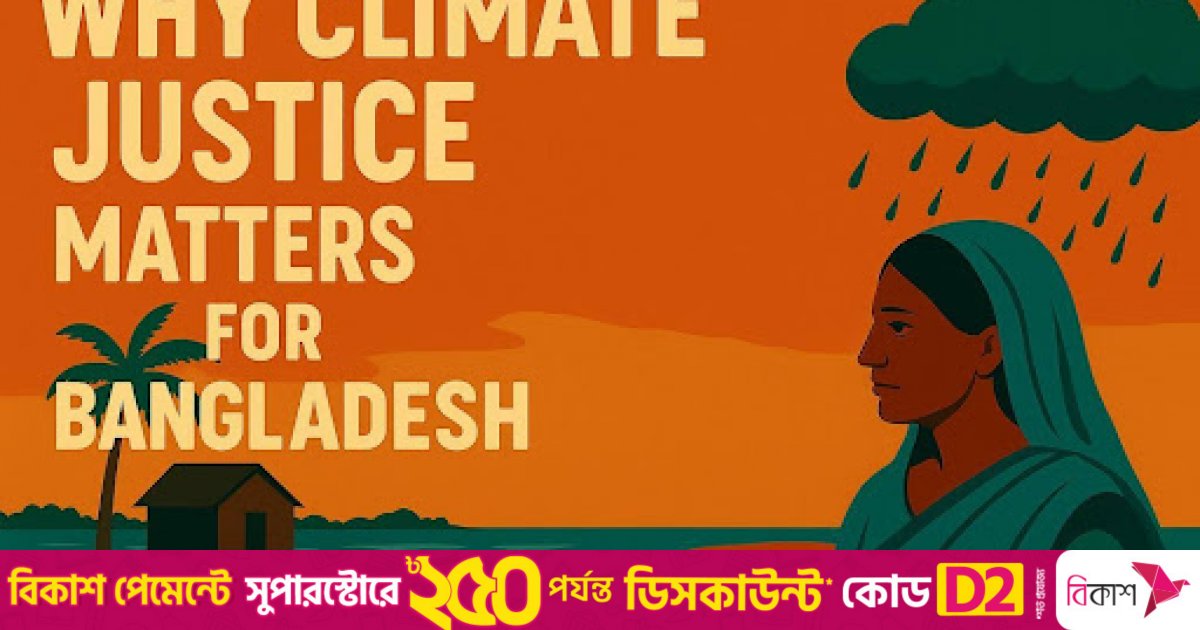
Bangladesh is one of the most climate-vulnerable countries in the world, despite having almost no role in creating the problem. The country contributes less than 0.5% of global carbon emissions, yet it consistently ranks among the top ten nation’s most at risk in the Global Climate Risk Index. Rising seas, cyclones, prolonged floods, salinity intrusion, erratic rainfall, and deadly heat waves are not distant threats here — they are daily realities. Whole communities have already lost homes, farmland, and safe water to disasters that strike with alarming regularity.
But Bangladesh’s climate story is not just about scientific data or projections. It is about justice. Climate justice means fairness and accountability: Ensuring that those who contributed the least to the crisis are not forced to bear its heaviest burdens. For Bangladesh, this isn’t an abstract debate in global conferences — it is a matter of survival. It decides whether farmers can stay on their land, whether children will inherit a livable future, and whether marginalized groups will have their rights protected.
The harshest impacts fall on people who are already vulnerable. In the coastal districts of Satkhira, Khulna, and Barguna, families watch their fields turn salty and unproductive. In Rajshahi and Naogaon, farmers struggle against drought. Along the rivers of Gaibandha and Kurigram, entire villages vanish overnight due to erosion. Indigenous communities in Rangamati and Bandarban face landslides and resource loss. Every disaster — whether flood, cyclone, or erosion — destroys crops, homes, and drinking water, pushing families deeper into landlessness and poverty.
Cyclone Sidr in 2007 killed over 3,000 people. Cyclone Aila in 2009 displaced hundreds of thousands, many permanently. More recently, Cyclone Amphan in 2020 devastated the Sundarbans and affected more than 2.6 million people. Each of these events has deepened inequality and reinforced the urgent call for climate justice in Bangladesh.
The gender dimension
This injustice also has a clear gender dimension. In rural areas, women carry the daily responsibility for food, water, and caregiving. When fields flood, they scramble to secure meals. When water turns salty, they walk farther each day in search of safe supplies, often risking harassment or violence. Social norms make them even more vulnerable. Many women never learn to swim, and in disasters they often remain behind to care for children or the elderly. This is why more women die in natural disasters — not because of biology, but because of inequality.
Yet women are not only victims. In Satkhira, women’s groups are cultivating salt-tolerant rice. In Barguna, women’s cooperatives are replanting mangroves to shield villages from storms. These are inspiring examples of leadership, but they remain the exception rather than the rule. True climate justice must therefore include gender justice, breaking barriers so that women can lead adaptation efforts on equal terms.
Displacement is perhaps the most visible face of Bangladesh’s climate injustice. Tens of thousands are uprooted each year by river erosion, floods, and sea-level rise. By 2050, as per the World Bank, one in every seven Bangladeshis — around 20 million people — could be displaced. Most end up in Dhaka, which already absorbs nearly half a million new migrants annually. They crowd into slums like Korail or Kamrangirchar, not because they are chasing opportunities, but because they have lost land, crops, and drinking water.
In the city, they face insecure work, exploitative wages, and unsafe housing — far from the dignity they once had in their villages. International law does not even recognize them as refugees. Without strong national policies and global recognition, millions risk becoming invisible victims of the climate crisis.
Climate justice for Bangladesh also means holding the world accountable. Wealthy nations of the Global North are historically responsible for the bulk of emissions. They pledged $100 billion a year in climate finance under the Paris Agreement, but much of it never arrives — and when it does, it often comes as loans instead of grants.
Bangladesh urgently needs resources to build embankments, restore mangroves, improve warning systems, and support communities in adapting to a hostile climate. The “Loss and Damage Fund” agreed at COP27 was a breakthrough, but unless money actually reaches the people losing land and homes, it will become another empty promise. Justice means reparations, not charity.
Fighting back
Bangladesh’s young generation is inheriting a crisis they did not create — yet they are the ones suffering the most. In national and international decision-making processes, their voices are often weak or overlooked. Still, young people are refusing to remain silent. From school strikes inspired by global climate movements to grassroots campaigns promoting renewable energy in rural areas, they are demanding accountability and justice.
For them, climate justice is not only about surviving today; it is about ensuring dignity, opportunities, and a livable future for tomorrow. It represents their right to inherit a world where they can thrive, not merely struggle to exist.
Amid overwhelming adversity, communities across Bangladesh are also responding with remarkable ingenuity. In Gaibandha, farmers are reviving floating gardens to cope with recurring floods. In Satkhira, fishers are combining aquaculture with salt-tolerant crops to adapt to salinity. In the drought-stricken Barind region, research and local experiments with drought-resistant rice varieties are opening new possibilities.
These initiatives are everyday acts of justice, where ordinary people innovate against extraordinary odds. Yet such efforts cannot be sustained without policy support, financial investment, and genuine recognition of local knowledge. Too often, top-down projects ignore realities on the ground, undermining community resilience. Real climate justice means placing communities at the heart of solutions, not treating them as passive recipients of aid.
At its core, Bangladesh’s climate crisis is a human rights crisis. It threatens the basic rights to food, water, health, housing, and dignity — rights that should never be negotiable. Viewing it through this lens changes the conversation. It transforms the narrative from one of charity to one of obligation, from temporary aid to long-term justice, from survival to the right to live with dignity.
Bangladesh’s story is one of both vulnerability and resilience. It has innovated, adapted, and shown leadership despite limited resources. But resilience is not limitless. Without justice — at home and abroad — the survival of millions remains precarious.
Climate justice for Bangladesh is therefore both a demand and a promise: A demand that the world’s biggest polluters take responsibility, and a promise to the people of Bangladesh that fairness, equity, and dignity will guide the nation’s struggle against the climate crisis.
For Bangladesh, climate justice is not optional — it is existential.
Syed Navid Anjum Hasan is a development worker.