
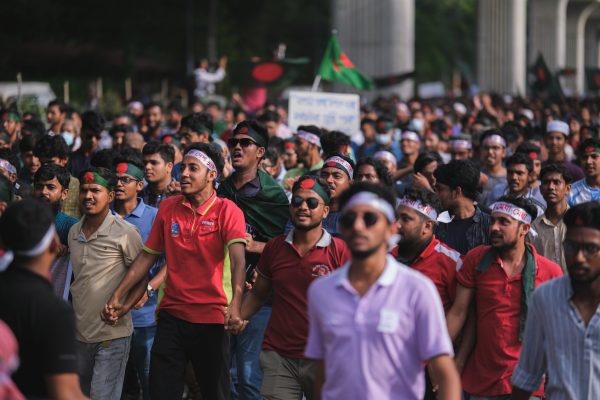
Tens of thousands of university students are out on the streets of Bangladesh to protest a quota system that reserves a substantial proportion of civil service jobs for children of liberation war fighters. At the time of writing, the protests are still ongoing and showing no sign of abating.
The protests continue despite threats and intimidation by the Bangladeshi police and ruling party activists. Prime Minister Sheikh Hasina has scolded the students and dismissed their demands. Leaders and ministers of the ruling Awami League have accused the students of various misdeeds.
The AL was the party that led Bangladesh’s liberation war. The protesting students insist that the quota system is discriminatory and enables the recruitment in government jobs of people who are already partisan toward the ruling party. They want instead a recruitment system based on merit.
The protests strike deeper than the quota issue. The issue gets to the heart of the AL’s claim that it represents the people and has the moral authority to rule, although it has remained in power thanks to an election that was neither free and fair nor inclusive.
In increasingly authoritarian Bangladesh, the room for protests against the rulers is severely limited. Single-issue topics like the quota system work as a conduit for expression of broader dissatisfaction. The quota protests are one type of “democratic bricolage” in a country where authoritarian leaders try to muffle and silence opposition by denying access to information or political spaces to express dissatisfaction.
In the original sense, bricolage refers to the act of creating something useful – a tool, for instance – from available material. It will not be perfect or beautiful the way things made in factories are, but it will serve the purpose. A good example is when Bangladeshi farmers who received Chinese water pumps converted these into boat engines during the wet season.
Democratic bricolage refers to acts that make use of whatever opportunity arises to make a larger, political and pro-democratic point. Fundamentally, where autocratic rulers seek to muffle dissent, democratic bricolage constitutes acts that express a demand to be heard.
In Bangladesh, democratic bricolage is about opening up spaces, often new and unexpected spaces. It is based on the principle that all have the right to protest and the right to be heard. The protest against the quota system becomes an objection against the ruling party, which relies on this system to remain in power.
With no one person leading the protest movement, officials and law enforcement agencies are confronted with a challenge in trying to suppress the protests. According to informed sources in Bangladesh, students are using internet messaging apps to coordinate their activities. They are divided into small groups and messages are forwarded from group to group without any central source. In this way, they are able to organize, coordinate, and stay connected while also dodging surveillance efforts by the law enforcers. Using these innovative tactics, the protesting students can continue their movement despite efforts by the ruling party to suppress them.
Several news reports of serious corruption and illicit wealth accumulation by Bangladeshi civil servants, including a prominent actor behind the deepening authoritarianism in the country, former police and chief of the elite Rapid Action Battalion Benazir Ahmed, a serving bureaucrat, and a National Security Intelligence official, have been doing the rounds in the last several months.
The protests and the news stories about corruption have come just a few months into Sheikh Hasina’s fourth continuous term as prime minister after yet another heavily machinated vote exercise. Seemingly solidly in power since 2009 and completely in command of the state machinery, Hasina’s party won elections virtually uncontested against an enfeebled opposition whose members have been heavily persecuted.
But if so solidly in power, why is the AL government still unable to tackle the protests or muffle the corruption revelations?
The two developments – the protests against the quotas and revelations of corruption – deny the rulers’ claim to authority and full control. The corruption revelations point to mutual back-scratching, embezzlement, and corruption in high places – circles that support authoritarianism and violations of civil and political rights for financial gain and illicit wealth accumulation. They both express a similar sentiment – an objection to the ruling party’s claim to be a legitimate ruler.
Instead, both underline a continued popular desire to have a say and a space in which to say it, of being able to hold the powerful accountable. These are expressions of democratic resilience that continue to exist in Bangladesh after 15 years of democratic backsliding and autocratic rule.
Over these years, Sheikh Hasina has stirred the country toward authoritarianism where critics, dissenters, and opposition activists came under severe repression, including imprisonment in phantom cases, extrajudicial killings, and enforced disappearances. While ruling party activists and leaders go largely scot-free despite evident corruption and street violence against opposition activists, the latter are forced to appear in court, go into hiding, or are imprisoned.
According to a New York Times report, many opposition activists have been slapped with over 400 cases each. Police shut down opposition rallies. Critics such as journalists Shahidul Alam and Rozina Islam have been imprisoned. A culture of fear grips society where news outlets apply self-censorship to remain safe.
Despite dominating the state, the government has been unable to establish control over society even after 15 years in power.
The resilience of a democratic spirit and a deep desire to be allowed to speak against power have made Bangladeshis of different walks of life engage in innovative forms of democratic bricolage to register their protest and criticism of the rulers.
Our research titled “Democratic Bricolage: Resilience and Innovation in Autocratic Bangladesh,” published earlier this year by the University of California Press in the journal Asian Survey, outlines many such acts of democratic resilience in Bangladesh.