

An inclusive democracy cannot be built by ignoring their voices

VISUAL: STAR
“>
VISUAL: STAR
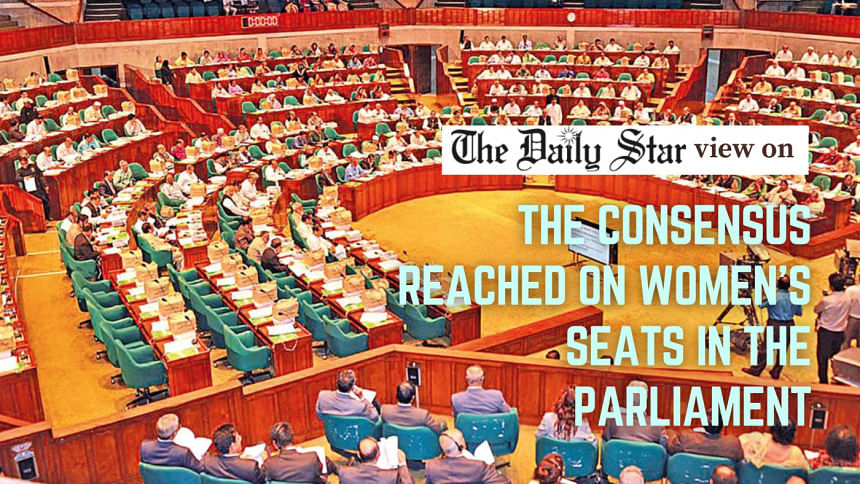
We share the concerns of rights groups regarding the National Consensus Commission’s (NCC) decision on reserved women’s seats. The decision reflects no change in the current number of reserved seats or the method by which parties nominate female candidates. Of the 350 parliamentary seats in Bangladesh, where women make up about 50 percent of voters, only 50 seats (or 14 percent) remain reserved for women.
But should this decision really come as a surprise? Since the regime change last year, women have faced increasing hostility in public spheres and women’s issues have repeatedly come under attack. When it came to the reform commissions, we saw that only one was headed by a woman. None of the seven NCC members are women. According to a report, the NCC did not even include the report from the Women’s Affairs Commission in its discussions, as it reportedly did not fall within the NCC’s “terms of reference (TOR).” It is baffling how recommendations aimed at improving the lives of half the population can fall outside the TOR of a national body. What kind of reforms did the commission and the political parties envision by sidelining the concerns of women? One wonders whether the NCC deliberately excluded the Women’s Affairs Commission’s input to avoid backlash from certain quarters.
 For all latest news, follow The Daily Star’s Google News channel.
 The limited presence of female representatives from political parties during the daily discussions was equally disheartening. From established legacy parties to newer ones, female participation was minimal. Senior leaders from BNP—a party led by a female chairperson for over four decades—were predominantly male. Even the National Citizen Party, whose leaders championed the July uprising in the name of a discrimination-free society, failed to send an adequate number of women representatives. The voices of most minority communities, too, were absent throughout the process.
In this context, can we truly expect political parties to keep their promise that five percent of all their nominees in the next election will be women? And even if they do, it’s likely that female candidates will be fielded in constituencies where the party has a weaker presence, reinforcing the pattern of tokenism in a male-dominated political culture. Since independence, symbolic representation has done little to meaningfully empower women in Bangladesh. It is time to demand real change. We, therefore, urge the NCC and political parties to consider the demands of the rights activists and revisit the agreed-upon issues in consultation with the groups representing marginalised communities before finalising the July Charter. Reforms that exclude the voices of women and minorities will ultimately ring hollow, and the vision to build a democratic society based on equity and fairness will falter.