
The International Court of Justice, also known as the World Court, last Wednesday laid out the duty of states to limit harm from greenhouse gases and to regulate private industry
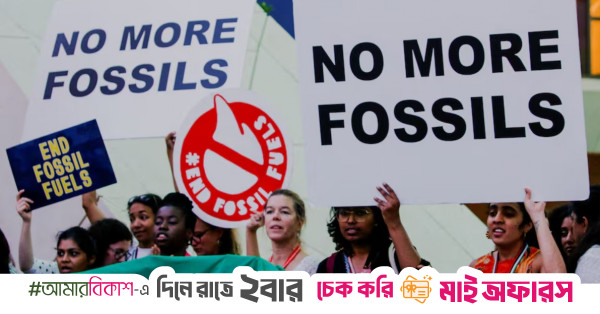
Climate activists protest against fossil fuels at Dubai’s Expo City during the United Nations Climate Change Conference COP28 in Dubai, United Arab Emirates, December 12, 2023. Photo: REUTERS/Thomas Mukoya/File Photo
“>

Climate activists protest against fossil fuels at Dubai’s Expo City during the United Nations Climate Change Conference COP28 in Dubai, United Arab Emirates, December 12, 2023. Photo: REUTERS/Thomas Mukoya/File Photo
Highlights:
- ICJ opinion implies governments can be sued for lack of climate action
- ICJ opinion says climate change is caused by man-made emissions
- US climate litigation may cite ICJ opinion despite mounting climate scepticism
A landmark opinion delivered by the United Nations’ highest court last week that governments must protect the climate is already being cited in courtrooms, as lawyers say it strengthens the legal arguments in suits against countries and companies.
The International Court of Justice, also known as the World Court, last Wednesday laid out the duty of states to limit harm from greenhouse gases and to regulate private industry.

It said failure to reduce emissions could be an internationally wrongful act and, found that treaties such as the 2015 Paris Agreement on climate change should be considered legally binding.
While not specifically naming the United States, the court said countries that were not part of the United Nations climate treaty must still protect the climate as a matter of human rights law and customary international law.
Only a day after the World Court opinion, lawyers for a windfarm distributed copies of it to the seven judges of the Irish Supreme Court on the final day of hearings on a case about whether planning permits for turbines should prioritise climate concerns over rural vistas.
It is not clear when the Irish court will deliver its ruling.
Lawyer Alan Roberts, for Coolglass Wind Farm, said the opinion would boost his client’s argument that Ireland’s climate obligations must be taken into account when considering domestic law.
Although also not legally binding, the ICJ’s opinion has legal weight, provided that national courts accept as a legal benchmark for their deliberations, which U.N. states typically do.
The United States, where nearly two-thirds of all climate litigation cases are ongoing, is increasingly likely to be an exception as it has always been ambivalent about the significance of ICJ opinions for domestic courts.
Compounding that, under US President Donald Trump, the country has been tearing up all climate regulations.
Not all US states are sceptical about climate change, however, and lawyers said they still expected the opinion to be cited in US cases.
In Europe, where lawyers say the ICJ opinion is likely to have its greatest impact on upcoming climate cases, recent instances of governments respecting the court’s rulings include Britain’s decision late last year to reopen negotiations to return the Chagos Islands in the Indian Ocean to Mauritius. That followed a 2019 ICJ opinion that London should cede control.
BONAIRE VERSUS THE NETHERLANDS
Turning to environmental cases, in a Dutch civil case due to be heard in October – Bonaire versus The Netherlands – Greenpeace Netherlands and eight people from the Dutch territory of Bonaire, a low-lying island in the Caribbean, will argue that the Netherlands’ climate plan is insufficient to protect the island against rising sea levels.
The World Court said countries’ national climate plans must be “stringent” and aligned to the Paris Agreement aim to limit warming to 1.5 Celsius (2.7 Fahrenheit) above the pre-industrial average. The court also said countries must take responsibility for a country’s fair share of historical emissions.
In hearings last December at the ICJ that led to last week’s opinion, many wealthy countries, including Norway, Saudi Arabia, and The United States argued national climate plans were non-binding.
“The court has said (…) that’s not correct,” said Lucy Maxwell, co-director of the Climate Litigation Network.
In the Bonaire case, the Dutch government is arguing that having a climate plan is sufficient.
The plaintiffs argue it would not meet the 1.5C threshold and the Netherlands must do its fair share to keep global warming below that, Louise Fournier, legal counsel for Greenpeace International, said.
“This is definitely going to help there,” Fournier said of the ICJ opinion in the Bonaire case.
‘URGENT AND EXISTENTIAL THREAT’
The ICJ opinion said climate change was an “urgent and existential threat,” citing decades of peer-reviewed research, even as scepticism has mounted in some quarters, led by the United States.
A document seen by Reuters shows the US Environmental Protection Agency may question the research behind mainstream climate science and is poised to revoke its scientific determination that greenhouse gas emissions endanger public health.
Jonathan Martel of the US law firm Arnold and Porter represents industry clients on environmental issues.
He raised the prospect of possible legal challenges to the EPA’s regulatory changes given that an international court has treated the science of climate change as unequivocal and settled.
“This might create a further obstacle for those who would advocate against regulatory action based on scientific uncertainty regarding the existence of climate change caused by anthropogenic emissions of greenhouse gases,” he said.
The US EPA changes would affect the agency’s regulations on tailpipe emissions from vehicles that run on fossil fuel.
Legal teams are reviewing the impact of the ruling on litigation against the companies that produce fossil fuel, as well as on the governments that regulate them.
The World Court said that states could be held liable for the activities of private actors under their control, specifically mentioning the licensing and subsidising of fossil fuel production.
Notre Affaire à Tous, a French NGO whose case against TotalEnergies is due to be heard in January 2026, expected the advisory opinion to strengthen its arguments.
“This opinion will strongly reinforce our case because it mentions (…) that providing new licences to new oil and gas projects may be a constitutional and international wrongful act,” said Paul Mougeolle, senior counsel for Notre Affaire à Tous.
TotalEnergies did not respond to a request for comment.