

Youth to reshape Bangladesh’s political future: Touhid
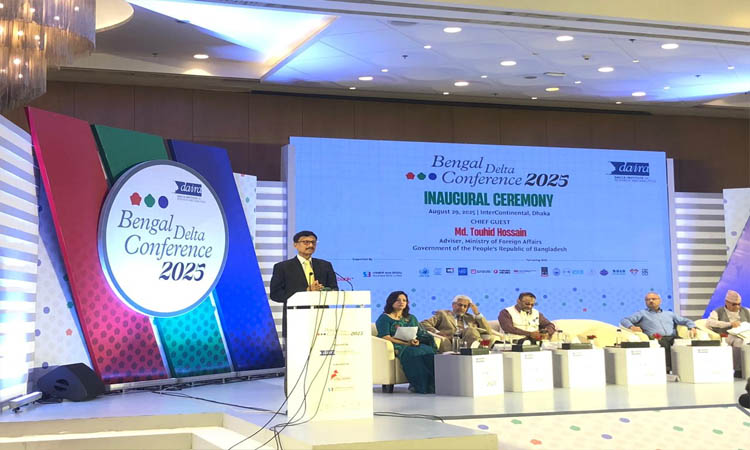
Foreign Affairs Adviser Md. Touhid Hossain spoke today as chief guest at the inaugural ceremony of the Bengal Delta Conference 2025 in Dhaka. Photo : BSS
DHAKA, Aug 29, 2025 (BSS) – Foreign Affairs Adviser Md. Touhid Hossain said today Bangladesh’s youth, who led last year’s historic July-August uprising, will ultimately reshape national politics and institutions, moving the country beyond past divisions toward a more constructive, knowledge-driven future.
“They (youths) may make mistakes along the way, but with time and experience, they will build a stronger and fairer political culture,” he said.
The adviser was speaking as chief guest at the inaugural ceremony of the Bengal Delta Conference 2025, which convened policymakers, academics and experts to deliberate on the intersection of politics, economics and geopolitics in the South Asian region.
Paying tribute to those who sacrificed their lives during the 2024 July-August movement, the Adviser said, “Without their determination and courage, the transformation we are witnessing today would not have been possible.”
He expressed confidence that the new generation would not allow Bangladesh to regress to the political dysfunctions of the past.
Highlighting the fast-changing global landscape, Touhid pointed to three defining events reshaping geopolitics: the Ukraine war, the genocide in Gaza, and rising US-China tensions.
He noted that Western public opinion, especially in the United States, is shifting significantly in support of the Palestinian cause, with growing voices even within Jewish intellectual circles condemning Israeli actions in Gaza.
On South Asia, he observed that US-India ties, once framed around containing China, appear to be undergoing recalibration.
He cautioned, however, against assuming permanent shifts, saying that the “geopolitical basics remain unchanged” even amid talk of new alignments involving India, China and Russia.
The Adviser underscored that the 21st century is certain to be an “Asian century,” followed by Africa’s rise in the 22nd century if the continent can harness its demographic advantage and take control of its resources.
Touhid Hossain warned that the protracted Rohingya crisis, now in its eighth year, is evolving from a national to a regional threat.
He reminded that nearly a million young Rohingyas, many now in their late teens and early twenties, cannot be expected to remain confined to camps indefinitely.
“It is absolutely naive to think they will accept a hopeless life forever. If unresolved, the crisis will spill beyond Bangladesh and become a serious regional and possibly global security issue,” he cautioned.
Turning to domestic priorities, the Adviser placed strong emphasis on education reform, decrying what he described as “educational apartheid.”
He lamented that while a small elite has access to world-class schooling, the majority of children, particularly in rural areas, are deprived of even basic quality education.
“About 30 percent of students completing primary school cannot even read Bangla properly, let alone English,” he said, warning that such disparities undermine national progress.
He urged universities, especially Dhaka University, his alma mater, to become genuine research-based institutions rather than mass-enrollment centers.
He stressed that the Dhaka University needs fewer students but higher quality outcomes in sciences, economics, and other critical fields.
The Adviser concluded by stressing that politics must be treated not as an end in itself, but as a means to strengthen institutions, improve education, and create opportunities for youth so they are not forced to risk their lives migrating illegally.
“The political culture has to change. Parties may seek power, but power must be used to build institutions, expand knowledge, and secure a better future for our young people,” he said.
Former Malaysian Education Minister Prof Dr Maszlee bin Malik, former water resource minister of Nepal Dr Dipaik Gyawali, Dhaka university vice chancellor Professor Niaz Ahmed Khan, founder editor of the Wire Siddhart Varadarajan and the Daily Star Editor Mahfuz Anam spoke as the special guests while Economics professor of SOAS University of London Dr Mushtaq Khan delivered the introductory speech.
The Bengal Delta Conference 2025, organized by Dacca Institution of Research and Analytics (DAIRA) has brought together regional and international experts to discuss the future of South Asia against the backdrop of climate change, shifting geopolitical alignments and economic challenges.
The conference features sessions on governance, sustainable development and the role of youth in shaping inclusive politics.