
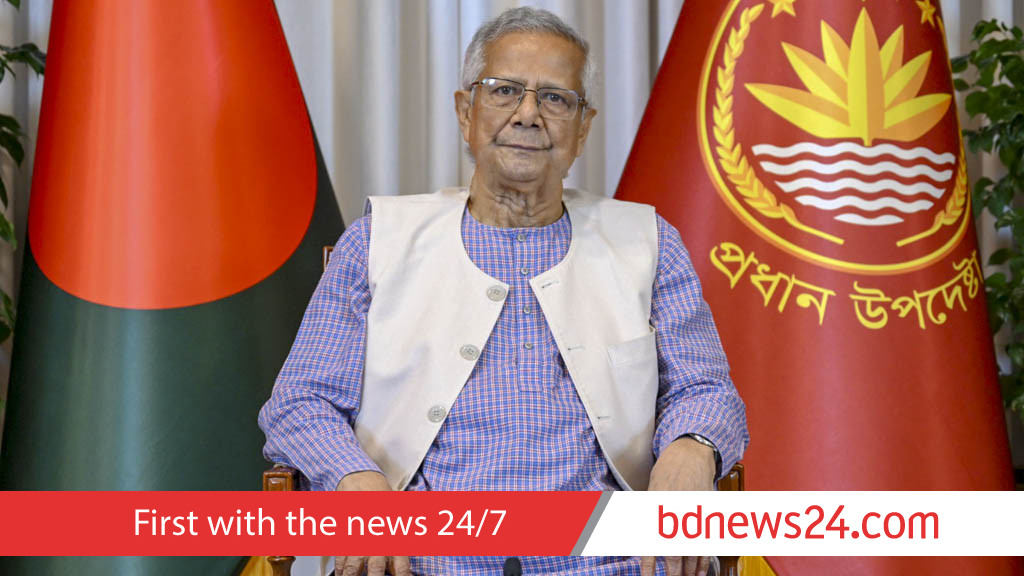
Chief Advisor Muhammad Yunus has called for “a fundamental change” in the way Bangladesh approaches its economy, saying the country’s financial recovery depends on breaking away from outdated methods.
Delivering a televised address to the nation on the occasion of the July Uprising Day on Tuesday, he listed government steps to build reserves by raising remittance and export earnings, curb inflation, recover money laundered abroad, and generate employment.
But he warned that technical fixes alone would not be enough.
The interim prime minister stressed the need for a fresh mindset in economic policy, arguing that Bangladesh must reimagine its natural geography as part of a long-term national strategy.
He cited the Bay of Bengal as a critical yet ignored economic frontier. “We often forget that a part of the Bay of Bengal is our country too. That area is actually larger than our total landmass.
“Yet we spend all our time thinking about the land-based half of our country,” he said. “We do not even count the other, water-based half — just because we do not live there. But we do not live in the haors either, and yet we do not ignore them.
Yunus added“From now on, we will treat our portion of the Bay as an essential part of the nation. We will trade across it, turning the seas into highways that connect us with the world.
“This water contains limitless resources. The fisheries give us a harvest every year, and under the water lies an abundance of gas. These assets must shape our thinking moving forward.”
He also discussed the government’s actions to stabilise markets during a challenging period marked by floods and crop damage.
Despite initial fears of sharp price hikes in essential goods, he said coordinated efforts helped prevent it.
“Relevant institutions and authorities took the right steps, increased oversight, and reduced the grip of middlemen,” Yunus said. “That is why, from this year’s Ramadan until now, market conditions have remained stable.”
Yunus described inflation control as the government’s toughest challenge. Food inflation had climbed to nearly 14 percent due to a fragile economy and flooding. That figure, he said, has since been halved.
“We hope it will fall to 6 percent by December. In June, the overall inflation rate dropped to 8.48 percent — the lowest in 35 months. This marks the fourth consecutive month of decline.”
He credited a surge in remittance and growing export income for renewed currency stability. “Last fiscal year, a record 30.33 billion dollars came in through banking channels. Exports rose by nearly 9 percent.
“As a result, the taka has gained strength. After many years, its value is rising against the dollar. Over the past 11 months, we have repaid 4 billion dollars in debt — both interest and principal — the highest ever.
“Even after settling previous arrears, the foreign currency reserves are growing. We expect this trend to continue.”
Citing foreign investment data, he said the country had drawn over Tk 105 billion in direct foreign investment in the first three months of the year — more than double the amount from the same period last year.
Counting from October, the six-month figure stood at over Tk 165 billion — also double the amount from the final six months under the previous government.
On employment, Yunus named job creation as one of the interim administration’s core goals.
He announced that Handa, a Hong Kong-based industrial group, has pledged to invest $250 million in Bangladesh’s textile and garments sector — the largest single investment from a Chinese firm in that industry.
“This will create jobs for 25,000 people. We firmly believe Handa’s investment will attract other Chinese companies to Bangladesh, opening new opportunities for our youth,” Yunus said.
The chief advisor also outlined efforts to repatriate money siphoned off during the Awami League’s tenure. “In the past 16 years, a huge amount of money was laundered out of the country. We have begun the process of bringing it back.
“The government has hired a top foreign legal firm for this complex legal task.”
“Through proper legal action, some of the wealth amassed by ‘fascist’ and people abroad has already been frozen,” he added. “We believe further results will follow soon if this effort is maintained.”
On port reform, Yunus said the government has moved to restructure operations at Chattogram Port.
The Navy-run Dockyard and Engineering Works Limited has been given control of container handling at the New Mooring Terminal.
He said, “Since they began, there have been immediate improvements. In the first two weeks alone, container handling rose by an average of 225 units per day.
“If this port is modernised, it will benefit not only Bangladesh’s economy but also those of neighbouring countries like Nepal and Bhutan.”
Yunus said the government is also working to ease visa-related barriers for Bangladeshi expatriates.
“The United Arab Emirates has resumed visa issuance for Bangladeshis. For the first time, Malaysia is offering multiple-entry visas to Bangladeshi workers. We are in talks with other countries as well to reduce visa-related complications.”
He added that the government is preparing to send at least 100,000 young Bangladeshis to Japan over the next five years. Special training and support programmes have already begun.
In addition, the caretaker admininstration is taking steps to send skilled workers to Italy, South Korea, Serbia and other destinations.
Yunus said irregular migrants in countries like Saudi Arabia, Jordan and Oman are now being regularised through diplomatic efforts. Agreements with host countries are being reviewed to ensure they better serve Bangladeshi nationals abroad.
“No matter where Bangladeshis live — inside or outside the country — we are taking steps to ensure they receive full access to civil rights and services.”
On Hajj, Yunus said around 87,000 Bangladeshis were able to perform the pilgrimage smoothly this year due to government initiatives. Costs were also reduced compared to previous years.
“To ensure a safe and organised Hajj experience, we launched an app called ‘Labbaik’, through which family members at home could track their loved ones’ locations in real time,” he added.