
In the context of a global push for a just transition and the 1.5°C temperature goal, experts stress that Bangladesh’s forthcoming NDC must be inclusive and community-driven, incorporating the voices of those most vulnerable — particularly youth and marginalised communities.
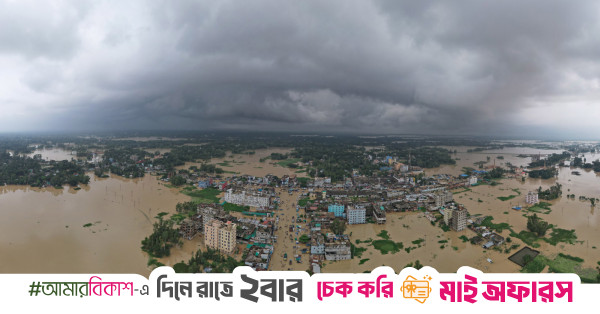
Higher temperatures turbocharge the planet’s weather engines, leading to more unpredictable, frequent and severe floods. File Photo: Mohammad Minhaj Uddin/TBS
“>

Higher temperatures turbocharge the planet’s weather engines, leading to more unpredictable, frequent and severe floods. File Photo: Mohammad Minhaj Uddin/TBS
Calls are growing for greater transparency and participation in Bangladesh’s Nationally Determined Contributions (NDC) — the country’s climate action plans submitted under the Paris Agreement — to more effectively tackle climate change.
In the context of a global push for a just transition and the 1.5°C temperature goal, experts stress that Bangladesh’s forthcoming NDC must be inclusive and community-driven, incorporating the voices of those most vulnerable — particularly youth and marginalised communities.
At a roundtable today (10 September), they said NDCs articulate each country’s strategies for reducing greenhouse gas emissions and adapting to the impacts of climate change. Although the Paris Agreement stresses participatory climate governance, civil society, youth, ethnic minorities, women’s groups, and other marginalised communities remain largely excluded from NDC development and implementation globally, and especially in Bangladesh.

Oxfam and The Business Standard jointly organised the event titled “Towards a People-Centred NDC: Amplifying Community Voices for Inclusive Climate Action” at TBS conference room in the capital’s Eskaton area.
Experts convene at a roundtable on “Towards a People-Centred NDC: Amplifying Community Voices for Inclusive Climate Action,” jointly organised by The Business Standard and Oxfam at TBS Conference Room, Dhaka, on Wednesday, 10 September 2025. Photo: Mehedi Hasan
“>

Experts convene at a roundtable on “Towards a People-Centred NDC: Amplifying Community Voices for Inclusive Climate Action,” jointly organised by The Business Standard and Oxfam at TBS Conference Room, Dhaka, on Wednesday, 10 September 2025. Photo: Mehedi Hasan
Shaikh Muhammad Mehedi Ahsan, general secretary of the Bangladesh Institute of Planners, moderated the discussion.
Farah Kabir, country director of ActionAid Bangladesh, said, “We have been contributing our time and effort to this process for a long time – this is our commitment. But there is no transparency in the government’s process; it is selective. The government does not demonstrate serious political commitment.”
“NDC-3 [Bangladesh’s next climate action plan] will happen, and it is fine for the government to select its own experts, but time must be allocated for consultations with them. We have repeatedly tried to highlight community experiences and need to know the results of the last NDC. This is not a story of failure — it shows where there has been success and where gaps remain. Grassroots consultations and working in local languages and formats are entirely reasonable,” she said.
Farah Kabir stressed that no effective plan is possible without including the local government and urban marginalised communities. “Even in a single ward like Dhanmondi, hundreds of thousands of people live there – specific plans are needed. There is no way forward without a bottom-up policy.”
She called for inclusive consultations at district and divisional levels, noting that civil society is ready to support the process. “We need a mechanism that ensures accountability. Complaints alone are not enough; responsible individuals or institutions must be held answerable. There can be no NDC without climate or gender justice. The climate budget must reflect the people’s voice.”
In a presentation titled “Inclusive Nationally Determined Contributions: Where Does Bangladesh Stand?” Haseeb Md Irfanullah, an independent consultant on Environment, Climate Change and Research System, emphasised the urgent need to revise Bangladesh’s updated NDC 3.0 by 2025 to accelerate greenhouse gas (GHG) emission reductions.
He noted that despite the Paris Agreement’s goal to limit global warming to 1.5°C, current global NDCs are falling short, making it difficult even to stay below 2°C. When developed inclusively, NDCs can positively shape climate policy by raising awareness, driving institutional change, and boosting political and public support. Research shows that engaging stakeholders – including civil society, academia, the private sector, and marginalised groups – leads to stronger emission reduction targets and more effective implementation.
Irfanullah highlighted gaps in Bangladesh’s NDC processes. Since 2015, several NDCs have been submitted, but inclusivity remains a key challenge. Early consultations involved some civil society organisations (CSOs), but later updates, especially in 2020 and 2021, largely excluded grassroots organisations, women’s rights groups, indigenous peoples’ organisations, and climate-vulnerable communities.
He said the process was often centralised, rushed, and tokenistic, with little feedback to stakeholders whose recommendations were ignored. Misalignments between NDC commitments and national policies further weaken ownership and accountability, while limiting opportunities to use local adaptation expertise. Non-inclusive NDC processes have also resulted in poor transparency, minimal public reporting, and failure to integrate social, gender, and intergenerational considerations.
Irfanullah recommends developing an Inclusive Planning Framework based on eight dimensions – recognising intersectionality, mapping stakeholders, ensuring access to information, building capacity, and integrating local and indigenous knowledge.
Additionally, he proposes creating a Community of Interest for Climate Change Mitigation (COI-CCM) and establishing a People’s NDC Advocacy Hub to coordinate civil society engagement and track progress on NDCs and long-term low-emission strategies.
Bangladesh’s climate commitments – intended NDC (2015), interim NDC (2020), and updated NDC (2021) – have shown weak participation, especially during formulation and implementation. A recent Oxfam study (late 2023–early 2024) found minimal involvement of grassroots communities and civil society, limiting public ownership, accountability, and effective climate action, he added.
Md Shamsuddoha, chief executive of the Centre for Participatory Research and Development, said, “The main goal of the NDC is to reduce greenhouse gas emissions, which is the core of the Paris Agreement. Initially, the target was to limit global temperature rise to below 2°C, but now the aim is to keep it within 1.5°C. Achieving this requires long-term low-emission strategies and a net-zero timeline, which Bangladesh has yet to establish.”
He added that a decision on this is needed before submitting the new NDC by 2025. The previous two NDCs were expert-driven and lacked public participation. Consultants do not adequately consider local experiences and knowledge, preventing the NDC from becoming truly people-centred.
Shamsuddoha further noted that, due to ministry-based interest groups, the same institutions are being assigned multiple responsibilities – adaptation, NDC formulation, and loss and damage management – which raises questions about their capacity and competence. “Systemic change is needed to ensure an impartial and participatory process for developing the NDC,” he said.
Farhana Islam, head of Environment, Social & Governance at Grameenphone, said active private sector participation is crucial for reducing carbon emissions in Bangladesh. Government and development initiatives alone are insufficient.
Grameenphone aims to cut its carbon footprint by 50% by 2030, aligned with the Science Based Targets initiative (SBTi) and the Paris Agreement, with a 27% reduction target by 2025, requiring access to 320 GWh of renewable energy.
She stressed the need for rapid implementation of the Corporate Power Purchase Agreement (CPPA) policy, noting that green transition is impossible without green electricity and policy support. Bangladesh has vast renewable energy potential, and investment in large solar plants with private sector participation could accelerate the transition.
She also highlighted Grameenphone’s training of 33 lakh marginalised people in basic internet skills last year and said effective mitigation and adaptation require coordinated efforts by the government, private sector, and development organisations.
Other participants at the roundtable included Tanzia Anjum, deputy manager, Resilience and Climate Justice, ActionAid; Roufa Khanum, assistant director, Centre for Climate Change and Environmental Research (C3ER), BRAC University; Munir Uddin Shamim, senior manager, Programme, Evidence and Learning, Ethical Trading Initiative; Md Golam Rabbani, associate director, Climate Hub, BRAC and BRAC International; Rabeya Begum, executive director, Shariatpur Development; Nuzhat Zabin, country director, Christian Aid; Banasree Mitra Neogi, director, Rights and Governance Programmes, MJF; Sekender Ali Mina, founder and executive Director, Safety and Rights Society (SRS); Sunzida Sultana, additional executive director, Karmojibi Nari; and Md Sariful Islam, head of ICAM, Oxfam.