
Close Menu
  • Home
  • Editorial
  • Politics
  • Economic
  • Sports
  • Religion
  • Contact us
  • About Us
Donate
Hand picked for you
  • Ethiopia, Bangladesh Commit to Deepening Ties Through Expanded Economic Cooperation – ENA English
  • Verma sees Bangladesh-India key to regional economic integration
  • Verma lauds IBCCI role in boosting India-Bangladesh economic ties | Business | FT
  • Bangladesh Economic Inequality and Oligarchs | The oligarch’s playbook: A warning for post-revolution Bangladesh
  • How BNP handles competing pressures to shape Bangladesh’s future: Crisis Group

Subscribe to Updates

Get the latest news from raznitee.

Reach out to us
  • Facebook
  • Twitter
  • Pinterest
  • Instagram
  • YouTube
  • WhatsApp
Facebook X (Twitter) Instagram
raznitee
Contact us
  • Home
  • Editorial
  • Politics
  • Economic
  • Sports
  • Religion
  • Contact us
  • About Us
raznitee
Facebook X (Twitter) Instagram
Contact us
Home»Environment»Finance gap threatens Bangladesh’s climate actions
Environment

Finance gap threatens Bangladesh’s climate actions

September 13, 2025No Comments3 Mins Read
Facebook Twitter Pinterest LinkedIn Tumblr Email
Cyclone Remal.jpg
Share
Facebook Twitter LinkedIn Pinterest Email

Country received only 1.25% of $270b in foreign climate finance needed to fully achieve its conditional targets

TBS Report 

13 September, 2025, 11:15 pm

Last modified: 13 September, 2025, 11:20 pm

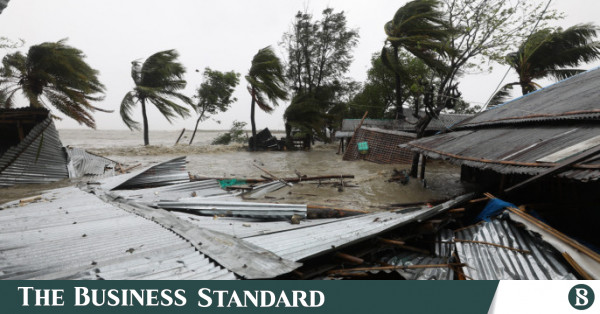
This photo, during Cyclone Remal, was taken from the Jelepara area of South Halishahar in Patenga, Chattogram in May 2024. Photo: Mohammad Minhaj Uddin

“>
This photo, during Cyclone Remal, was taken from the Jelepara area of South Halishahar in Patenga, Chattogram in May 2024. Photo: Mohammad Minhaj Uddin

This photo, during Cyclone Remal, was taken from the Jelepara area of South Halishahar in Patenga, Chattogram in May 2024. Photo: Mohammad Minhaj Uddin

A new study has found that Bangladesh is on track to meet its greenhouse-gas reduction targets under NDC 2.0, the country’s climate action plan under the Paris Agreement that sets both emission reduction goals and adaptation strategies.

However, the country has received only 1.25% of the $270 billion in foreign climate finance needed to fully achieve its conditional targets.

The findings were presented yesterday by Change Initiative in a study titled “Bangladesh’s NDC-3.0: Pathways for Ambition, Action, and Finance.” The study warns that without timely international support, Bangladesh’s next climate target, NDC 3.0, could falter despite its potential to cut emissions fivefold. 


The Business Standard Google News
Keep updated, follow The Business Standard’s Google news channel

For Bangladesh, NDC 3.0 requires $316 billion by 2030, including $46.38 billion unconditionally and $270.13 billion conditionally. The study highlights that conditional finance is not a charitable act; it is a matter of carbon justice, equity, and international credibility.

M Zakir Hossain Khan, chief executive of Change Initiative, emphasised, “Conditional finance is a question of carbon justice. Meeting commitments from developed countries is the bare minimum owed to vulnerable people and the planet’s ecosystems.”

The research identifies several barriers to progress, including an annual $2.86 billion funding gap, weak coordination across sectors, poor integration in transport, waste, and urban systems, unreliable baseline data, fragmented MRV systems, and limited institutional capacity to manage climate finance effectively.

Prof Ijaz Hossain, energy expert and member of the NDC 3.0 formulation team, said, “Dhaka is one of the world’s most densely populated cities, yet it is no longer truly livable. A just transition must be built on renewable energy, improved waste management, and inclusive dialogue with citizens and stakeholders.”

The study recommends treating conditional finance as a matter of carbon justice, leveraging carbon and pollution taxes, enhancing participation in carbon markets, and promoting blue carbon, agroforestry, and sustainable land use to increase mitigation.

Khan added, “COP30 is a final wake-up call for global leaders: prove your commitment to protect the planet by dismantling failing economic systems and embracing Natural Rights Led Governance. Anything less risks betraying climate justice and global credibility.”
Bangladesh’s climate ambitions, the study concludes, depend not only on domestic action but also on timely and reliable support from the international community to safeguard both people and the environment.

Share. Facebook Twitter Pinterest LinkedIn Tumblr Email

Related Posts

Climate-resilient housing models slow to gain ground in disaster-prone Bangladesh

April 6, 2026

ADB country director meets Mintoo to boost climate finance cooperation

April 6, 2026

Zero tolerance for corruption in water development board: State minister

April 6, 2026

India’s Role Seen As Vital To Bolster Bangladesh-Nepal Economic Ties

April 6, 2026
Add A Comment
Leave A Reply Cancel Reply

Subscribe to Updates

Get the latest news from raznitee.

We are social
  • Facebook
  • Twitter
  • Pinterest
  • Instagram
  • YouTube
  • WhatsApp
Latest Posts

Ethiopia, Bangladesh Commit to Deepening Ties Through Expanded Economic Cooperation – ENA English

April 23, 2026

Verma sees Bangladesh-India key to regional economic integration

April 23, 2026

Verma lauds IBCCI role in boosting India-Bangladesh economic ties | Business | FT

April 23, 2026
Follow us on social media
  • Facebook
  • Twitter
  • Pinterest
  • Instagram
  • YouTube
  • WhatsApp
Categories
  • Corruption (411)
  • Culture & Society (114)
  • Economic (1,916)
  • Environment (1,320)
  • Foreign Relations (359)
  • Health & Education (70)
  • Human Rights (5)
  • Politics (2,176)
  • Uncategorized (2)
Facebook X (Twitter) Instagram Pinterest Vimeo YouTube
  • About Us
  • Contact us
  • Disclaimer
  • Privacy policy
© 2026 Designed by raznitee.com

Type above and press Enter to search. Press Esc to cancel.