
A year on, Bangladesh’s economic woes remain unchanged. Can Nepal be a different story?
Across Bangladesh and Nepal, youth-led unrest has been triggered by a common set of drivers such as economic despair, political disenchantment, and growing digital connectivity. Despite Bangladesh’s relatively stronger economic growth under Hasina, compared to Nepal’s economy, both countries face alarmingly high youth unemployment.
Educated youth face a stagnant job market, and a lack of meaningful opportunities pushed frustration to come out in the open. Political systems viewed as dynastic, corrupt, and self-serving have only deepened public disillusionment.
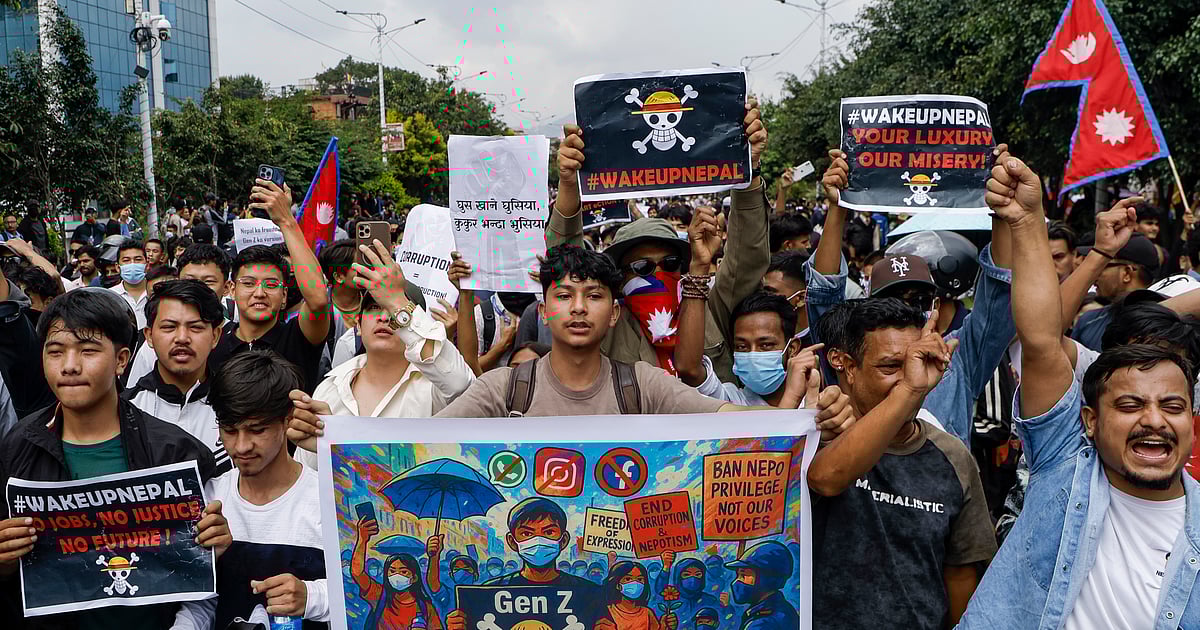
Digital platforms have transformed how this frustration is expressed. In Bangladesh, protesters last year flooded social media with red profile pictures on Facebook and WhatsApp, a symbol of their solidarity and defiance. In Nepal, platforms like TikTok and encrypted apps were critical tools for organising protests in the face of government surveillance and censorship. This convergence of the economically marginalised but digitally empowered youth is proving volatile. Protesters also have ranged from job-seeking graduates to garment workers and balloon sellers, unified in their demand for dignity, opportunity, and systemic change.
But while Nepal’s political trajectory remains uncertain, Bangladesh’s economic reality has seen little improvement even after a year under an interim government. There seems no meaningful focus on the economic pressures facing ordinary people as politics continues to dominate the agenda.
According to the International Labour Organization, around 30% of Bangladeshi youth are not in employment, education, or training. Among young women, unemployment stands at 23%, as against 15% for young men. Opportunities for women remain largely confined to government, NGOs, and the education sector, where career progression is often limited.
The structural issues too remain unresolved. In 2024, the government offered just 18,000 jobs against more than 2 million new entrants to the job market annually.
Nepal continues to face a growing youth employment crisis. In 2024, the unemployment rate for those aged 15–24 stood at 20.8%, according to the World Bank, pushing many young people to leave the country in search of work. But most of the jobs they find abroad are low-paid.
Remittances now account for 33.1% of Nepal’s GDP, a figure that has steadily increased over the past three decades. This heavy reliance on foreign employment highlights the lack of stable and meaningful job opportunities for young people at home.
Sri Lanka’s Aragalaya
Sri Lanka too experienced a momentous political transformation, rooted in a deep economic crisis where the youth played its part in getting the Rajapaksa family out of power. While mass protests in Colombo captured international attention, the first signs of unrest emerged earlier, in the rural heartlands.
In 2021, the government abruptly banned chemical fertilisers and pesticides, initially framed as a step toward organic farming. This decision, however, severely impacted rice and tea production, two vital sectors that employed over 30% of the population and depended heavily on state subsidies. Many saw the ban as a cost-cutting measure aimed at reducing the budget deficit.
This perhaps could ignite the broader protest movement against the corruption and nepotism known as Aragalaya (“struggle”) in 2022, which was driven in large part by the youth. Their demands for accountability and “system change” led to the ousting of President Gotabaya Rajapaksa and, eventually, the 2024 election of the NPP government to power.