
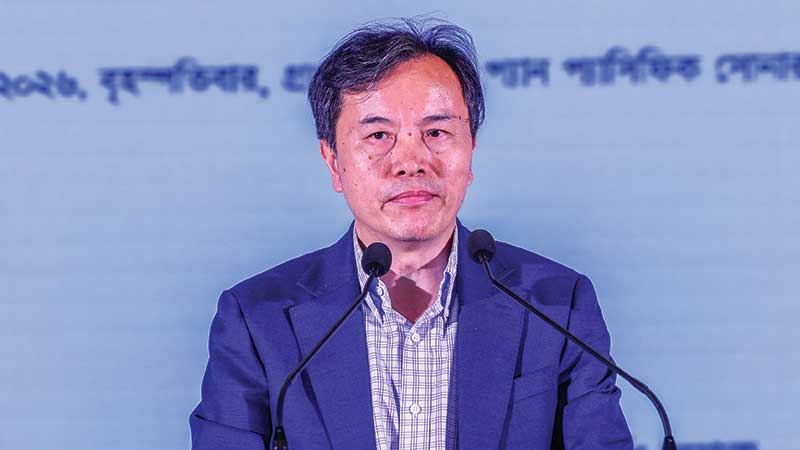
Distinguished panellists, ladies and gentlemen, thank you to Bonik Barta for bringing us together, and to all the distinguished panellists for sharing their insights. Much has already been said about climate mitigation, so I will focus on climate resilience.
For the Asian Development Bank (ADB), climate resilience in Bangladesh means protecting decades of progress and securing the future of the next generation. The country’s long history of exposure to cyclones and its dependence on monsoon rainfall make it particularly vulnerable to flooding, rising sea levels, salinity and extreme heat.
With a population of nearly 150 million living in a relatively small territory, these risks threaten food and water security, health, infrastructure and livelihoods simultaneously.
These pressures also compound one another. They put further strain on land and public services, displace communities, deepen poverty and constrain economic growth. Average annual losses from cyclones have been estimated at around $1 billion. Projections also suggest that Bangladesh could have 13 million internal climate migrants by 2050.
The message is clear: resilience must shape economic decisions today. Bangladesh has already demonstrated what determined action can achieve, reducing cyclone-related deaths by hundredfold since 1970.
With this in mind, I would like to make three recommendations to help build a climate-resilient economy for Bangladesh.
First, we need to invest in collective resilience systems.
From ADB’s side, we are working with the government on the Integrated Growth Network Development initiative, a 20-year programme worth $80 billion. The programme highlights the need for better roads and drainage, functional canals, wastewater treatment and reliable waste collection.
Agriculture needs healthy soils and dependable water supplies. Restoring rivers requires controlling pollution at its source.
Planning must therefore connect river basins, cities and production centres, with funding for maintenance built into infrastructure investment from the outset.
ADB President Masato Kanda during a visit to Bangladesh in May agreed to provide $5 billion as catalytic financing for this initiative. ADB is also providing $250 million for the Coastal Towns Climate Resilience Project, which supports 20 towns through flood management, waterbody restoration, waste management and stronger local capacity.
These investments show how climate adaptation and environmental services can reinforce one another.
Second, we need to make clean energy a driver of competitiveness.
Rooftop solar has attracted considerable attention, and rightly so. But our message goes beyond rooftop solar: Bangladesh needs to make clean energy a driver of economic competitiveness.
Dependence on imported fossil fuels exposes businesses and public finances to price shocks, a vulnerability underscored by the crisis in the Middle East. ADB, together with the World Bank and other multilateral development banks, stands ready to finance rooftop solar.
But rooftop solar alone will not be enough. We must pair it with a stronger electricity grid, greater energy efficiency and measures to reduce gas losses. This would strengthen energy security while reducing carbon emissions.
A successful renewable energy transition also requires stronger private sector investment. To attract that investment, Bangladesh needs clear regulations, credible payment arrangements and bankable projects.
Right now, ADB is supporting this transition. We have committed $2 billion to renewable energy over the next five years. Last week, we also secured approval for $200 million in financing for power transmission and renewable energy.
Third, we need to turn policy commitments into investment and measurable results.
In this regard, ADB’s approval of $100 million for the first two Climate-Resilient Inclusive Development (CRID) programmes support both policy and institutional reforms.
Effective delivery depends on capable institutions, sound project preparation, transparent procurement and robust environmental safeguards.
Predictable investment can also encourage cleaner production, recycling and climate-resilient agribusiness. Through the government-led Bangladesh Climate Development Partnership (BCDP), we can strengthen coordination and develop projects that are ready for investment.
Public and concessional finance must reach vulnerable communities. We must also mobilise private capital to expand the scale of investment.
ADB’s proposed $5 billion in catalytic financing is part of this effort. We will work with other multilateral development banks and the private sector to scale up investment in climate resilience and renewable energy.
As Bangladesh prepares for COP31, the priority is clear: climate finance must be accessible and affordable, backed by clean energy and other investment priorities, and tied to measurable outcomes.
Our success should not be measured by the number of workshops or conferences we hold. It should be measured by cleaner air, cleaner water, healthier soils, safer communities, reliable energy and more productive jobs.
ADB stands ready to work with Bangladesh and all our partners, particularly those in the private sector, to deliver resilience in Bangladesh.
Thank you so much.
—————
[ADB Country Director in Bangladesh Qingfeng Zhang made the remarks at the policy conclave titled “Green Dialogue: Climate Change and Realignment of Economy”, organised by The Daily Bonik Barta.]