
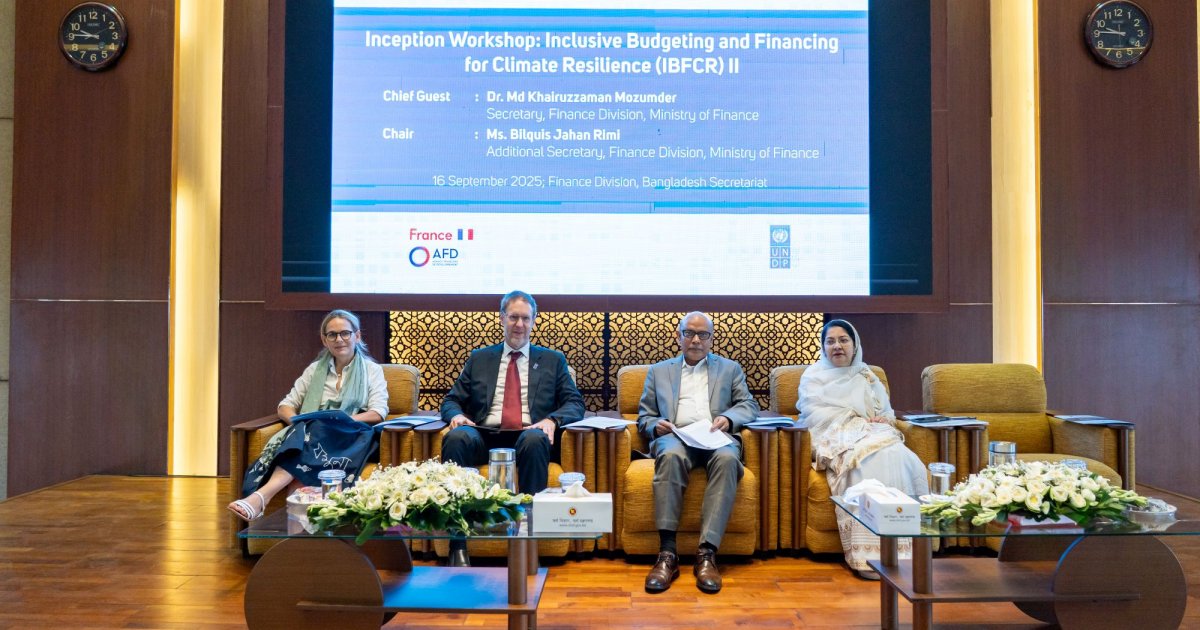
The Government of Bangladesh on Tuesday launched the second phase of the Inclusive Budgeting and Financing for Climate Resilience (IBFCR-II) project in Dhaka, a flagship initiative designed to integrate climate priorities into national budgeting and financial management systems.
Organized by the Finance Division in collaboration with the United Nations Development Programme (UNDP) and supported by the Agence Française de Développement (AFD), the inception workshop brought together senior government officials, development partners, academics, and climate finance experts to chart the next steps for mainstreaming climate resilience in public finance.
Speaking as the chief guest, Dr Md Khairuzzaman Mozumder, Secretary of the Finance Division, highlighted the urgency of mobilizing resources for adaptation and resilience. “Bangladesh is among the most climate-vulnerable countries in the world, and our policies, programs, and financing must reflect this reality. To meet our adaptation targets by 2050, we will need around $8.5 billion annually. This makes it urgent to mobilize resources through a joint effort that engages all stakeholders, particularly the private sector, in investing in climate change adaptation and mitigation. Through coordinated policies and platforms such as IBFCR, we are aligning development efforts and mobilizing resources to build resilience and strengthen our national response,” he said.
Stefan Liller, Resident Representative of UNDP Bangladesh, emphasized the critical role of climate-informed budgeting in safeguarding the country’s development gains. “As we embark on the second phase of this program, UNDP stands ready to continue supporting Bangladesh in strengthening systems, mobilizing resources, and building resilience,” he said.
Cecilia Cortese, Deputy Country Director of AFD, highlighted IBFCR-II as part of AFD’s broader support to the Government of Bangladesh in addressing climate change. “Recognizing the scale and complexity of the task ahead, AFD is proud to stand alongside you as partners in this important project,” she said.
Chairing the inaugural session, Bilquis Jahan Rimi, Additional Secretary of the Finance Division, reaffirmed the government’s commitment to embedding climate resilience across the budget cycle and ensuring that financial planning aligns with national development priorities.
Technical sessions featured a presentation on the IBFCR-II roadmap by Dr Maliha Muzammil of UNDP, followed by insights from Dr Fazle Rabbi Sadeque Ahmad, Climate Change Expert, and Dr Fahmida Khatun, Executive Director of the Centre for Policy Dialogue.
A panel discussion moderated by Dr Ziaul Abedin brought together senior policymakers to discuss cross-ministerial coordination, transparency, and building institutional capacity to ensure climate finance reaches those most exposed to climate risks.
Building on Phase I, the three-year IBFCR-II initiative will update and operationalize Bangladesh’s Climate Fiscal Framework, strengthen the Climate Finance Tracking System, and develop a National Climate Finance Strategy. The project will also reinforce local-level planning through tools such as the Local Adaptation Plan of Action and Climate Vulnerability Index, ensuring resources support community-led adaptation and resilience.
The workshop concluded with a vote of thanks from Muhammad Abul Kasem, Joint Secretary of the Finance Division, with broad consensus that inclusive, climate-responsive public finance is central to Bangladesh meeting its climate commitments and sustaining development progress.