
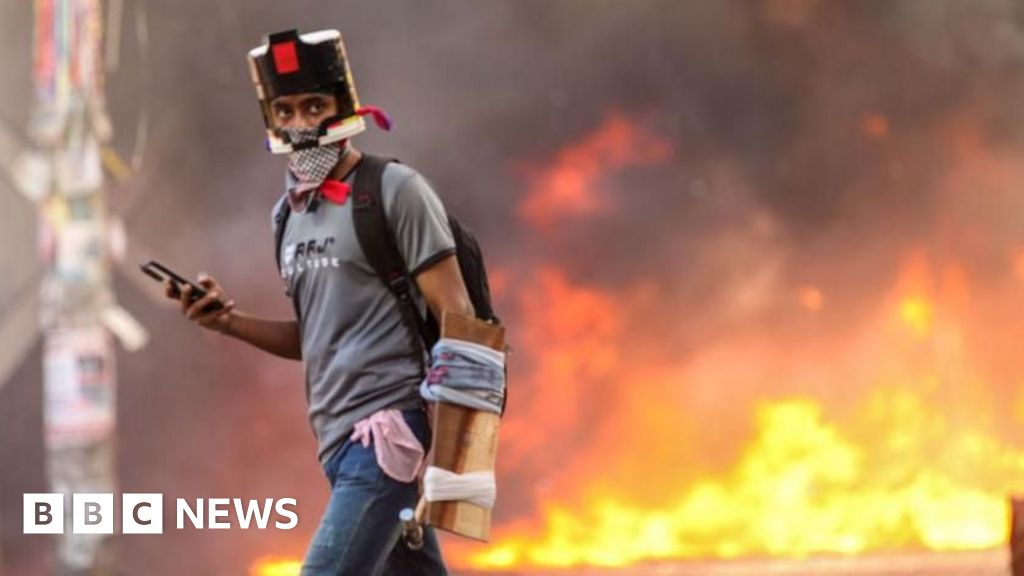
“One, two, three, four, Sheikh Hasina is a dictator!”
The words had become a rallying cry for young Bangladeshis in recent weeks – and on Monday their fury ended the prime minister’s 15-year reign.
The 76-year-old Ms Hasina had ruled the South Asian nation of 170 million with an iron fist since 2009 – just a month ago, protests demanding her resignation would have been unthinkable.
But by Monday morning, she was stuck in a deadly stalemate. It had been several days since the top court scrapped the job quotas that originally sparked the protests in early July. But the agitation continued, morphing into an anti-government movement that wanted her out of power.
What finally tipped the scales was the ferocity of the clashes between the protesters and police on Sunday. Nearly 300 people are estimated have died in the violence so far but Sunday alone saw at least 90 people, including 13 police officers, killed – the worst single day of casualties incurred during protests in Bangladesh’s recent history.
Critics called it “carnage”, even as Ms Hasina stood her ground.
Bangladesh PM resigns and flees country: Follow live
And yet, tens of thousands took to the streets on Monday, many of them marching towards the capital Dhaka, in defiance of a nationwide curfew.
Bangladeshis, it appeared, no longer feared bullets. What had been a political movement was now a mass uprising.
Ms Hasina’s decision to flee was also hastened by the military, which would have put pressure on her to step down. The army, which has ruled Bangladesh in the past and is still hugely respected, has an outsized influence over the country’s politics.
The violence from the weekend as well as the prospect of facing fresh rounds of massive protests would have made the military establishment re-think its options.
Junior officers had already raised concerns about being asked to fire on civilians in a meeting with the military chief, General Waker-Uz-Zaman, on Friday.
What lies ahead is less clear but Gen Zaman is in talks with “various stakeholders”, including opposition parties and civil society groups to find an “interim” solution, a high-level source familiar with the matter tells the BBC.
It is no surprise that Ms Hasina has fled to India. It’s unclear what counsel she received from across the border but Bangladesh’s giant neighbour has been a crucial ally of hers throughout.
It is partly why, as her popularity diminished, strong sentiment against India grew within Bangladesh.
Delhi always viewed its foothold in Bangladesh as key to the security of the seven landlocked states in India’s north-east, most of which share a border with Bangladesh. Ms Hasina has given transit rights to India to make sure goods from its mainland make it to those states.
She also clamped down on anti-India militant groups based in Bangladesh, a key issue in India.
But in recent weeks, Delhi faced a dilemma – by backing its unpopular ally, it risked alienating a mass movement and damaging its long-term relationship with Bangladesh. Ms Hasina’s resignation has solved that problem.
The daughter of Bangladesh’s founding president, Sheikh Hasina had been the world’s longest-serving female head of government.
Her father was assassinated with most of the family in a military coup in 1975 – only Ms Hasina and her younger sister survived as they were travelling abroad at the time.
After living in exile in India, she returned to Bangladesh in 1981 and joined hands with other political parties to lead a popular uprising for democracy that made her a national icon.
Ms Hasina was first elected to power in 1996 but later lost to her rival Begum Khaleda Zia of the Bangladesh Nationalist Party (BNP) in 2001.
She came back to power in 2009 in polls held under a caretaker government.
Her time in power was rife with accusations of forced disappearances, extra-judicial killings, and the crushing of opposition figures and her critics – she denied the charges, and her government often accused the main opposition parties of fuelling protests.
In recent weeks too, Ms Hasina and her party – the Awami League – blamed their political opponents for the unrest that gripped the country.
But this time, the anger was louder than ever before. It was certainly the most serious challenge Ms Hasina, who won a contentious election in January which the opposition boycotted, had faced during her years in office.
For weeks, she had refused to give ground, even calling the protesters “terrorists” at one point.
But the realisation that the force of the security establishment couldn’t keep people off the steets does not augur well for any leader – least of all an embattled one.