
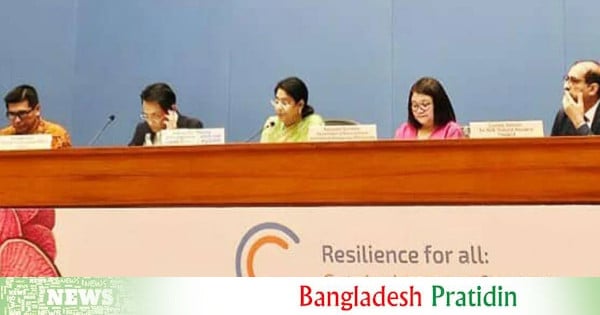
Environment, Forest, and Climate Change Adviser Syeda Rizwana Hasan has stressed that transformational adaptation requires moving beyond short-term, incremental projects to systemic, long-term integration across agriculture, water, biodiversity, and coastal systems.
She emphasized the wider adoption of climate-smart technologies, nature-based solutions, and renewable energy as essential for sustainable resilience, according to media statement.
“Bangladesh has proven that adaptation is possible even under extreme vulnerability,” Adviser Rizwana said, adding, “But to deliver transformational change, the global community must step up with scaled-up finance, technology transfer, and stronger international cooperation.”
She made these remarks at the Ministerial Roundtable of the 9th Asia-Pacific Climate Change Adaptation Forum, held in Bangkok on Wednesday under the theme “Resilience for All: Catalyzing Transformational Adaptation.”
Highlighting Bangladesh’s bold and innovative measures over the past decades, Adviser Rizwana noted that the country has not only saved lives but also safeguarded land, water, biodiversity, and coastal systems.
She pointed to landmark policy frameworks such as the Bangladesh Climate Change Strategy and Action Plan and the National Adaptation Plan, which sets out 113 interventions across eight thematic areas with an estimated cost of USD 230 billion.
She also cited the Bangladesh Climate Change Trust Fund, the world’s first country-led adaptation fund, which has already supported climate projects in Bangladesh.
She said on disaster preparedness, Bangladesh’s Cyclone Preparedness Programme has mobilized over 78,000 volunteers—half of them women—and facilitated the construction of more than 4,291 cyclone shelters and 523 flood shelters. Multipurpose rescue boats for persons with disabilities and community radio services for early warning have further enhanced coastal safety.
She said for food security, Bangladesh has developed drought, salt, and flood-tolerant rice varieties, alongside innovations such as floating agriculture in wetlands. Ecosystem-based projects have restored degraded lands in the Barind Tract and Haor wetlands, while the co-management of Tanguar Haor has strengthened biodiversity conservation and community resilience. Coastal embankments and freshwater management systems are also helping communities fight salinity intrusion.
Adviser Rizwana underscored that the success of Bangladesh’s adaptation journey rests on strong policies and governance, community-based leadership, and innovative financing. Article 18A of the Constitution provides a firm legal foundation, while grassroots innovations and volunteer networks demonstrate people-centered approaches.
She also highlighted the importance of financial mechanisms such as the Climate Fiscal Framework and the Bangladesh Climate Change Trust Fund, along with international sources including the GEF, GCF, LDCF, and the Adaptation Fund, in scaling up action.
DOI Kentaro, Vice Minister for Global Environment Affairs of Japan; John Warburton, Head of Climate Change and Environment at the Indo-Pacific Regional Department of the British High Commission in Delhi; Dechen Tsering, Regional Director of UNEP Asia and the Pacific Office; Noralene Uy, Assistant Secretary of the Department of Environment and Natural Resources of the Philippines; and Anouj Mehta, Country Director of the ADB Thailand Resident Mission, also spoke on the occasion.
Bd-pratidin English/ ANI