
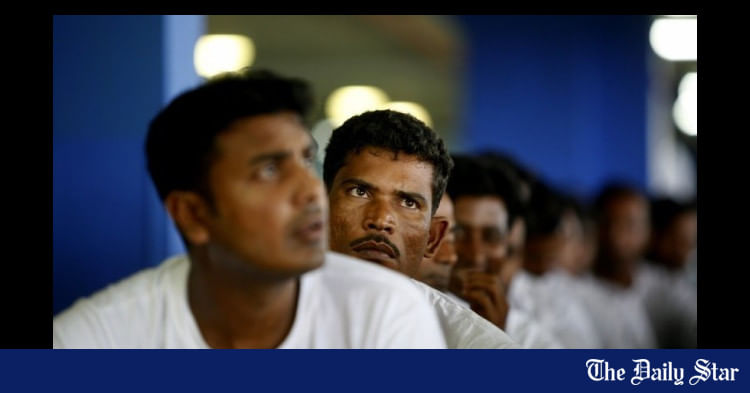

While Bangladesh actively pursues foreign investors, a domestic investment boom could be ignited simply by recognising and empowering its own returning citizens. FILE PHOTO: REUTERS
“>

While Bangladesh actively pursues foreign investors, a domestic investment boom could be ignited simply by recognising and empowering its own returning citizens. FILE PHOTO: REUTERS
Bangladesh’s rural economy is now experiencing a significant influx of capital from returning migrant workers, who are largely invisible in official data. The same remittance that policymakers have regarded for decades as a foreign exchange lifeline is emerging as an informal driver of rural enterprise, as returnee savings become a primary source for newly established businesses.
In the FY2024-25 alone, Bangladesh received a record remittance of $30.32 billion, coinciding with funds flowing into major rural districts such as Sylhet, Noakhali, Cumilla, and Jashore. According to the Bangladesh Bureau of Statistics, about 466,666 expatriates permanently returned over the two years around 2021-22. The World Bank’s Bangladesh Return Migration Survey (BRMS) revealed that a large share of returnees prefer self-employment, with many starting small businesses and micro-enterprises such as grocery shops, mills, transport services, and fisheries, financed by foreign earnings.
 For all latest news, follow The Daily Star’s Google News channel.
 A socio-economic survey conducted in 2024 shows that in some upazilas, 54.3 percent of returnees invested their savings in small businesses, and one in every three new businesses is established by returning migrants. If even a fraction of the savings that returnee migrants bring home were systematically channelled into small enterprises, the economic impact could be substantial. These returnee-financed ventures form part of the rural grey economy—legal but operating outside formal registries and policy frameworks. Such ventures create a ripple effect of diversified incomes, local employment, and new rural supply chains. However, because these entities remain unregistered, they are not included in national investment statistics, receive no formal credit, and make little contribution to GDP.
The major problem lies in the absence of policies. There is virtually no structure for reintegration once a worker returns. In one study on 270 returnees, 74 percent had brought back savings of at least Tk 100,000, and over 80 percent expressed a desire to set up businesses in their village. However, most face the common barriers of no collateral for loans, no policy recognition or entrepreneurial training.
While some commendable support programmes exist to assist returnees, they are very few in number and have the capacity to reach only a fraction of the returning migrant population. Even for the beneficiaries who receive seed funding or formal training, the ventures they establish tend to remain small. This is largely because the broader economic system offers no clear pathway for these micro-enterprises to scale up.
Conservative estimates suggest the informal returnee capital formation is now significant enough to rival the country’s entire foreign direct investment (FDI). While Bangladesh attracted approximately $3 billion in FDI in 2023, the cumulative, on-the-ground investment from its own returning citizens is believed to be operating on a comparable scale.
To put this potential in perspective, total remittances soared to a record $30.32 billion in the 2024-25 fiscal year, contributing over six percent of the nation’s GDP. While most of this income supports families, the savings brought back by permanent returnees represent a massive, untapped pool of investment capital. This indicates that while Bangladesh actively pursues foreign investors, a domestic investment boom could be ignited simply by recognising and empowering its own returning citizens.
If policymakers are serious about efforts to reduce rural inequality and dependence on Dhaka-centric industries, returnee investment must be focused on as one of the central economic policies. The Recovery and Advancement of Informal Sector Employment (Raise) project, a government-led initiative supported by the International Organisation for Migration (IOM) and the World Bank, aims to create welfare centres and a database of returnees. A comprehensive data registry must also include metrics on savings amounts, vocational skill sets, investment preferences, asset ownership, and business sectors. The government’s “Recognition of Prior Learning (RPL)” under the Raise project also offers support to a large number of returnees to validate skills gained overseas. Expanding RPL and combining it with business training will significantly reduce failures among new businesses and increase access to formal markets.
Additionally, lending schemes must be simplified and tailored to returnee needs to minimise the disparity between informal savings and formal investment, especially in rural regions. Financial instruments must also include matched grants for start-up capital, low or zero-interest small business loans, possibly via Probashi Kallyan Bank, and a returnee SME credit window. Small rural enterprises founded using returnee capital should be subject to simplified or tiered registration regimes, reduced fees, and tax relief.
While economists debate how to attract more foreign investors, Bangladesh’s own investment opportunities are hardly recognised due to the lack of acknowledgement in policy frameworks and economic statistics. For a nation aspiring to upper-middle-income status, this is an economic necessity that can turn into a powerful homegrown strategy.
Sumaiya Mahjabin is student of economics and finance at Brac University.
Views expressed in this article are the author’s own.
Follow The Daily Star Opinion on Facebook for the latest opinions, commentaries and analyses by experts and professionals. To contribute your article or letter to The Daily Star Opinion, see our guidelines for submission.