
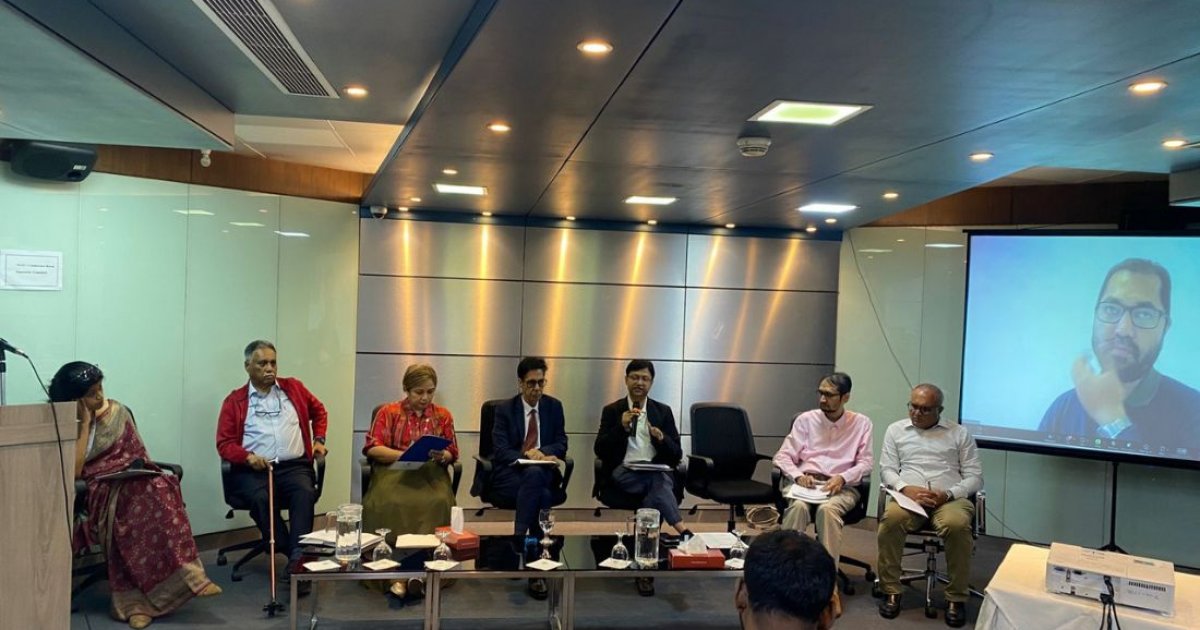
Bangladesh is facing a rapidly escalating public health and economic crisis driven by climate change, according to the Lancet Countdown on Health and Climate Change 2025 report, launched on Thursday at Brac Centre in Dhaka.
The report revealed that in 2024 alone, Bangladesh lost $24 billion — equivalent to 5% of its GDP — due to heat-related productivity losses. Citizens experienced an average of 28.8 heatwave days, 13.2 of which would not have occurred without climate change. Meanwhile, dengue transmission potential has surged 90% compared to the 1951–1960 period, highlighting growing risks from vector-borne diseases.
The national launch was jointly organized by the Centre for Climate Change and Environmental Research (C3ER) of BRAC University and The Lancet Countdown, with support from the Climate Change and Health Promotion Unit under the Ministry of Health and Family Welfare.
Delivering the keynote, Environmental Economist and Senior Fellow at the Grantham Research Institute, London School of Economics, Dr Shouro Dasgupta, highlighted that the 2025 global report tracks over 50 indicators across sectors such as health, agriculture, and labor, revealing how climate change is already reversing development gains.
Emeritus Professor at BRAC University, Professor Ainun Nishat, said extreme climate events are already reshaping lives across Bangladesh. “Health may not have been treated as a separate sector in the National Adaptation Plan (NAP), but it is deeply interlinked with 14 identified climate hazards, including heat stress and water insecurity,” he noted. He warned that warming in Bangladesh could reach 3.7°C, amplifying human suffering and economic losses.
The report found that heat exposure caused 29 billion potential work hours lost in 2024 — a 92% increase since the 1990s. Agricultural workers were hardest hit, accounting for 64% of lost work hours.
Air pollution remains one of the country’s deadliest health threats. In 2022, fine particulate matter (PM2.5) contributed to 225,000 deaths, a 38% rise from 2010, with over 90,000 deaths linked to fossil fuel combustion. Between 2016 and 2022, carbon emissions rose 30%, while renewables contributed only 0.85% of national electricity generation. Bangladesh spent $8.2 billion on fossil fuel subsidies in 2023, far exceeding investments in clean energy or mitigation.
Director at the Department of Environment, Mirza Shawkat Ali, said the government is taking steps to improve air quality and reduce emissions. “We have declared Savar a regulated air-quality zone where no brick burning will be allowed. Indoor air pollution remains a challenge, but we are collaborating with Australian and Korean partners to introduce electric cookstoves,” he said. “Our NDC targets 25% renewable energy by 2035, and we are working with city authorities to address heat stress.”
Rising sea levels continue to threaten millions. Nearly 14 million Bangladeshis now live less than one meter above sea level, heightening vulnerability to flooding and salinity intrusion.
Associate Professor at the James P. Grant School of Public Health, BRAC University, Farzana Misha, stressed that climate change is already undermining health security. “Health must be recognized as a core pillar of adaptation at COP30 and integrated into the NAP, not sidelined,” she said. “Building climate-resilient health systems is no longer optional — it is urgent.”
First Secretary of the Embassy of Sweden in Dhaka, Nayoka Martinez Bäckström, added that health is central to Sweden’s climate work. “In Bangladesh, we are working with partners and midwives to reach isolated communities. Solutions must be localized and aligned with national frameworks like the NAP and NDC,” she said.
Experts at the event warned that without decisive national action and enhanced international support, Bangladesh risks reversing decades of development progress. They called for dedicated climate finance and coordinated investments in renewable energy, air quality, and health adaptation to protect lives and livelihoods.
Moderated by Dr Iqbal Kabir of the Directorate General of Health Services, the event brought together senior government officials, researchers, and public health professionals, who echoed a unified message: “Climate change is no longer a future threat — it is a present public health emergency for Bangladesh.”