
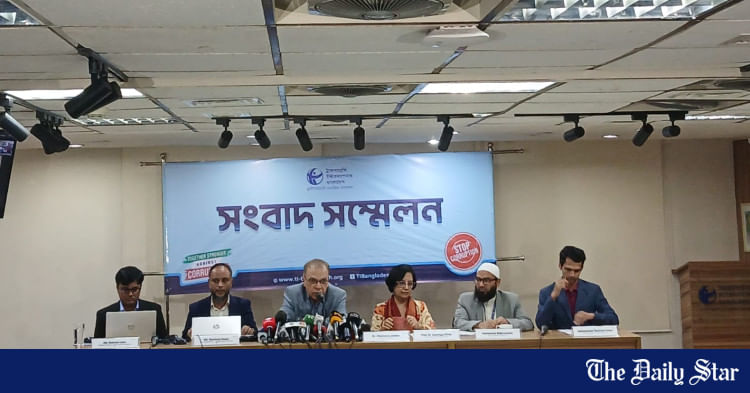
More than half of Bangladesh’s climate fund has been lost to corruption, according to a new study by Transparency International Bangladesh (TIB).
Between 2010 and 2024, more than $248 million of the $459 million allocated to 891 projects under the Bangladesh Climate Change Trust (BCCT) was misused or siphoned off.
 For all latest news, follow The Daily Star’s Google News channel.
 The findings indicate that political influence and collusion among members of the Trustee Board and the Technical Committee played decisive roles in project selection and approval, while BCCT officials responsible for oversight failed to prevent irregularities.
TIB found chronic implementation delays across projects.
Of the 891 projects reviewed, 62 percent had their duration extended from an average of two years to more than four years, while some four-year projects took as long as 14 years to complete.
Similar delays were recorded in internationally funded projects, where 41 percent of 51 projects were extended, pushing the average completion time to 2,978 days or more than eight years.
The study estimated that Bangladesh requires $12.5 billion annually to address climate impacts, but has received only $86.2 million a year on average from national and international sources between 2015 and 2023, which is just 0.7 percent of the required amount.
Between 2003 and 2024, the country received only $1.2 billion from foreign sources, an “insignificant amount given the scale of climate losses”, said Iftekharuzzaman, executive director of TIB, at the report’s launch event yesterday.
The climate fund was initially formed with the promise of effective action, but the reality has been “deeply disappointing and embarrassing as a citizen”, he said.
“In terms of value for money, the results of climate finance are extremely poor. Even of the limited funds that were allocated, a major portion, worth over Tk 2,100 crore, has been lost to corruption and irregularities. More than half of what was financed never reached the people it was meant for.”
The outcome was “tragic”, with the burden falling on the most climate-vulnerable communities.
“Instead of reaching those who are most at risk, the funds were diverted and misused for political purposes. Politically influential local elites captured the funds, while the truly climate-affected communities were left behind.”
Iftekharuzzaman described the scale of irregularities as a “severe blow to governance and accountability”, adding that political interference and institutional inefficiency were evident at every level from fund managers to implementing agencies.
“We have even seen projects designed for four years taking fourteen years to complete. This is a distressing and shameful picture.”
Despite these irregularities, he called climate finance a “matter of national survival” for Bangladesh.
“We are not underestimating the importance of other sectors, but for coastal and climate-affected regions, this is literally a matter of life and death.”
TIB also revealed that more than 15 percent of the Climate Change Trust Fund’s money had been trapped in a “fraudulent bank”.
“This is nothing but the looting of public resources meant for the most vulnerable,” Iftekharuzzaman said, referring to funds stuck in Padma Bank.
The bank now claims it will repay the money by 2030, but there is no guarantee of this.
“This is an unacceptable situation.”
He criticised the authorities for failing to safeguard or recover the funds despite the trustee board including ministers, secretaries and the Bangladesh Bank governor.
“The previous government did not act, perhaps because there were vested interests involved,” he said.
TIB urged the government to act on its recommendations, identify and hold accountable those responsible for corruption and adopt preventive measures to stop such irregularities in the future.
The Trustee Board of the Climate Change Trust Fund must be restructured and strengthened with qualified, independent, and non-partisan individuals, Iftekharuzzaman said.
“Only by ensuring competence, independence, and integrity can this vital institution regain credibility and serve its original purpose.”