
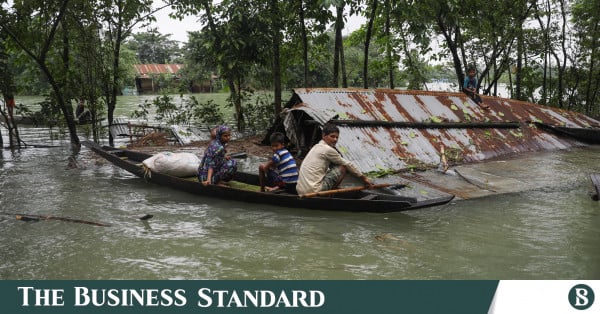
Climate change‑related disasters cost every affected Bangladeshi an average of Tk1.17 lakh ($954) in just ten months, according to new findings unveiled by Oxfam in Bangladesh during the launch of its Loss and Damage Dashboard in Dhaka on Tuesday.
The data, collected between June 2023 and March 2024 across 19 districts, logged 11,579 climate loss and damage incidents amounting to Tk1.35 billion ($11 million) in reported losses. The average loss per person equals around 15 months of income for a typical Bangladeshi worker, underscoring the steep economic pressure climate change is exerting on vulnerable households.
Building on these insights, Oxfam in Bangladesh, in collaboration with Oxfam Australia and Novib, with support from the Swedish International Development Cooperation Agency (Sida), published a report titled From Ground to Global: The Loss and Damage Dashboard for Climate Equity at an event in Dhaka on 5 November.

Loss and damage from climate change has become one of the most pressing challenges. Despite minimal contribution to global emissions, countries in the Global South face escalating climate disasters. Bangladesh — among the world’s top ten most climate‑impacted nations — loses $3 billion annually, or 1–2% of GDP, due to climate‑related disasters (World Bank, 2024). Multiple unofficial accounts and claims by government and non‑government sources suggest that loss and damage, along with the response to it, cost more than $5 billion a year for Bangladesh. Yet these figures understate the real picture, excluding slow‑onset events such as salinity intrusion and sea‑level rise.
To bridge the data gap, Oxfam in Bangladesh has developed the Loss and Damage Dashboard — a participatory, bottom‑up, real‑time tool that captures and validates economic and non‑economic climate losses. Integrating citizen science, satellites and AI‑driven validation, it empowers communities and equips policymakers with credible evidence to quantify and visualise climate impacts and advance global climate justice.
Joining the launch event, Nicolas Weeks, ambassador of Sweden to Bangladesh, said: “The Loss and Damage Dashboard shows how local knowledge, backed by scientific evidence, can drive global change. When community voices inform policy, we build stronger climate justice and ensure funding reaches those who need it most.”
The report also highlights gendered disparities: men reported higher total losses than women, but women bore disproportionate health and livelihood impacts — especially in waterborne disease and nutrition. This underscores the need for gender‑responsive climate finance and resilient health systems. Geospatial analysis found Cox’s Bazar, Kurigram, Satkhira and Sunamganj to be the most affected regions with reported cases.
Ashish Damle, country director of Oxfam in Bangladesh, stated: “The Dashboard translates pain into policy. By turning community stories into scientific evidence, Bangladesh is setting a global example of climate leadership. True justice begins with credible data — evidence that can influence finance decisions and hold polluters accountable.”
Roufa Khanum, assistant director at C3ER, BRAC University, added: “Science alone cannot solve the crisis without people. This dashboard democratises data, allowing communities to own their stories and be part of solutions. It’s an inclusive approach that makes policy more human.”
Sharif Jamil, coordinator of Waterkeepers Bangladesh, said: “For too long, communities facing pollution and floods have been spoken for. Now, they can speak for themselves. This tool empowers local people to record their losses, prove the connection to climate change, and demand action from government and industry.”
The report warns that climate‑related loss and damage are worsening global inequality. Least Developed Countries (LDCs) like Bangladesh bear the greatest costs of a crisis they did not cause. The richest 10% of populations account for over half of historical emissions, yet climate finance remains unjust. The Loss and Damage Dashboard helps correct this imbalance through verifiable, community‑generated data that strengthens Bangladesh’s voice in global financing negotiations.
Dr Mohammad Emran Hasan of Oxfam presented the report. The event, moderated by Md Sariful Islam of Oxfam, brought together leading voices from Bangladesh’s climate and development community — academics, private‑sector leaders and youth activists — who reflected on how community‑driven data and local innovation can transform global climate negotiations and accountability.