
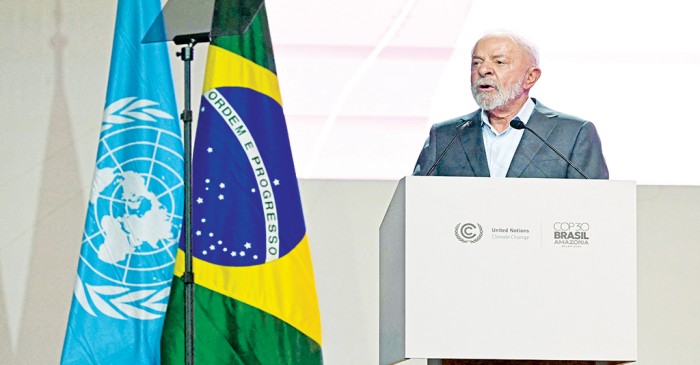
Brazil’s president Luiz Inacio Lula da Silva delivers a speech during the COP30 UN Climate Change Conference opening ceremony in Belem, Brazil on November 10. | Agence France-Presse/Pablo Porciuncula
AS THE world convenes for the 30th Conference of Parties under the United Nations Framework Convention on Climate Change, Bangladesh is championing a historic and groundbreaking principle in its climate agenda: just transition. For the first time, this concept has been formally incorporated into Bangladesh’s Nationally Determined Contribution — making it not only the first in Bangladesh but also the first in Asia to include just transition in a national climate policy document. This bold step underscores Bangladesh’s commitment to ensuring that climate action is both ambitious and socially equitable, setting a global example of integrating environmental sustainability with social justice.
A just transition is a framework designed to ensure that the shift towards a low-carbon, climate-resilient economy protects workers, communities and livelihoods, while addressing the broader socio-economic impacts of climate change. For Bangladesh, a nation highly vulnerable to rising seas, intensified cyclones, riverine flooding and other climate-induced hazards, embedding equity and fairness into climate action is both urgent and essential. Climate solutions must not exacerbate existing inequalities but rather foster inclusive, sustainable growth that leaves no one behind.
By incorporating just transition into its NDC, Bangladesh is pioneering a model that balances environmental ambition with social equity. The approach emphasises support for the most vulnerable populations — including informal workers, coastal communities and low-income groups — who are disproportionately affected by both climate impacts and the economic adjustments necessitated by climate mitigation strategies. This first-of-its-kind move in Asia signals that ambitious climate action and social justice are mutually reinforcing objectives.
At COP30, Bangladesh will focus on three interlinked priorities to advance just transition:
Equitable climate finance: Developing countries often face the dual burden of implementing ambitious climate strategies while simultaneously addressing poverty reduction, social protection and employment generation. Bangladesh will advocate for international climate financing mechanisms that explicitly incorporate social safeguards, ensuring that climate action benefits all communities, particularly the most vulnerable.
Capacity-building and skills development: Transitioning away from carbon-intensive sectors requires reskilling and empowering workers to participate in emerging green industries. Bangladesh will emphasise the importance of technical cooperation, knowledge transfer and training programmes that provide inclusive economic opportunities and minimise social disruption during the transition.
Inclusive policy and regulatory frameworks: Policies promoting renewable energy, climate-resilient infrastructure and sustainable agriculture must ensure tangible benefits for vulnerable communities. Incorporating labour rights, gender equity and social protection into climate strategies is essential for achieving a genuinely just transition.
Bangladesh will also share its practical experience in areas such as solar energy expansion, climate-resilient agriculture and coastal protection initiatives, demonstrating that environmental ambition and social equity can advance hand in hand. Furthermore, linking just transition with loss and damage, Bangladesh will advocate for mechanisms that provide equitable support to communities affected by unavoidable climate impacts, reinforcing fairness and justice as central pillars of the global climate agenda.
By being the first country in Asia to incorporate just transition in its NDC, Bangladesh positions itself as a global advocate for people-centred climate action. This initiative highlights the inseparable connection between ambitious climate goals and social justice, offering a model for other nations seeking to balance environmental responsibility with the protection of human livelihoods. COP30 provides a critical platform for Bangladesh to demonstrate that equitable, sustainable, and resilient climate solutions are not only aspirational but fully achievable.
Bangladesh’s leadership in this regard reflects a commitment to a future where climate policies protect both the planet and the people who inhabit it. True climate progress is measured not solely by emissions reductions but by the fairness, inclusivity and resilience of the transitions it promotes. By advancing just transition on the global stage, Bangladesh is ensuring that no worker, community or nation is left behind as the world moves towards a low-carbon, climate-resilient future.
Bangladesh’s pioneering inclusion of just transition in its NDC sets a new benchmark for Asia and the world. It reinforces the country’s vision of climate action that is ambitious, equitable and people-centred. By emphasising fairness, social protection and inclusivity alongside environmental objectives, Bangladesh is demonstrating that the path to sustainable development must be just, resilient and forward-looking.
Mohammad Navid Safiullah is an additional secretary, climate change wing, environment, forest and climate change ministry.