
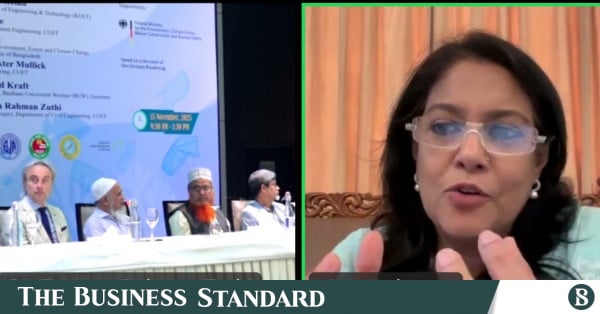
Environment Adviser Syeda Rizwana Hasan has called on universities to lead the national transition toward sustainability by declaring and maintaining plastic-free campuses through student engagement, awareness efforts, and access to eco-friendly alternatives.
Speaking virtually from her residence in the capital at the “Awareness Building and Dissemination Campaign on Sustainable Plastic-Free Marine Environment,” organised under the Sustainable Capacity Building to Reduce Reversible Pollution by Plastics (SCIP Plastics) project by CUET at Radisson Blu Chattogram Bay View, she urged academic institutions to involve students, especially girls, in producing paper, jute, and cloth bags.
She said, “A generation that moves away from excessive convenience will not only curb harmful plastic consumption but also help revive local industries such as jute, strengthen the national economy, and promote environmentally responsible production.”

She also noted that the shift from plastic to sustainable alternatives requires time, effort, and a fundamental change in consumer behaviour. The consumption patterns developed over decades cannot be reversed overnight, she said, adding that achieving plastic-free campuses by eliminating single-use and avoidable plastic items would require sustained institutional commitment.
Commenting on the widespread use of single-use plastics, the Adviser explained that consumer dependence is largely driven by convenience and the misconception that these products come “free.”
In reality, plastic production carries high costs—including labour, electricity, imported machinery, and raw materials—with the hidden environmental price borne by ecosystems.
She said that today’s educational interventions will shape tomorrow’s environmental outcomes and emphasised the importance of teaching students about the sustainable lifestyles of previous generations, as well as the ecological and economic advantages of reducing single-use plastics.
She further pointed out that alternatives exist for most single-use plastic items—except for some products such as disposable pens, where sustainable substitutes are still evolving.
Bangladesh, she added, is well-positioned due to its easy access to jute, cloth, and other local materials that can replace plastics in daily life.
“Increasing student engagement on plastic alternatives is an encouraging sign of progress,” she said.
Referring to the Bay of Bengal as the ninth most plastic-contaminated marine ecosystem in the world, she said, “The pollution results from poor domestic waste management and upstream inflow, rather than unusually high plastic consumption in Bangladesh. Recycling is often seen as a solution but is energy-intensive and chemically complex.”
“Bangladesh must therefore prioritise reducing plastic use, redesigning products for easier recycling, and enforcing extended producer responsibility,” she added.
She highlighted global best practices, including mandatory payments for shopping bags, bottle deposit-return systems, and strict regulatory actions, that Bangladesh could adapt.
She added that the country must modernise its waste management system to handle all types of waste, with plastics requiring special attention due to their non-biodegradable nature.
The programme’s Chief Patron was Prof Ing Eckhard Kraft, project lead of the SCIP Plastics Project at Bauhaus-Universität Weimar (BUW), Germany. The session was chaired by Prof Mst Farzana Rahman Zuthi, scientific director of the SCIP Plastics Project and faculty member of the Department of Civil Engineering at CUET.