
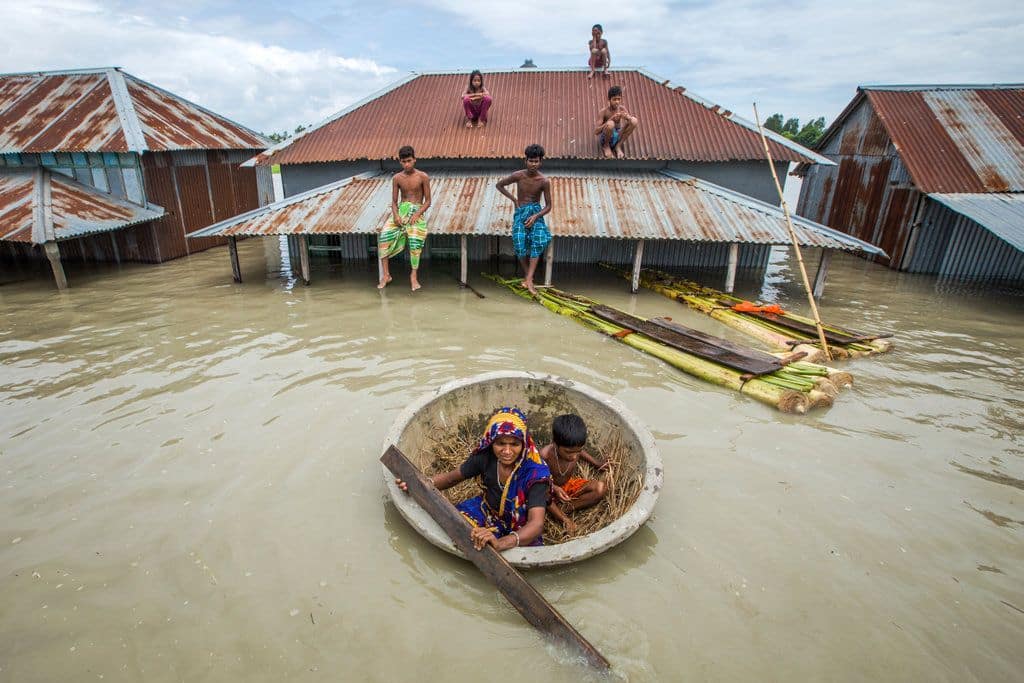
“Leaders at COP30 must recognize that adaptation cannot run on sympathy and speeches. It is time to choose between prevention and collapse now, because the longer they wait, the higher the cost – in more ways than you could imagine,” writes Tishma Joarder, a Bangladeshi climate economics researcher at the University of Toronto Mississauga.
—
By Tishma Joarder and Jeffrey Sun
At the COP30 climate summit in Brazil, world leaders are debating how to finance climate adaptation in developing countries, including my home country, Bangladesh. In a recent memo, Bill Gates applauded this mission, calling for wealthy nations to “step up and invest more” in building resilience to climate change, for the sake of those who contribute the least to global warming but suffer its effects the most. While this message was lost among climate skeptics and right-leaning politicians in favour of their own agendas, it wasn’t lost on me.

As a Bangladeshi and expert in climate economics, I do not need to be reminded that climate change is not a distant threat, but a crisis already unfolding in one of the world’s most exposed nations. As global warming accelerates – intensifying storms, disrupting rainfall and salting once-fertile land – one fact cannot be overstated: in the absence of bold, forward-looking adaptation and increased investment from wealthy nations, tens of millions of Bangladeshis will die or be displaced.
Rich nations should push for a much more ambitious and collective financial goal to fund such resilience strategies, especially supporting local governments and NGOs working on the frontlines of disaster risk reduction and climate-resilient agriculture. These are more than abstract policy goals – they determine whether vulnerable communities can survive the next monsoon or will be uprooted by it.
Cyclones are not new to Bangladesh. In 1970, the Bhola Cyclone, one of the deadliest hurricanes in recorded history, brought tidal waves that tore through embankments with wind speeds exceeding 240 kilometers per hour. Radio contact with the coast vanished as families were swept away. Two decades later, Gorky devastated Chattogram, the port city of Bangladesh. Boats dangled from the upper stories of buildings as soldiers scrambled to deliver supplies to the stranded. For my father, these are not statistics; they are lived memories of a young boy from Khulna – and warnings of the catastrophes that nature can bring if adaptation does not keep up with climate events.
The water-bound nation is home to nearly 174 million people – more than Canada, Italy and the UK combined – living in an area less than a third the size of California. This densely populated, largely rural country is deeply dependent on the regularity of the monsoon. Any disruption to this cycle between April and October can drastically endanger harvests.
Bangladesh’s groundwater resources are depleting faster than almost any other country on Earth. The water table in Dhaka has dropped from 25 meters in 1996 to 75 meters in 2023 and is projected to fall to 120 meters by 2050. As the 14th lowest-lying country in the world, sea level rise and storm surges are already reducing agricultural productivity, as sea water erodes and salts the earth. At least 30% of its cultivable land is at risk of salinization, with outright submersion projected to be widespread.

With nearly 40% of the population working in farming, Bangladesh remains a net food importer, importing almost 10 times by value as much food as it exports. A 2024 analysis estimated that approximately 16.5 million people across the country experienced acute food insecurity from April to October of that year. With a GDP per capita under US$2,600, the country has little flexibility to make up for a loss of domestic agricultural productivity.
The UN Environment Programme found that, by 2035, adaptation finance needs in developing countries will exceed US$310 billion per year – 12 times the amount of current international funding. What we need is not just “more money” – we need timely, targeted support. Farmers rebuilding embankments after storms each year should have access to durable infrastructure; women walking farther for fresh water should have access to local water storage systems; and children should not have to pause their education during floods because classrooms double as storm shelters.
Wealthy nations cannot afford to treat Bangladesh’s climate crisis as a local one. They were not supportive when the Syrian civil war displaced five million refugees, a country one seventh the size of Bangladesh. The next refugee crisis will be measured in tens of millions, and international assistance will be far less costly, both politically and economically, than managing the mass displacements and economic shocks that will follow.
Even in 2019, the Global Commission on Adaptation found that the benefit-cost ratios for resilience measures range from 2:1 to 10:1. Leaders at COP30 must recognize that adaptation cannot run on sympathy and speeches. It is time to choose between prevention and collapse now, because the longer they wait, the higher the cost – in more ways than you could imagine.
Featured image: Moniruzzaman Sazal / Climate Visuals Countdown, via Wikimedia Commons.
More on the topic: Climate Adaptation At COP30: What You Need to Know
—
About the authors: Tishma Joarder is Climate Economics Researcher at the University of Toronto Mississauga. Jeffrey Sun is Assistant Professor of Economics at the University of Toronto.
This story is funded by readers like you
Our non-profit newsroom provides climate coverage free of charge and advertising. Your one-off or monthly donations play a crucial role in supporting our operations, expanding our reach, and maintaining our editorial independence.
About EO | Mission Statement | Impact & Reach | Write for us