
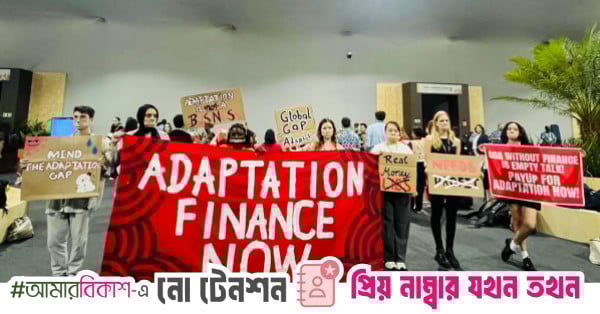
COP30 entered its second week today (17 November) mired in deadlock, with negotiations on climate finance, adaptation, technology transfer, gender equality and just transition showing little movement.
Bangladesh and other vulnerable nations warned that without concrete support, global ambition risks remaining “a paper dream” while climate disasters intensify.
Tensions rose throughout the first week of the UN climate summit as delegates struggled to resolve disputes over finance architecture, science-based targets, technology mechanisms and the pace of fossil fuel phase-out.

“Without finance, data and tools, ambition is only a paper dream,” said AKM Saiful Islam, professor at Buet’s Institute of Water and Flood Management and one of Bangladesh’s lead negotiators.
He said negotiations intensified as ministers arrived, but several critical areas remained stuck due to “political, financial and technical deadlocks.”
“Parties have made modest progress on transparency rules and early drafts of the Global Goal on Adaptation (GGA),” he explained. “Yet consensus continues to be blocked on climate finance, particularly the scale, source and structure of the New Collective Quantified Goal (NCQG). Loss and damage operationalisation is also facing obstacles as countries disagree on mandatory contributions, fund governance and access modalities for vulnerable nations,” added the Buet professor.
Disputes over fossil fuel language, equity and accountability have further complicated the talks, he said. “Ministers now face the challenge of bridging deep divides to deliver an outcome that reflects both ambition and fairness.”
The head of the Bangladesh delegation and Fisheries and Livestock Adviser Farida Akhter, speaking on behalf of the Least Developed Countries (LDCs) at a ministerial dialogue, said climate finance was not simply a negotiating item but a matter of “survival, justice and human dignity.”
“We are not here to repeat the problems; we are here to find solutions that match the scale of our suffering,” she said. “Rich countries repeatedly fail to meet their Paris Agreement commitments. We do not want loans; we want grants, and we make this demand clearly.”
Divides deepen
Global stocktake discussions remain contentious, with Norway taking a leading role. Delegates remain split over whether COP30 will commit to a fossil fuel phase-out and how responsibility will be distributed across developed and developing economies.
Gambia and Germany, leading ministerial consultations on adaptation, have highlighted the need to protect marginalised communities. But developing countries say promises are meaningless without concrete delivery systems.
Tensions over finance escalated as UK minister Ed Miliband and Kenya’s Debora Mlingo Barasa attempted to bridge gaps between donor and recipient nations. Delegates warn COP30 could “lose credibility” without a clear adaptation roadmap and secured funding for loss and damage.
Mitigation talks, led by Spain and Egypt, remain uncertain as major emitters shy away from commitments to phase out fossil fuels.
Just transition, tech transfer & gender talks falter
Just transition discussions, co-led by Mexico and Poland, have become another flashpoint, with disagreement over fairness for workers and communities affected by the green shift.
Technology transfer talks, chaired by Australia and India, are also stuck. Developing nations say existing mechanisms offer “little practical benefit” and fail to address real needs on the ground.
Gender equality negotiations, led by Chile and Sweden, have seen “limited progress,” according to feminist delegates. “Gender is still just a footnote in climate policy,” said negotiators of vulnerable countries.
Bangladesh’s team expressed frustration over insufficient technology transfer, minimal attention to climate science and persistent delays in adaptation finance.
Professor Saiful urged ministers to intervene decisively. “We request ministers to urgently engage and unlock political guidance on the outstanding issues, particularly the NCQG, Loss and Damage funding arrangements and language on fossil fuel phase-out,” he said. “Technical negotiations have reached their limits.”
He outlined the expected focus for the coming days, “Intense consultations are expected on NCQG, with a push to set a finance figure that reflects the real needs of vulnerable countries. Negotiations will also focus on operationalising the Loss and Damage Fund, simplified access, grant-based financing and strong institutional arrangements. Adaptation will take centre stage through finalising the GGA with concrete support commitments, metrics and accountability. LDCs will advocate for clear, time-bound language on fossil fuel phase-out to protect vulnerable communities.”
Bangladesh youth delegates have echoed the urgency. Sohanur Rahman, Executive Coordinator of YouthNetGlobal, said young people were running out of patience. “We need more than political statements from this COP, we need tools to save lives,” he told The Business Standard.
Consultations reshaped
Advocate Mohammad Hafijul Islam Khan, co-chair of the Executive Committee of the Warsaw International Mechanism (WIM), told The Business Standard, “The COP plenary had formally closed the Subsidiary Bodies (SBs) and adopted several outcomes, including decisions on Action for Climate Empowerment, capacity-building under the Kyoto Protocol, LDC matters and the UNFCCC budget.”
He said next week’s negotiations would continue across three tracks: ministerial consultations, technical negotiations and Presidency-led consultations.
“Technical negotiations continue across a wide range of items and are expected to conclude by Tuesday,” Hafijul said. Presidency consultations will address cooperation with international organisations and new agenda items, he added.
“With only a week remaining, the global climate community is at a crossroads,” he said. “Whether COP30 delivers tangible outcomes or becomes another missed opportunity depends on negotiators overcoming deadlock and providing real support to the countries and communities most at risk.”
Dr. Md. Arifur Rahman, one of the Civil Society Organization leaders and Chief Executive of YPSA, told The Business Standard that COP30 must shift the world from promises to real delivery.
“Vulnerable communities need predictable grants, not loans and support that strengthens resilience, protects ecosystems and upholds rights,” he said.
He stressed that adaptation finance must be accessible and locally led, with clear accountability. “Global leaders must act with urgency, protect the Amazon, operationalise loss and damage, and ensure no one is left behind in the climate transition.”