
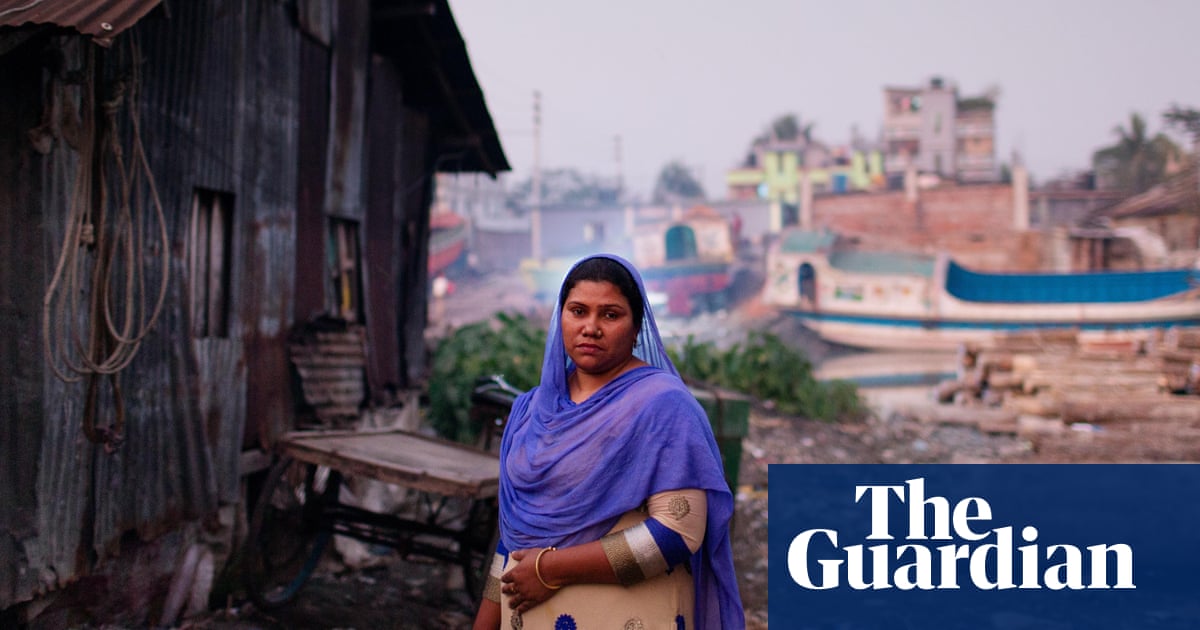
As far back as she can remember, Shahanaz Ali has been running from cyclones. “Moving constantly from one place to another is exhausting,” says Ali. “Nowhere feels like home.” Her family first fled from their house in 1970, when Bangladesh was devastated by Cyclone Bhola – one of the deadliest cyclones in history.
Up to 500,000 people died, including Ali’s grandparents. The largely inadequate response of the ruling Pakistani government towards the cyclone’s Bengali victims in what was then East Pakistan triggered Bangladesh’s war of independence a year later.
Natural disasters continue to shape political and economic life in Bangladesh. Situated on the Ganges-Brahmaputra delta – the world’s largest – the small south Asian country’s unique geography and low-lying topography make it particularly vulnerable to climate change. Yet against the odds, Bangladeshis have adapted as best they can.
Now a new report by the International Centre for Climate Change and Development (ICCCAD), a leading research institute in Dhaka, warns that the country is reaching the limit of its ability to adapt to extreme weather.
Climate events in Bangladesh are increasing at such an alarming rate, it says, that current policies and adaptation strategies will soon not be enough to safeguard the country’s people, infrastructure and ecosystems.
Between 2000 and 2019, Bangladesh experienced 185 extreme weather events, including cyclones, heatwaves, flooding and droughts.
In 2005, Bangladesh was one of the first least-developed countries to develop a national programme of action and has now become recognised as a global leader in adaptation and resilience. Government policy and local initiatives have averted the worst effects and saved millions of lives; the death toll from cyclones alone has fallen from up to 500,000 during Cyclone Bhola in 1970 to 35 during Cyclone Sitrang in 2022.
Prof Mizan Khan, deputy director of ICCCAD and one of the lead authors of the report, says: “The research shows that by the end of the century, even under a very low-emissions scenario, Bangladesh could see a further 0.8C [1.44F] of warming compared with previous decades.
“Heavier rainfall could increase peak river flow by 16% relative to 1971–2000, raising the inevitable risk of flooding and causing further devastation than we are already seeing,” he says.
Despite Bangladesh’s progress in adapting, the report says significant gaps remain at grassroots level and in monitoring the policies’ effectiveness.
To help her community become more climate resilient, Ali, 36, who is now settled in Barishal, joined the Hatkhola Squad, a female-led disaster-response team, set up by the Bangladesh Red Crescent Society. Ahead of the cyclone season, the women go from house to house to help neighbours prepare and make sure they know when and how to safely evacuate.
The transformative, community-led approach of these women has inspired others to join. Nipa Khatun, 23, one of the younger members, sees it as an opportunity to challenge cultural stereotypes.
“It’s not common for women to help in such a physical way during an emergency,” she says. “I feel like I have much more respect now and am taken more seriously.”
But the women’s work is under threat. Due to limited funding, the Bangladesh Red Crescent has only been able to support 2,500 people in the community, despite a need to help many more.
The ICCCAD report, one of the first to look at the limits of adaptation in the country, is dedicated to the lead author, Prof Saleemul Huq, the renowned Bangladeshi scientist and director of the centre who died last October. It concludes that Bangladesh’s ability to continue responding to the climate crisis requires multiple strands of action: national coordination and government investment; locally led adaptation; fair loss and damage funding; and a large-scale shift to secure, low-carbon energy.
“We are running out of time,” says Khan. “To address these challenges, Bangladesh must assess climate-change impacts from a human-vulnerability perspective and take immediate action. The poorest in the country are the most vulnerable as they have no cushion to withstand these adversities.”
He also argues that development partners need to step up financing for local adaptation.
The Bangladesh government spends roughly 7% of its annual budget on climate adaptation, about 75% of which comes from domestic sources. However, scaling up measures outlined in the National Adaptation Plan will require seven times the current spending.
During Cop28, global leaders agreed on a loss-and-damage deal, totalling more than $700m (£550m), to support nations facing the brunt of climate crisis. There are concerns, however, about the size of the fund and it being managed by the World Bank. Pledges are in the form of loans rather than grants, which will add to vulnerable countries’ already significant debt burdens.
Bangladesh has emphasised the fund needs to be based on grants to reflect developing countries’ needs in the face of the climate crisis. “The international community must understand there are limits to adaptation,” says Saber Chowdhury, Bangladesh’s environment minister.
“While we welcome the loss-and-damage fund, it is nowhere near what is needed. Along with raising more funding, it needs to raise its ambitions to ensure adaptation plans are effective in the long term.”
On the sidelines of Cop28, Bangladesh initiated talks on setting up a Climate Development Partnership Platform, the first of its kind in Asia, to bolster its mitigation and adaptation financing.
“We are not just victims of climate change – we are global leaders in the fight against it,” says Chowdhury, noting Bangladesh’s plans for 40% of its energy to come from renewables by 2041.
However, even with accelerated action, continued warming and extreme weather will put stress on Bangladesh’s adaptation efforts, making it harder to protect lives and livelihoods, and highlighting the need to step up international action.
“What’s happening in Bangladesh is not only limited to our borders,” says Chowdhury. “There will be spillover – it is not a question of where but when. This is a global crisis and we all need to come together and solve it faster than we are creating it.”