
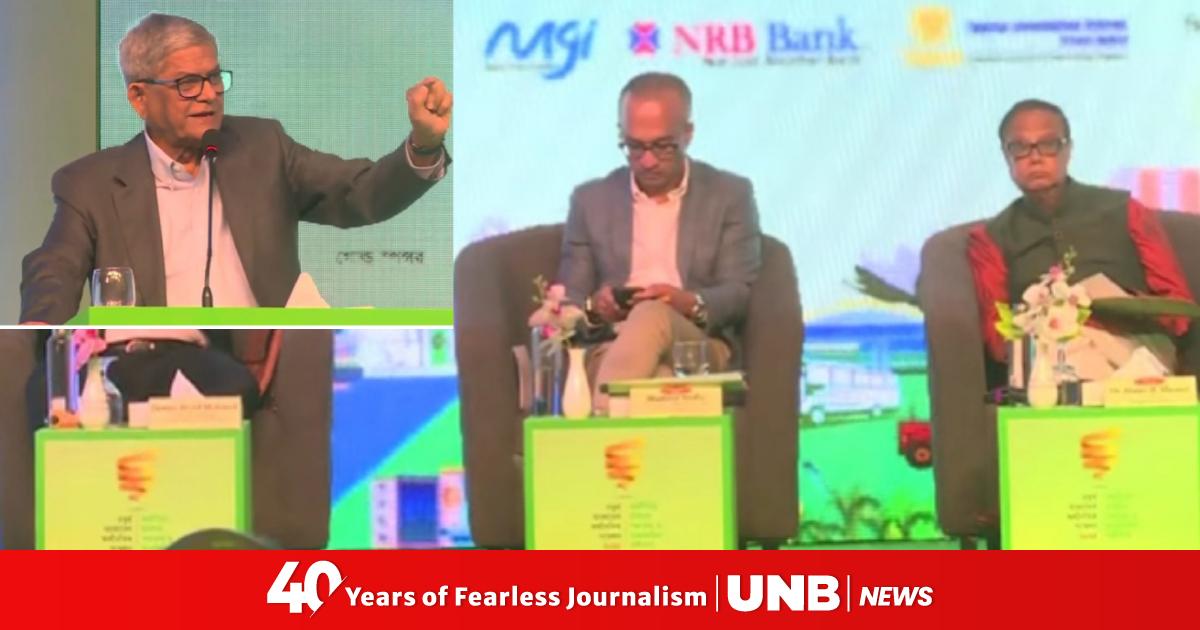
Leaders from various sectors on Saturday warned that creating new employment opportunities and restoring stability in the job market will be major challenges for the incoming government elected in the upcoming national election, as social discontent rises amid widening economic disparities.
The concerns were repeatedly echoed by speakers throughout the day-long Bangladesh Economic Conference 2025, held at Hotel Sonargaon in the capital and organised by Bonik Barta.
At the concluding session, National Citizen Party (NCP) Convener Nahid Islam identified job creation and meeting the needs of the rapidly expanding urban middle class as the two biggest policy priorities at present.
“Millions of young people enter the job market every year. Ensuring employment and securing the livelihoods of metropolitan middle-income families must be prioritised,” he said. He emphasized affordable education, healthcare and essential public services to prevent further social frustration.
Industrial stagnation and contracting private investment have resulted in 1.4 million job losses, leaving many “wandering the streets without employment,” said Ha-Meem Group Managing Director and former FBCCI President A.K. Azad.
Speaking at the conference’s opening session, he warned that Bangladesh is failing to generate sufficient new jobs despite the expanding labour force.
“Every year, 30 lakh people enter the job market. Of them, 1.2 lakh join government and semi-government bodies, 8 lakh migrate abroad, and 10 lakh find jobs in the private sector. The rest remain unemployed,” he said, adding that expected levels of new employment are not being created.
Citing the Bangladesh Bank bulletin released on November 23, Azad said the country’s GDP growth fell to 4.22% last year and is expected to further decline to 3.97% this year.
Meanwhile, Bangladesh Bank Governor Ahsan H. Mansur cautioned that the banking sector will require 5 to 10 years to recover from its severe non-performing loan (NPL) crisis.
“NPLs have become a major structural problem, with more than one-third of bank loans now classified as non-performing. Banks are running on the remaining two-thirds, putting the entire financial sector under strain,” he said.
He noted that the NPL rate has already crossed 35%, far above earlier estimates. “This crisis cannot be resolved overnight. We must move step by step,” he added.
BIDS Director General A.K. Enamul Haque criticised the country’s economic governance model, describing it as dominated by a “catch-the-thief mindset” that discourages business confidence.
He said regulatory bodies lack strong accountability structures, comparing the nation’s tax administration to the old “zamindari system,” focused solely on revenue collection rather than development.
BSMA President Jahangir Alam said businesses are under excessive pressure from multiple import duties and advance income tax (AIT). He also criticised the recent increase in turnover tax from 0.1% to 1%, saying companies are being forced to pay even when they incur losses—“a system unheard of elsewhere in the world.”
Despite these challenges, City Bank Managing Director Mashrur Arefin expressed cautious optimism, saying discipline and governance in the banking sector are improving. “Loans that were once approved in boardrooms are now processed according to proper rules,” he said.
He acknowledged weak private sector credit flow but said businesses may be waiting for more certainty. “The investment climate will improve after the national election,” he added.
At the second session of the summit, BNP Secretary General Mirza Fakhrul Islam Alamgir emphasised the urgent need to reopen factories and industries that have been closed for the past 15 years, which he said has left 1.4 million people unemployed.
“Where will these people go? Why are we creating this unemployment? We must focus on restarting factories and creating jobs through these institutions,” he said.
He criticised punitive actions against entrepreneurs that lead to factory closures, arguing that such measures harm thousands of workers.
Fakhrul highlighted the BNP’s commitment to improving the lives of ordinary citizens and restoring economic stability. He referred to the party’s earlier policy proposals, including Khaleda Zia’s Vision 2030 and the 31-point reform plan of 2023.