
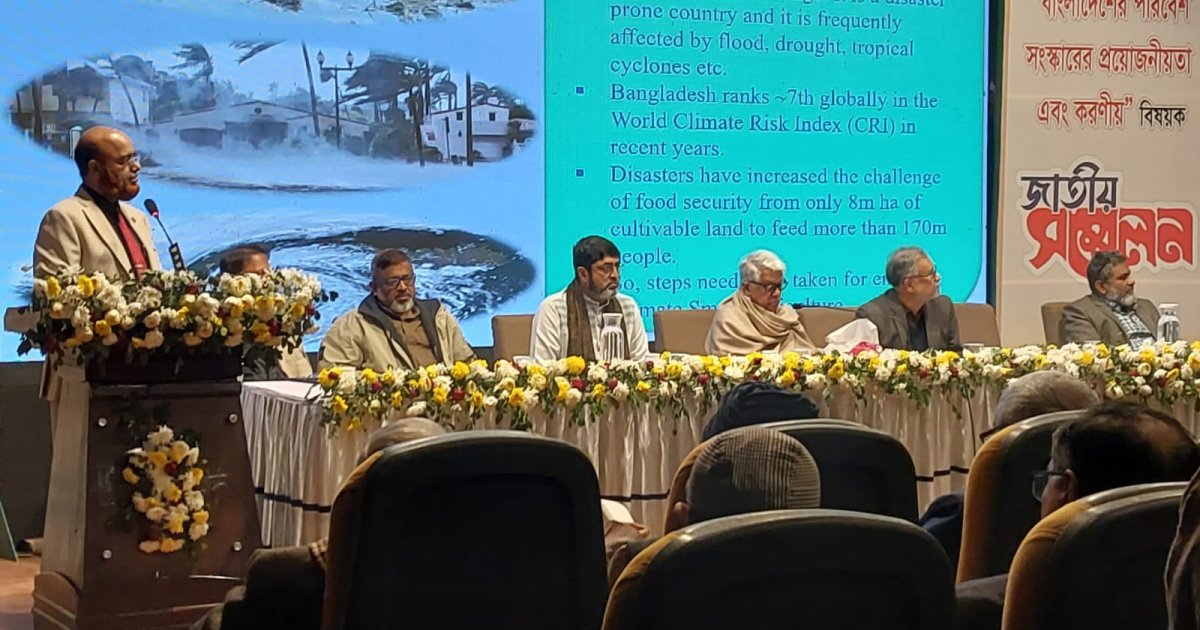
Environmental experts on Saturday stressed the need for long-term planning, coordinated initiatives and sustained action to address Bangladesh’s growing environmental crisis, warning that short-term and fragmented projects are no longer sufficient.
They said protecting the environment and making Dhaka a livable city require strong political commitment, along with integrated and systematic planning across key sectors, including agriculture, water resources, biodiversity and coastal management.
The remarks were made during a special session on the second day of the National Environmental Conference titled “The Need for Environmental Reforms and the Way Forward,” held at the Krishibid Institution auditorium in the capital. The conference was jointly organized by Bangladesh Poribesh Andolon (BAPA) and Bangladesh Environment Network (BEN).
The session was chaired by Dr Nazrul Islam, chairman of the Urban Development Research Centre. Speakers included former Fire Service and Civil Defence Director General AKM Sakil Newaz, eminent urban planner architect Iqbal Habib, energy expert Md. Shahriar Ahmed Chowdhury, agriculturist Md. Shah Kamal Khan, BAPA Treasurer Zakir Hossain and BAPA General Secretary Md Alamgir Kabir.
On the second day, separate sessions were held on air, noise and water pollution, and waste management, chaired by Dr. Mahbub Hossain. Another session on disasters, climate variability and related issues was chaired by Dhaka University teacher Md. Niamul Naser.
A session on urbanization, physical planning, transport and mobility was chaired by Jahangirnagar University Professor Adil Mohammad Khan, while the session on climate change and related issues was chaired by Teesta Forum General Secretary Mahmudul Islam Selim.
A total of 117 local and international experts presented research papers at the conference, while grassroots environmental activists shared their field-level experiences. More than 500 delegates, including domestic and foreign experts, took part in the two-day event.
Speaking at the conference, AKM Sakil Newaz warned that Dhaka remains at severe risk of a major earthquake. “An earthquake will happen—whether today or tomorrow, small or large. We must prepare now,” he said.
He noted that 76 percent of Dhaka’s roads are narrow, restricting the movement of emergency vehicles. Gas and electrical lines pose serious explosion risks during earthquakes, while shortages of rescue equipment and trained personnel remain critical challenges. He emphasized the need for a comprehensive and coordinated disaster preparedness plan.
Architect Iqbal Habib highlighted the consequences of unplanned urbanization, saying Dhaka has become increasingly unlivable. He said making the city livable requires urgent reconstruction and reorganization of existing urban structures rather than pursuing new developments.
He also called for planned urbanization, decentralization and improvements in rural livelihoods, advocating environmentally friendly, inclusive and well-planned urban development in harmony with nature.
In his closing remarks, Dr Nazrul Islam said policy reform alone is not enough to resolve environmental challenges. “Institutional reform of environment-related agencies is equally necessary,” he said, expressing hope that the government would move forward with both policy and institutional reforms in the coming days.