
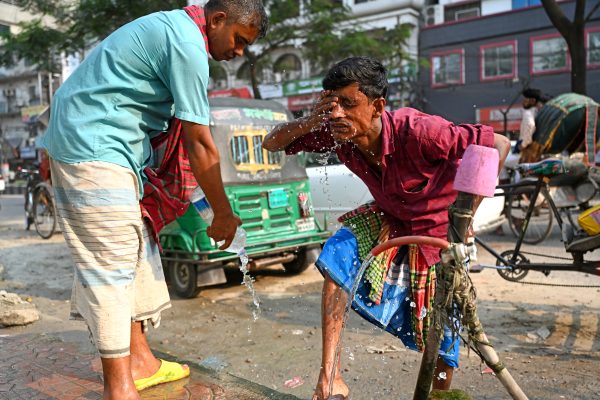
Bangladesh has been facing increasing heat waves during summer for the last couple of years. 2024 is the hottest year yet, recording average temperatures of 40 to 42 degrees Celsius in all the districts. The population and biodiversity of the country are at stake due to such an unprecedented catastrophe.
According to news reports, at least four individuals have died from heatstroke, and millions of people have suffered several health implications, including vomiting, diarrhea, heat exhaustion, headache, pneumonia, shortness of breath, dehydration, etc. Some of the educational institutions temporarily closed due to the extreme heat.
This extreme weather reflects Bangladesh’s environmental vulnerability and weak environmental governance. The country is already a top-listed victim of global climate change; the indiscriminate human activities that destroy its environment are worsening its plight. Academic studies have identified “massive and common” environmental crimes over the last few years. White-collar criminals clear-cut thousands of acres of forestlands, emitted harmful gases from their industries, and encroached on riverbanks. Even some government institutions have been accused of committing environmental crimes. It demonstrates that there are severe weaknesses in environmental governance in Bangladesh.
Environmental governance, a fundamental pillar of overall governance, doesn’t only deal with water and land management; it is intricately linked to factors like public health, agriculture and livelihood, industry and infrastructure, population management, etc. In Bangladesh, however, environmental governance is characterized by its discreet, sporadic, outdated, and weak nature.
Despite the presence of several ministries working on environmental governance, their roles and responsibilities often remain unclear, leading to a lack of effective action in critical cases. For instance, while the National River Commission is tasked with identifying and addressing illegal river-related activities, it lacks the power to take direct legal action against offenders. This has allowed human-induced environmental damage to reach alarming levels in Bangladesh.
We can identify some basic loopholes in overall environmental governance. First, Bangladesh follows a traditional environmental governance approach, which is obsolete in the country’s context. It is highly structural, and environmental agencies do not get much priority in policy initiatives.
Under the current set-up, the public has little ability to influence Bangladesh’s environmental policies. For example, the environmental court requires a report from the inspector of the Department of Environment to file any legal case against environmental harm. As a result, a citizen cannot secure environmental justice. Besides, local communities and civil society groups have little influence on environmental policy formulation. In one example, the government established a coal-based power plant despite civil society groups’ strong opposition, considering its negative consequences to the Sundarbans.
Second, there is a lack of coordination, collaboration, and communication in environmental management. Though Bangladesh has several ministries, institutions, and departments dealing with environmental issues, they do not have effective mechanisms to coordinate. For instance, when any incidents occur in a river, it’s hard to know who would be responsible for taking action between the Ministry of Environment, Forest, and Climate Change; the National River Conservation Commission, the Ministry of Fisheries and Livestock, the Bangladesh Water Development Board, or the Ministry of Water Resources.
Adding to the problem, government agencies at times are the ones committing environmental damage. Some local government institutions were found to breach environmental law by cutting hills.
Third, there is a lack of regular monitoring and consistency. Environmental well-being is a regular process that can not be done overnight. The current heat wave is not a result of sudden activities; rather, it is caused by long-term misconduct. Hence, a clear directive and long-term measuring and compliance mechanisms are necessary to ensure environmental protection.
Let’s return to the current heatwave situation. According to Climate Impact Tracker Asia, daytime temperatures have increased by about 2.74 degrees C over the last 20 years. Besides, the summer season tends to be prolonged while the winter session has shortened. Md Kamruzzaman Milon, a climatologist and senior scientific officer at Bangladesh Rice Research Institute (BRRI) considers these extreme heatwaves to be a consequence of human activities against the environment. Studies clearly show that global climate change is linked to the heatwaves in South Asia.
Bangladesh’s overall contribution to the global phenomenon of climate change is extremely limited compared to developed countries. Thus the country cannot eliminate the problem on its own. That said, the government must acknowledge the domestic human-induced activities that contribute to heat waves. Actions taken within Bangladesh impact the environment and degrade public health and the population’s productivity. This problem cannot be resolved unless Bangladesh rethinks environmental governance, focusing on responsive regulation, which balances affirmative and negative compliance motivation.
An immediate response would be taken to tackle the current emergency by establishing a Heat Adaptation Plan, where Bangladesh will undertake specific methods to minimize the suffering. Still, the long-term strategy is to strengthen environmental governance through regular environmental monitoring, community empowerment, restorative justice, adaptive institutionalism, and research.