
- In one of the world’s most climate sensitive deltas, disasters are on the rise. The need for resilient housing has become a significant concern for Bangladesh.
- Amid various challenges, architectural models to promote sustainable construction materials are emerging.
- Experts recommend separate zonal building codes for specific climatic event-prone areas.
Bangladesh’s low-lying terrain combined with the crisscrossed river network, which is cause for recurring floods, tidal surges and river erosion, and frequent cyclones make it vulnerable to climate change-related devastations.
Between 2008 and 2024, the Internal Displacement Monitoring Centre (IDMC) recorded 123 disaster events that triggered huge displacement, including about 11.3 million people who experienced pre-emptive evacuations during cyclones.
IDMC assessed that many such movements, however, only last for a short period of time, but every year disasters still leave tens of thousands of people without hope of returning to their homes immediately after.
In such a context, safe housing is a survival need instead of merely an infrastructural demand. However, the concept of safe or sustainable housing for the disaster victims still remains a donor-funded matter, as the use of climate-and-disaster-resilient construction plans and materials are not popular in Bangladesh.
“Sustainable and safe housing is the first line of defense in disaster risk reduction,” says Mohammad Abu Sadeque, executive director of Centre for Housing and Building Research (HBRC), a private sector research hub focused on creating sustainable, affordable, and climate-resilient housing solutions.
Sadeque has observed that conventional housing, especially in Bangladesh’s rural and low-income areas, often lacks structural safety and durability against cyclones and tidal surges, riverbank erosion, flooding, flash floods, salinity intrusion, earthquakes and heat stress.
According to the government’s disaster-related statistics of 2021, more than half of the country’s households are non-concrete.
Living in fragile tin-roofed or mud-walled structures, millions of families are exposed to the mounting climate shocks.
Advocating for climate-and-disaster-resilient housing, Sadeque says that such houses reduce mortality and injury, protect assets and savings, minimize displacement, and lower long-term recovery costs for both victim families and the state.
“Resilient housing is not merely a construction issue. It is a social protection mechanism, a climate adaptation strategy, and a pathway toward sustainable national development,” he says.
He recommends that sustainable construction materials in Bangladesh must meet five criteria: structural safety against cyclones, floods, and earthquakes; durability in humid and saline atmospheres; low maintenance and long service life; cost-effectiveness for mass housing; and reduced environmental impacts.

Emerging model of low-cost resilient housing
In December 2025, 690 climate-resilient, low-cost housing units for urban poor communities were inaugurated in Chandpur, Kushtia, Noakhali and Gopalganj districts.
The Local Government Division of Bangladesh government implemented the housing project with support from the U.K. government and the United Nations Development Programme (UNDP).
Architectural firm Onushongo Bangladesh designed the construction plan.
Architect Moinul Alam from Onushongo says, “We did not use any conventional brick walls. The structures were built with hollow blocks, and the pillars with stone-chip casting.”
From doors and windows, the architectural firm avoided relatively expensive materials. Instead of applying floor tiles, the low-cost houses got neat cement-finish flooring.
Planning affordable and durable houses is the architectural firm’s initial objective.
“Whenever we talk about affordable climate-resilient housing, we tend to think only of construction materials, which are only one component. There is planning, design, and execution. Actually, cost savings can be possible from the planning phase,” Moinul says.
The firm was assigned to plan a 30-square-meter (320-square-foot) housing unit, of which only 14.8 m2 (160 ft2) were initially livable space for a dwelling family.
However, the firm reconfigured circulation and stair layouts to minimize costs of these and, at the same time, to maximize dwelling space to 20.4-23.2 m2 (220-250 ft2).
With the model, construction of such a 30 m2 housing unit in a multistory building would cost $5,000-$6,500, says Moinul.

Concrete resilience in coastal Bangladesh
BRAC, a Bangladesh-based international development NGO, has built 35 climate-resilient two-story buildings on 65.7 m2 (708 ft2) of land each in the coastal Barguna, Satkhira, Bhola and Patuakhali districts.
Moreover, two more buildings were piloted in Khulna and Cox’s Bazar districts under the Nationally Determined Contribution Action Project under the Ministry of Environment, Forest and Climate Change and the United Nations Environmental Programme (UNEP).
Head of BRAC’s Climate Change Programme, Abu Sadat Moniruzzaman Khan, says, “We call these buildings mini cyclone shelters.”
Designed to withstand wind speeds of up to 280 kilometers per hour (174 miles per hour) and tidal surges recorded over the past 50 years, the elevated structures can shelter up to 40 people and their livestock during disasters.
Built mainly with ceramic and Indigenous knowledge-based treated fire-burnt bricks, the buildings are fitted with wooden doors and windows to prevent salinity-induced rust.
According to Sadat, each building costs about $10,000.
“BRAC has set such an example that can be replicated by neighbors in the community,” Sadat says. “Self-invested labor and optimization of locally treated materials can further minimize cost.”
The BRAC climate-resilient housing model won the Aga Khan Award for Architecture in 2022.

Replacing fire-burnt bricks with ferroconcrete
Campaigning against the traditional fire-burnt clay brick manufacturing, as it continues to degrade the environment and contribute to deforestation, air pollution and greenhouse gas emissions, HBRC promotes ferrocement-based lightweight systems, flood-resilient stilt houses and low-carbon construction technologies.
The northeastern flood recovery project (by UNDP-HBRC), portable housing for Rohingya refugee camps in Cox’s Bazar, and energy-efficient rural housing models are among the HBRC’s key projects.
HBRC’s Sadeque says, “We recommend ferrocement systems, engineered lightweight concrete blocks, compressed stabilized earth blocks and elevated structural systems as viable options for building resilient house.”
On the HBRC’s field lab at Dhaka’s Purbachal area, a self-sufficient coastal model house, among other models, is built, which is climate resilient, sustainable and energy efficient.
Construction of the house on 32.5 m2 (350 ft2) of land would cost $3,200, according to HBRC.

Challenges and urgent need for rural building codes
Although there are alternatives to conventional construction materials, Sadeque says adoption is not gaining pace due to “cultural and market inertia.”
“Burnt clay bricks and conventional reinforced concrete remain deeply entrenched in people’s minds. There is a perception that heavier means stronger,” he observes.
He adds that engineers and contractors often lack hands-on training in alternative construction materials, and universities provide limited studies.
A 2025 study finds that the use of local and sustainable construction materials is the least adopted practice in Bangladesh.
It also reveals that only 28% of the study respondents, including engineers, builders, architects, planners, local residents and policymakers both in government and non-government organizations, are “highly aware” of climate-resilient construction practices.
The state-run Housing and Building Research Institute (HBRI) director general Mohammad Giasuddin Haider points to another barrier: weak promotion for sustainable construction materials.
“Although the HBRI has developed sustainable materials, the institute lacks staff for promotion and feedback analysis,” he says, adding that the shortage of skilled masons trained in alternative materials further hampers expansion.
Experts have understood that perhaps the most critical gap for promoting sustainable materials lies in regulation.
Currently, the national building code is applied mainly in urban settings, while rural areas, where most climate-vulnerable populations live, fall outside regulation.
BRAC’s Abu Sadat says, “Specific climatic event-prone regions require specific house-building guidelines,” while Onushongo Bangladesh’s Moinul adds, “There should be separate zonal building codes and standard of materials for different types of houses.”
HBRI’s request to another state-run Bangladesh Standards and Testing Institution (BSTI) for standardizing sustainable construction materials went in vain, says Giasuddin.
“However, HBRI is going to develop a rural house building guideline with support from foreign development partners,” he says.
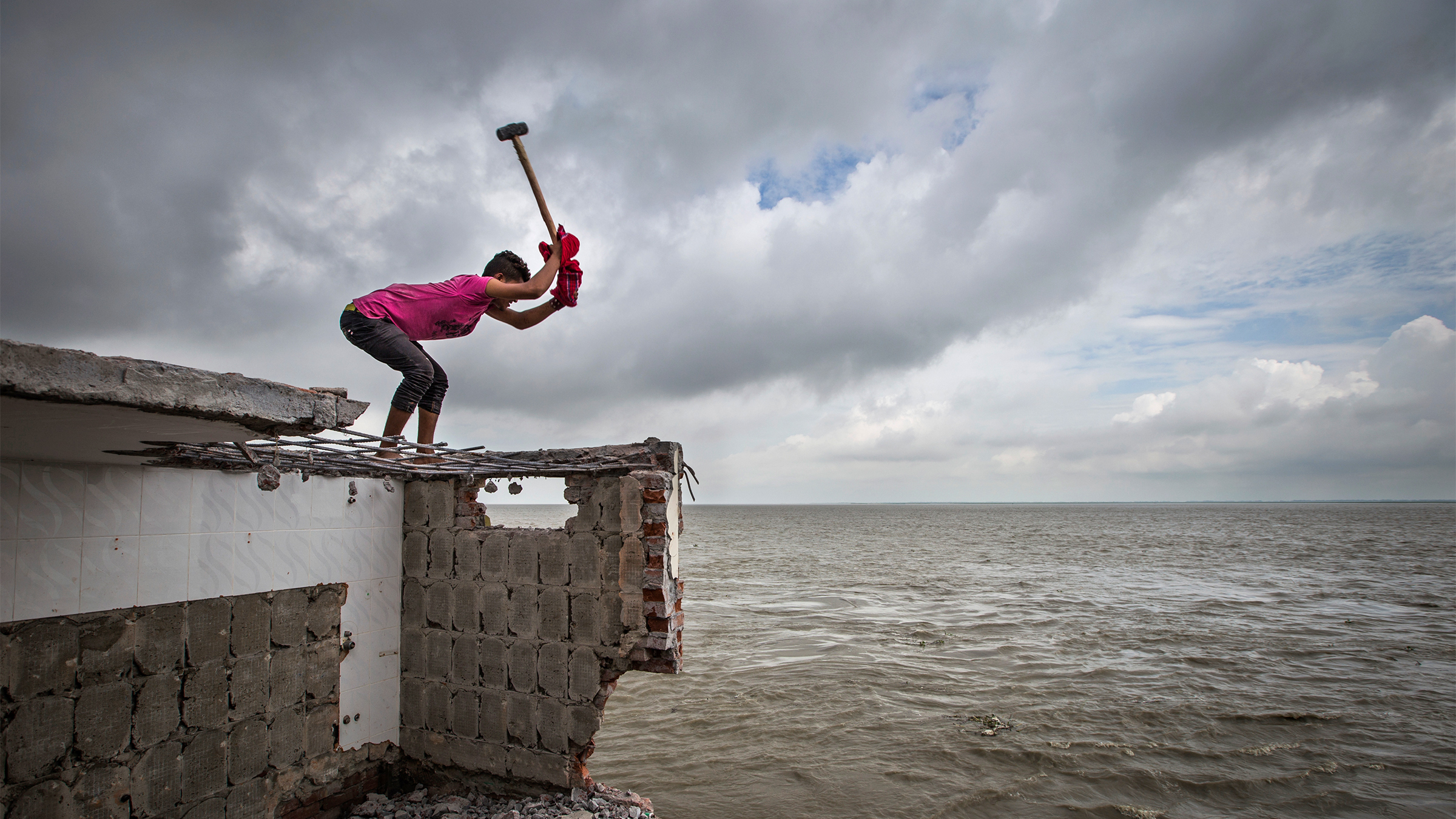
Banner image: In Shariatpur district, Billal Hossain breaks his house and collects the bricks to move to another place to settle following floods, 2018. Image by Moniruzzaman Sazal / Climate Visuals Countdown.
Studies link stronger dengue outbreak in Bangladesh to climate change
Citation:
Hoque, M. Z., Nath, P. K., Hossain, F., & Kallal, K. R. I. (2025). A study on climate-resilient construction in Bangladesh: Building a safer future. International Journal of Creative Research Thoughts, 13(12), g599–g608. Retrieved from: http://www.ijcrt.org/papers/IJCRT2512739.pdf
Feedback: Use this form to send a message to the author of this post. If you want to post a public comment, you can do that at the bottom of the page.
