
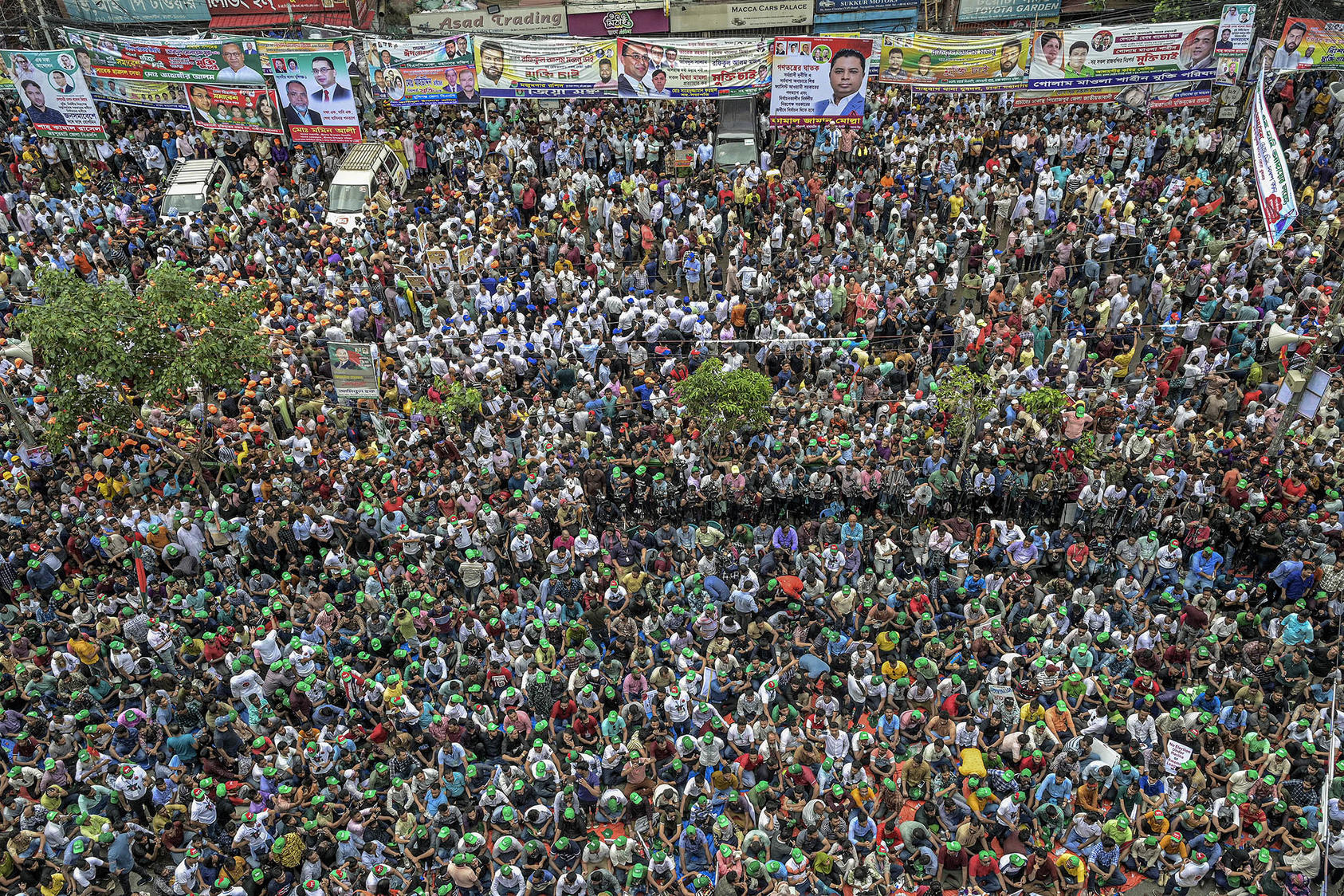
Unpacking the October 28th Street Protests and Their Aftermath
On October 28, Bangladesh’s primary opposition party, the Bangladesh Nationalist Party (BNP), called a “grand rally” in pursuit of its “one-point demand” of nonpartisan election administration. With elections fast approaching, the rally — which Jamaat-i-Islami and other political parties joined — was widely viewed as the opposition’s last stand against the ruling Awami League (AL), prompting the AL to call a “peace rally” for the same day to showcase its own popular support.
With all political competitors in the streets, violence erupted between the police and AL supporters on one side and BNP activists on the other. Each side has contested what sparked the day-long street battle. But regardless of the trigger, first-hand accounts, photos and video footage implicate both sides in violence. Police were seen assaulting unarmed citizens and firing indiscriminately into crowds. Meanwhile, mobs of opposition supporters beat a police officer to death and badly injured several others, set fire to a police hospital, attacked the supreme court chief justice’s house, and assaulted journalists.
The BNP has claimed, with some corroboration, that its supporters’ violence was either deliberately provoked or part of government sabotage to defame the protest. But its role in violence and property destruction cannot be credibly denied. In response, the AL government has arrested thousands of BNP members and supporters, including the party’s secretary general and dozens of other leaders. The AL argues that the BNP’s political violence cannot go unpunished — while the opposition and rights groups claim the anti-government movement is being unjustly dismantled under the guise of law and order.
Since its foiled rally, the opposition has escalated its tactics, shifting from public demonstrations to calls for nationwide strikes and blockades to paralyze transportation and commerce across the country. During the first two weeks of opposition-led blockades, at least 100 vehicles were set ablaze. The BNP is again pushing evidence of government connivance in this violence, but its supporters are implicated in many instances. The government claims the blockade and accompanying violence, which have left many previously bustling public spaces desolate, have cost the economy billions.
International Entanglement
International actors have become increasingly entangled in Bangladesh’s tumultuous domestic politics. Over the past two years, the United States, European Union and other primarily Western governments have — while maintaining political neutrality — pushed for improvements to Bangladesh’s democratic processes. The opposition has embraced this outside pressure: The BNP has consistently praised U.S. policies and statements promoting democracy, with one BNP leader calling the U.S. ambassador the party’s savior. The BNP has also cited the European Union’s decision to abandon a full-scale election observation as validation of its own election boycott, claiming the EU decision shows Bangladesh’s political environment is not conducive to fair elections. After the violent confrontation on October 28, a senior BNP official said that the Bangladesh government will be answerable to Western governments if Sheikh Hasina fails to resign.
On the other side, India and China are bolstering the status quo. While India has also called for credible elections in Bangladesh, it has long held concerns about U.S. policy and recently reiterated that the upcoming elections are Bangladesh’s “internal matter.” Under pressure from the West, the AL has welcomed this diplomatic support from Delhi, while at times lashing out against its critics. China, which previously criticized American “interference” in Bangladesh, recently said the elections should follow Bangladesh’s constitution, a statement which the BNP condemned for echoing the AL’s election stance.
Western embassies, international nongovernmental organizations and domestic actors have called for dialogue to solve Bangladesh’s political stalemate. The AL has, at times, been open to dialogue, but the party foreclosed this option after the election calendar was announced on November 7. Meanwhile, the BNP has been notably silent on dialogue.
Even if both sides agreed to sit and negotiate, reaching a consensus would be difficult. The BNP is wedded to its maximalist position — citing documented flaws in the 2014 and 2018 national polls and recent byelections — while the AL insists the election commission is independent and will not countenance the return of the caretaker system it scrapped in 2011 after a controversial supreme court decision.
Where do Bangladesh’s politics go from here?
Although the BNP is publicly committed to nonviolence, its strategy of election boycott and street blockades to unseat the ruling party has forced a confrontation with the state that has inevitably turned violent. Bangladesh’s current cycle of blockades, street violence and heavy-handed police reprisal echoes a long history during election periods. With parliamentary elections scheduled, the BNP has called for continued strikes to cancel the polls, but the AL has shown no indication of reducing its pressure on the opposition.
Bangladesh’s political tradition of confrontational street politics is ascendant. In this setting, both sides are incentivized to tactically deploy violence to demonstrate their strength to citizens trying to judge which party will triumph in the country’s clientelist politics. Political accommodation is needed to shift Bangladesh’s zero-sum politics to positive sum. But if compromise — rather than violence — is viewed as an existential political threat, then Bangladesh is headed for an election that will only perpetuate its current political crisis.