
Close Menu
  • Home
  • Editorial
  • Politics
  • Economic
  • Sports
  • Religion
  • Contact us
  • About Us
Donate
Hand picked for you
  • Corruption Control in Bangladesh | Governance Reform: Anti-Corruption Strategies for the BNP
  • What does Bangladesh’s new government need to do to revitalize democracy?
  • Bangladesh Nationalist Party claims victory in country’s first election since 2024 uprising
  • BBCTwo protests, two elections: How Nepal's Gen Z succeeded where Bangladesh's stumbledBut nearly two years on, Bangladesh's youth movement has yet to gain any meaningful political power. In the country's first post-protest….3 weeks ago
  • Is Bangladesh killing reforms introduced after student-led protests? | Politics News

Subscribe to Updates

Get the latest news from raznitee.

Reach out to us
  • Facebook
  • Twitter
  • Pinterest
  • Instagram
  • YouTube
  • WhatsApp
Facebook X (Twitter) Instagram
raznitee
Contact us
  • Home
  • Editorial
  • Politics
  • Economic
  • Sports
  • Religion
  • Contact us
  • About Us
raznitee
Facebook X (Twitter) Instagram
Contact us
Home»Environment»Findings from Mozambique and Bangladesh: Climate change impacts reproductive health
Environment

Findings from Mozambique and Bangladesh: Climate change impacts reproductive health

August 25, 2024No Comments2 Mins Read
Facebook Twitter Pinterest LinkedIn Tumblr Email
6711 A Bangladeshclimatenurbanu.jpg
Share
Facebook Twitter LinkedIn Pinterest Email

In Mozambique, interview participants explained that women tend to be the ones primarily responsible for farming and food production. As a result, they are disproportionately impacted by devastation to the agricultural sector. The most fertile farmland also tends to be in the highest-risk areas for extreme weather, called “risk zones.” Resettlement neighborhoods set up by the government are in “safe zones” not ideal for farming, with few alternative economic opportunities nearby. Resettlement neighborhoods are primarily inhabited by women and children, while men commonly migrate to cities or neighboring countries in search of work.

As a result, many women and their children in the communities we studied in Mozambique lead an unstable, semi-nomadic lifestyle, frequently migrating between their farmland and resettlement neighborhoods. Mothers either bring their children with them, which interrupts their education, or else leave them behind at the resettlement centers for extended periods of time. Some women have decided to remain permanently on their farms in risk zones to avoid constant migration.

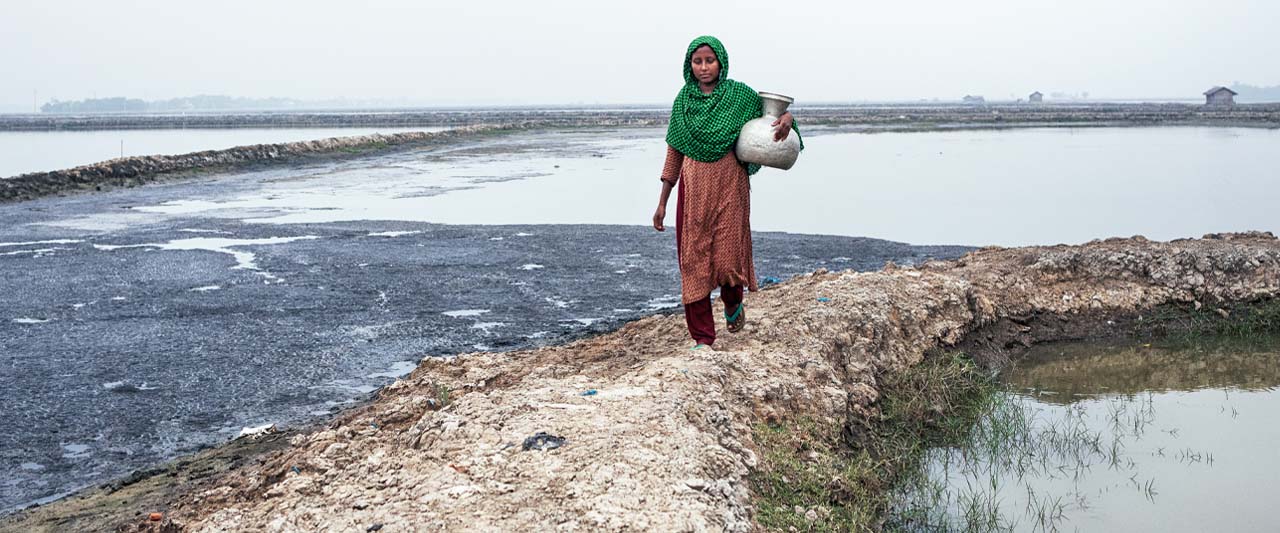
In Bangladesh, a central theme interview participants identified was that women lack opportunities for paid work outside of the home due to cultural norms around their role as caregivers and household workers. Climate-induced migration leaves many women to care for their families alone. Women who become heads of household in this way—in addition to unmarried, widowed, or divorced women—are particularly vulnerable to violence and poverty. They described resorting to jobs that put their reproductive health at risk—such as fishing waist-deep in polluted waters and transactional sex—to feed their children and save money for future disasters.

Share. Facebook Twitter Pinterest LinkedIn Tumblr Email

Related Posts

Climate-resilient housing models slow to gain ground in disaster-prone Bangladesh

April 6, 2026

ADB country director meets Mintoo to boost climate finance cooperation

April 6, 2026

Zero tolerance for corruption in water development board: State minister

April 6, 2026

India’s Role Seen As Vital To Bolster Bangladesh-Nepal Economic Ties

April 6, 2026
Add A Comment
Leave A Reply Cancel Reply

Subscribe to Updates

Get the latest news from raznitee.

We are social
  • Facebook
  • Twitter
  • Pinterest
  • Instagram
  • YouTube
  • WhatsApp
Latest Posts

Corruption Control in Bangladesh | Governance Reform: Anti-Corruption Strategies for the BNP

April 29, 2026

What does Bangladesh’s new government need to do to revitalize democracy?

April 29, 2026

Bangladesh Nationalist Party claims victory in country’s first election since 2024 uprising

April 26, 2026
Follow us on social media
  • Facebook
  • Twitter
  • Pinterest
  • Instagram
  • YouTube
  • WhatsApp
Categories
  • Corruption (413)
  • Culture & Society (114)
  • Economic (1,916)
  • Environment (1,320)
  • Foreign Relations (359)
  • Health & Education (70)
  • Human Rights (5)
  • Politics (2,179)
  • Uncategorized (2)
Facebook X (Twitter) Instagram Pinterest Vimeo YouTube
  • About Us
  • Contact us
  • Disclaimer
  • Privacy policy
© 2026 Designed by raznitee.com

Type above and press Enter to search. Press Esc to cancel.