
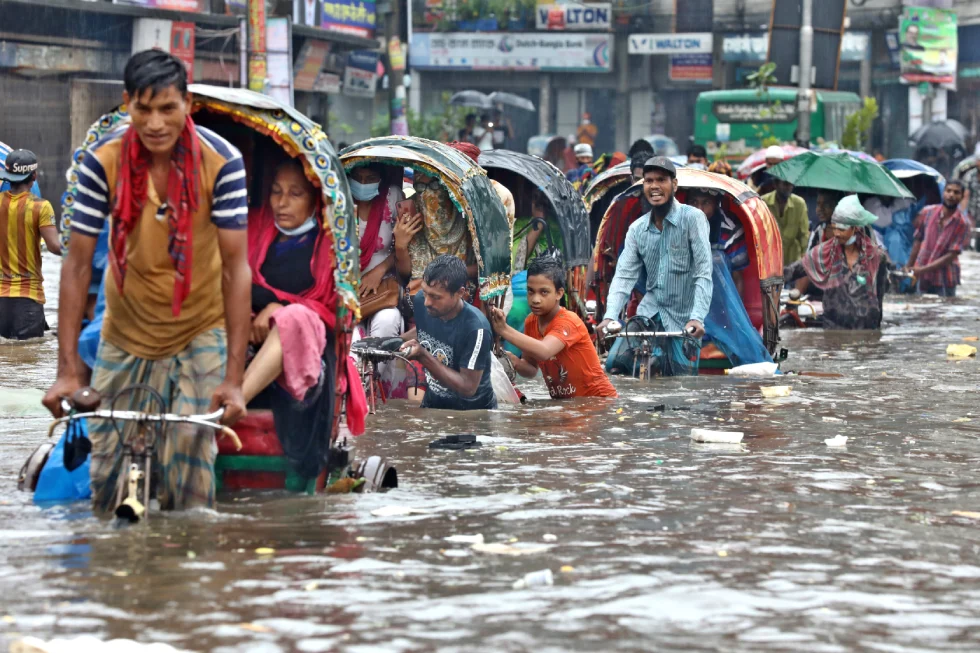
Bangladesh has emerged as the leading voice of climate change activism in the Global South in recent years. The country has shown resilience, determination and an unapologetic stance in the pursuit of climate justice.
As a low-lying, densely populated country, Bangladesh finds itself on the frontline of climate change impacts, grappling with rising sea levels, extreme weather events, and the displacement of vulnerable communities. Currently, the country is reeling from extreme flooding which has displaced half a million people and killed at least 23.
Despite contributing minimally to the carbon emissions responsible for these changes, Bangladesh still holds the developed world accountable for its part in accelerating climate change. However, Bangladesh also must fight to bring the Global South into climate action. The advocacy Bangladesh demonstrates for climate action and justice must remain at the forefront of the global stage.
Bangladesh fights for climate justice within its own borders
Bangladesh, often described as one of the most climate-vulnerable countries, has been dealing with the severe consequences of climate change for decades. Geography and socio-economic conditions make it uniquely susceptible to the impacts of global warming. Rising sea levels pose an existential threat to coastal communities, and extreme weather events such as cyclones and floods disrupt livelihoods. According to the World Bank’s Country and Climate Development Report, tropical cyclones cost Bangladesh about $1 billion annually on average. The country could see as many as 13.3 million people displaced by 2050 due to climate change. Its GDP could fall by as much as 9% in case of severe flooding.
In the face of these challenges, Bangladesh displays an action-centered attitude in dealing with climate change. The World Bank calls it “the emerging hot spot” where climate threats and action meet. Its initiatives have resulted in impressive climate adaptation ventures, including the construction of the world’s largest multi-storied social housing project in Coxs Bazar, which will rehabilitate 4,400 families displaced by climate change. In mitigation, Bangladesh has become one of the world leaders in Solar House Systems, with 6 million households using solar photovoltaic systems.
Bangladesh has not stopped at the social level. It has also worked towards boosting economic action to mitigate climate damage. Bangladesh was one of the first developing countries to establish a coordinated action plan in 2009. Till now, its climate policy deck includes the Bangladesh Climate Change Trust Act, the Delta Plan 2100, and the Mujib Climate Prosperity Plan. Each policy focuses on directing funds towards the prevention of climate damage.
The country has also set up a Climate Change Trust Fund, the first of its kind, allocating $300 million from domestic resources between 2009 and 2012. In 2014, the country adopted the Climate Fiscal Framework to create climate-inclusive public financial management. Bangladesh also introduced a National Sustainable Development Strategy to align economic development with climate priorities further. Bangladesh put forward a target to generate 5% of its electricity from renewable energy sources by 2015 and 10% by 2020.
However, Bangladesh has failed to meet either of these targets. It continues to generate most of its electricity from fossil fuels. The reliance on natural gas and coal puts Bangladesh at risk of power crises. This should not, however, be a sign of lax climate advocacy. Bangladesh continues to fight for justice both within its borders and on the regional stage.
The regional stage must join Bangladesh in advocating for climate justice
Pursuing climate justice also includes Bangladesh’s proactive advocacy of raising awareness about the disproportionate impact of climate change on vulnerable nations. In the latest Munich security conference, this issue of regional disparities in renewable energy investment was discussed broadly. Till now, the funding discrimination in the Global South is glaring—mostly circulating in China and some high- and middle-income economies, with India and Indonesia gaining recent attention due to the steep rise in emissions. But poorer nations in the south are still largely off the radar.
During the pandemic, Bangladesh launched the South Asian regional office for the Global Center on Adaptation (GCA) in Dhaka in September 2020. The GCA Bangladesh office will promote indigenous nature-based sustainable solutions and innovative adaptation measures with the regional countries.
In December 2022, Bangladesh even became a party to the case by an international organization of small island states, known as the Commission of Small Island States (COSIS). COSIS sought an advisory opinion, the first request of its kind, on the states’ obligations regarding climate change at ICJ. Bangladesh submitted a written statement explaining the need for international law regarding climate change.
The failure of advanced economies, the major contributors to climate change, to mobilize investments in renewables for low-income countries is a critical discussion that must be kept alive for opportunities for global green growth. While Bangladesh should continue to be a vocal party to this conversation regarding other low-income countries, it too must advocate for itself. Its measures are not adequate to deal with its climate urgencies forever, especially considering the pressure of financing climate actions on its emerging economy. The country could require an estimated $26.5 billion to meet its goal of generating 40% of electricity from renewables by 2041.
Bangladesh must be vigilant in securing climate finance and technology from the public and private sectors at future COPs, or it risks losing decades of economic gains to climate change during the crucial period of its development. Thus the country has emerged as a vocal proponent for the need for collective global responsibility in addressing climate change.
The Global South cannot face climate change alone
The hallmark of Bangladesh’s climate awareness and advocacy is that it has played a crucial role in shaping the discourse around loss and damage at international climate negotiations. Bangladesh has consistently called for developed nations to take decisive actions in reducing their carbon footprints.
Bangladesh calls for such nations to provide financial and technological support to developing countries. The failure of advanced economies, the major contributors to climate change, to mobilize investments in renewables for low-income countries is a critical discussion that must be kept alive for opportunities for global green growth.
Bangladesh has been a member of essential bodies set up by the United Nations Framework Convention on Climate Change (UNFCCC) over the years, such as the Adaptation Fund Board and the Green Climate Fund Board. It also plays a significant role in international climate diplomacy, having organized and led the Least Developed Countries negotiating bloc in the United Nations Framework Convention on Climate Change (UNFCCC) negotiations since the bloc’s inception. The country’s advocacy has contributed to establishing the Warsaw International Mechanism for Loss and Damage, which promotes dialogue around climate change effects. Bangladesh’s global advocacy signals a step forward in recognizing and addressing the impacts beyond action.
The burden of climate change disproportionately falls on those who have contributed the least to its causes. Recognizing the challenges the Global South faces is crucial for fostering a fair and inclusive response to the climate crisis. The COP28 Loss and Damage Fund has been the right direction to take in this regard. The global community must acknowledge and support the efforts of nations like Bangladesh to pursue climate justice. Climate justice is not a charity but a shared responsibility for a more equitable and sustainable future for all.
The views expressed in this article are the author’s own and do not necessarily reflect Fair Observer’s editorial policy.