
By Oritro Karim
UNITED NATIONS, Sep 6 2024 (IPS) – Since late August, severe flash floods and monsoons plaguing Bangladesh have affected nearly 6 million people. Bangladeshi officials have declared the floods to be the country’s worst climate disaster in recent memory. These recent floods follow the wake of Cyclone Remal, which devastated Bangladesh and West Bengal earlier this year.
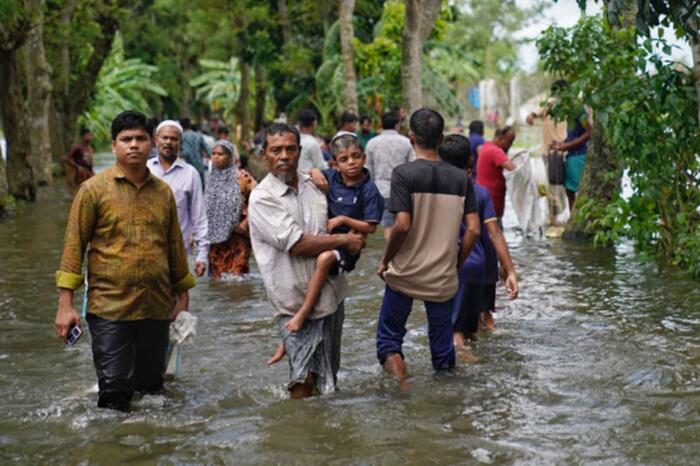
Floods have caused widespread destruction in Bangladesh, with the Feni, Cumilla, Laxipur, Chattogram, and Noakhali districts among those hit hardest. The United Nations Children’s Fund (UNICEF) has stated that 71 people have been reported dead. The floods have decimated villages, with thousands of homes having been destroyed or submerged underwater, causing widespread internal displacement.
“So far, a reported 500,000 people have been displaced in more than 3,400 evacuation shelters”, Stéphane Dujarric, Spokesman for the UN Secretary-General, said during a press briefing held on September 4 at the headquarters in New York.
“We, along with our humanitarian partners, are mobilized and supporting the government-led flood response,” Dujarric said. “We are also helping with local efforts to help the most vulnerable people and communities impacted by these floods.”
Displacement shelters in Bangladesh have become overcrowded due to the sheer amount of civilians that were displaced from their communities. According to an August 30 report from the United Nations Inter-Cluster Coordination Group (ICCG), this has heightened protection concerns for affected women and girls.
Floods have also damaged critical infrastructure in Bangladesh, greatly impeding relief efforts by humanitarian organizations. Farah Kabir, Country Director of ActionAid Bangladesh stated “The disruption of roads and communication has further escalated their plight, making it difficult for them to reach safety and essential resources. The UN reports that certain areas are entirely inaccessible to aid workers due to the extent of the high water levels.
According to the ICCG report, in Noakhali, approximately 50 percent of the flood-affected areas are considered “unreachable” by local authorities and aid personnel. The floods have also caused significant power outages, aggravating these challenges in accessibility.
This has taken a significant toll on nationwide education. Floods have ravaged educational facilities across the nation and have made countless roads and passages inaccessible, making schooling for children extremely difficult. According to Dujarric, over 7000 schools are now closed due to flooding, which has impacted 1.7 million children and young people.
Water sanitation systems have been severely compromised with the swelling of dirty water filling the streets. Without access to emergency medical supplies, the risk of contracting waterborne diseases has risen significantly.
Kabir added, “The collapse of the sanitation system in many areas has heightened the public health crisis”.
Last week, In one instance last week, Bangladesh’s Directorate of General Health Services (Dte. GHS) reported that over a period of 24 hours since the flooding began, 5000 people had been hospitalized, reporting cases of diarrhea, skin infections and snake bites. UNICEF is currently on the frontlines of this disaster, distributing 3.6 million water purification tablets to prevent the spread of illnesses.
Additionally, the livelihoods of millions have been impacted by the floods. Agriculture, specifically, has been hit the hardest. According to Bangladesh’s agriculture ministry, the floods have resulted in a loss of 282 million US dollars due to crop damage, impacting over 1.3 million farmers. This is significantly detrimental as the agricultural sector employs roughly 42 percent of Bangladesh’s workforce.
Dujarric added that the floods have caused 156 million US dollars worth of losses in livestock and fisheries. This has devastated Bangladesh’s economy as well as greatly exacerbated levels of food insecurity nationwide.
“With supplies disrupted, thousands of families are still stranded in shelters without any food,” said Simone Parchment, the World Food Programme (WFP) Representative in Bangladesh, in a press release issued on August 30. “Our focus is on delivering emergency assistance to the people who have been displaced and lack the means to cook for themselves.”
Hundreds of thousands of people are facing risks of starvation and malnutrition as aid workers scramble to distribute dry food to shelters. WFP is currently in the process of delivering fortified biscuits to 60,000 families in areas that have been hit the hardest.
The UN’s Acting Relief Emergency Coordinator, Joyce Msuya, has allocated 4 million dollars from the UN’s Central Emergency Response Fund (CERF). In addition, UNICEF is on the frontlines of this disaster, providing over 338,000 people with live-saving supplies. However, current efforts are not enough to mitigate this disaster. UNICEF has requested over 35 million dollars from donors in order to provide all families affected with medical assistance.
It is also imperative to tackle the climate crisis, as Bangladesh is one of the world’s most climate-sensitive nations. A 2015 report by the World Bank Institute stated that approximately 3.5 million people in Bangladesh are affected by annual river flooding, an issue that is only worsened by the climate crisis.
Deputy Representative of UNICEF Bangladesh Emma Brigham remarked that the devastation caused by the floods in the eastern regions of Bangladesh are “a tragic reminder of the relentless impact of extreme weather events and the climate crisis”, particularly for children. “Far too many children have lost loved ones, their homes, schools, and now are completely destitute,” she said.
IPS UN Bureau Report