
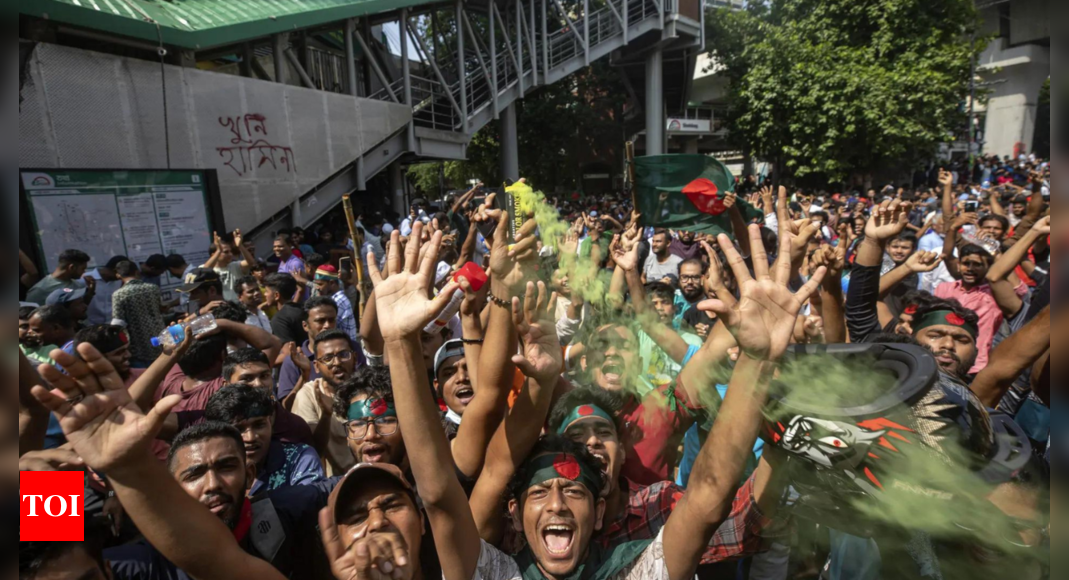
Students’ peaceful protests against the government job quota system in Bangladesh escalated into widespread unrest, eventually leading to Prime Minister Sheikh Hasina‘s resignation and escape by helicopter. After nearly 300 deaths during violent clashes, the military and opposition leaders are discussing forming an interim government to organize new elections.
The upheaval ended Hasina’s 15-year tenure, marked by violent protests that saw nearly 300 fatalities, according to local media.Protests continued to escalate despite government efforts to impose curfews, internet outages, and aggressive crackdowns, fueling more discontent. On Monday, amid calls for change, protesters defied a military curfew and marched into the capital’s centre.
Following a weekend of violence, troops pulled back, and internet access was restored. Tens of thousands of people celebrated in the streets, with many storming the official residence of the Prime Minister. In the immediate aftermath, the military chief announced that the army would consult with President Mohammed Shahabuddin to appoint an interim government and dissolve Parliament for fresh elections.
President Shahabuddin met with Gen Waker-uz-Zamam and opposition politicians, stating that Parliament would be disbanded as soon as possible to pave the way for new elections. Student leaders suggested that Nobel Peace Prize laureate Muhammad Yunus head the interim government.
Nahid Islam, a key student leader, posted a video on social media expressing that Yunus had agreed to lead the interim government given the current state of the country. Yunus, who had faced corruption accusations during Hasina’s rule, stated that the charges were an act of vengeance.
“Keep faith in the military, we will investigate all the killings and punish the responsible,” Gen. Waker-uz-Zaman assured. “I have ordered that no army and police will indulge in any kind of firing.” He appealed for patience as the new government takes form.
“Now, the students’ duty is to stay calm and help us,” he added.
The protests initially focused on a controversial quota system allocating 30% of government jobs to family members of veterans from Bangladesh’s 1971 war of independence against Pakistan. Protesters claimed this system was discriminatory and favoured supporters of Hasina’s Awami League party, leading the independence movement.
Economic distress, including falling exports and low foreign exchange reserves, exacerbated frustrations. Young graduates faced a scarcity of quality jobs, driving them to seek stable and lucrative government positions. The Supreme Court ruled last month to reduce the veterans’ job quota to 5%, allocating 93% of jobs on merit and the remaining 2% to ethnic minorities and transgender and disabled individuals.
The government accepted the court’s decision and restored internet access, hoping to pacify the situation. However, the protests intensified, with demands for investigations into the deadly government crackdowns and, ultimately, the resignation of Hasina and her cabinet.
As the situation unfolds, the country is now set for a transitional phase, with the military emphasising a thorough investigation into the violent incidents. The aim is to restore order and lay the groundwork for democratic elections, reflecting the significant public outcry for change and accountability.
The upheaval ended Hasina’s 15-year tenure, marked by violent protests that saw nearly 300 fatalities, according to local media.Protests continued to escalate despite government efforts to impose curfews, internet outages, and aggressive crackdowns, fueling more discontent. On Monday, amid calls for change, protesters defied a military curfew and marched into the capital’s centre.
Following a weekend of violence, troops pulled back, and internet access was restored. Tens of thousands of people celebrated in the streets, with many storming the official residence of the Prime Minister. In the immediate aftermath, the military chief announced that the army would consult with President Mohammed Shahabuddin to appoint an interim government and dissolve Parliament for fresh elections.
President Shahabuddin met with Gen Waker-uz-Zamam and opposition politicians, stating that Parliament would be disbanded as soon as possible to pave the way for new elections. Student leaders suggested that Nobel Peace Prize laureate Muhammad Yunus head the interim government.
Nahid Islam, a key student leader, posted a video on social media expressing that Yunus had agreed to lead the interim government given the current state of the country. Yunus, who had faced corruption accusations during Hasina’s rule, stated that the charges were an act of vengeance.
“Keep faith in the military, we will investigate all the killings and punish the responsible,” Gen. Waker-uz-Zaman assured. “I have ordered that no army and police will indulge in any kind of firing.” He appealed for patience as the new government takes form.
“Now, the students’ duty is to stay calm and help us,” he added.
The protests initially focused on a controversial quota system allocating 30% of government jobs to family members of veterans from Bangladesh’s 1971 war of independence against Pakistan. Protesters claimed this system was discriminatory and favoured supporters of Hasina’s Awami League party, leading the independence movement.
Economic distress, including falling exports and low foreign exchange reserves, exacerbated frustrations. Young graduates faced a scarcity of quality jobs, driving them to seek stable and lucrative government positions. The Supreme Court ruled last month to reduce the veterans’ job quota to 5%, allocating 93% of jobs on merit and the remaining 2% to ethnic minorities and transgender and disabled individuals.
The government accepted the court’s decision and restored internet access, hoping to pacify the situation. However, the protests intensified, with demands for investigations into the deadly government crackdowns and, ultimately, the resignation of Hasina and her cabinet.
As the situation unfolds, the country is now set for a transitional phase, with the military emphasising a thorough investigation into the violent incidents. The aim is to restore order and lay the groundwork for democratic elections, reflecting the significant public outcry for change and accountability.