
- Data Bangladesh generates around 87,000 tons of single-use plastics annually, of which 96% are directly discarded as garbage.
- Lack of awareness has led to the collection of plastic waste all over the cities, especially near rivers or lakes, where they mix with water and soil, affecting ecosystems and food chains.
- The current government in the country is implementing the existing law by banning single-use plastic, which started on Oct. 1.
The newly formed government in Bangladesh is about to implement the existing law regarding plastic usage by strictly banning — initially — single-use plastic and, gradually, all possible plastic uses.
Civil society members formed the current non-political government on Aug. 8, 2024, after former Prime Minister Sheikh Hasina and her cabinet left the country on Aug. 05 following mass protests against the government’s various acts of misconduct.
Syeda Rizwana Hasan, the newly appointed advisor for the environment, forest and climate change ministry, told Mongabay, “As the first step, we are banning the use of polythene-made bags for grocery use and, gradually, we will implement all possible usage.”
“We have had a law since 2002 to stop the use of plastics. However, it has never been implemented. The current government decided to implement the act to save our environment and ecology,” she added.
According to Section 6A of Bangladesh Environment Conservation Act, 2002 (Amended), the ministry of environment, forest and climate change (MoEFCC) has the authority to control the production and use of polythene-made products, including single-use plastic bags and water bottles.
The act permits the authority to impose monetary fines or imprisonment on the violators.
As part of implementing the law, single-use plastic bags for grocery purposes were prohibited from Oct. 1. Meanwhile, all government offices have stopped using single-use plastic water bottles. Instead, the government suggests using glassware or other forms of reusable materials.
Additionally, on Aug. 28, the government issued a circular mentioning 17 plastic-made materials as single-use plastic, which will be phased out gradually.
On another note, the government’s department of environment (DoE) says it will conduct enforcement activities against using single-use plastic bags by seizing the products and shutting down the production across the country from Nov. 1.
A study showed that the country generates around 87,000 tons of single-use plastics annually, of which 96% are discarded as garbage.
Solid Waste Management Rules, 2021, and the Mandatory Jute Packaging Act, 2010, are the two legal instruments for managing used plastic through recycling and curbing the use of plastic-made products by introducing biodegradable alternatives. In 2021, the High Court issued an order to phase out the use of single-use plastic, considering its negative impacts on the environment and ecology.
However, none worked adequately; instead, the permeation of plastic in the environment reached a point where researchers found microplastic in the fish from the country’s rivers and canals and also in agricultural production, affecting food chains.

Promoting alternatives
The Mandatory Jute Packaging Act, a law that Bangladesh formulated in 2010 to curb the use of plastic bags for packaging, directs the use of biodegradable jute sacks for 19 commodities, including paddy, rice, wheat, fertilizer and sugar. However, despite substantial monetary fines and imprisonment for violating the law, it has remained dormant due to a lack of monitoring and available jute packs against the demand.
Citing the statistics of the Food and Agriculture Organization (FAO), the investment promotion agency Bangladesh Investment Development Authority says the country is the second largest jute producer in the world, amounting to 1.6 million tons annually.
In 2017, Bangladesh Jute Mills Corporation (BJMC) showcased jute-made biodegradable bags, an alternative to single-use polythene shopping bags. The government has directed the related agencies to invest in producing the bags to adjust market demand with the jute ones.
According to a study, the country’s per capita plastic consumption in urban areas was 9 kilograms (20 pounds) in 2020, compared to 3 kg (6.6 lbs) in 2005. Of these, the capital city of Dhaka, one of the world’s most populated cities, with a population of 165 million in 2022, produced the most at 24 kg (53 lbs).
Though no study on the exact figure is available at this moment, Abdullah Al Mamun, deputy director of DoE, said, “I assume that around 30% of them are single-use polythene bags used for grocery purposes.”
He added that the rate of such plastic use can be reduced “if we can arrange for alternatives made from jute and other biodegradable materials to be available on time.”
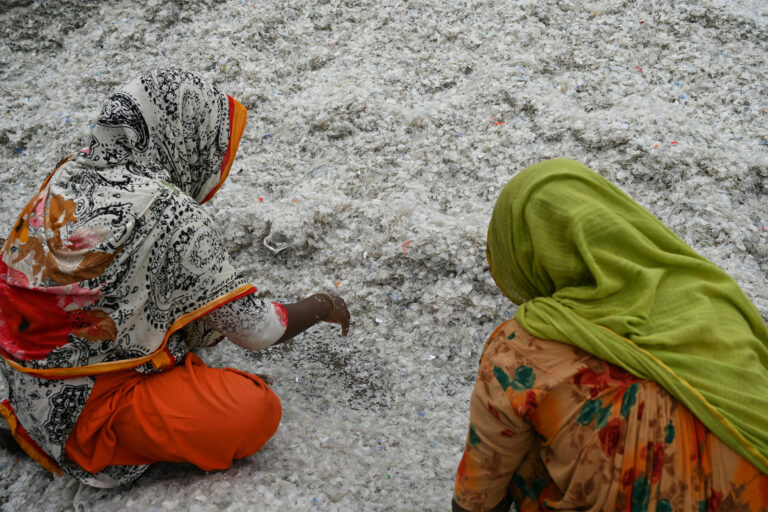
Banner image: Two workers sift through plastic waste collected for recycling. Image by Mumtahina Tanni via Pexels (Public domain).
In Bangladesh, microplastic threat to frogs is also concern for rice farming
In the battle against plastic pollution, Asia’s informal workers are critical allies (commentary)
Citation:
Mim, F. I., Md. J., & Abdullah, M. S. (2024). Plastic tsunami: Bangladesh’s maritime ecosystem under siege. Environmental Forensics, 1-3. doi:10.1080/15275922.2024.2330026
