
- Since 1999, Bangladesh has declared 13 biodiversity-rich areas as Ecologically Critical Areas (ECA) under the country’s environment protection act.
- However, the government has failed to conserve the ECAs over the years other than a few project-based protection measures undertaken in some of the areas like Saint Martin’s Island, Tanguar Haor, Hakaluki Haor, Cox’s Bazar Beach and Sonadia Island.
- Now, the current civil society-led government plans to limit tourism in biodiversity hotspots to ensure the health of the ecosystem.
- The coral-rich Saint Martin’s Island and one of the country’s largest wetlands, Tanguar Haor, will see the first through tourism restrictions.
In a bid to protect biodiversity hotspots in the country, Bangladesh plans to restrict tourism and introduce environment-friendly guidelines and directions for tourists visiting the Ecologically Critical Areas (ECAs).
The coral reef-rich Saint Martin’s Island and one of the largest haors — a type of wetland ecosystem — in the country, Tanguar Haor, known to be a habitat for breeding fish and waterfowls, will soon see the first restrictions on tourism.
Syeda Rizwana Hasan, the newly appointed advisor for the environment, forest and climate change ministry, said, “Initially, we will impose restrictions on night stays at Saint Martin’s Island to reduce the pressure on the island soon. Gradually, we will increase the level of restrictions as well as the number of ECAs under tourism restrictions.”
She added that some of these restrictions would include banning the use of single-use plastic, minimizing the number of visitors and banning all kinds of tourism during the breeding season of the region’s wildlife.
“After implementing the tourism restrictions on the coral-rich island, we will focus on Tanguar Haor,” she said, adding that the government is working with different stakeholders, including tour operators and local communities, to find a sustainable way to protect these ecologically important areas.
Since 1999, Bangladesh has declared 13 biodiversity-rich areas as ECAs under the Environment Protection Act, 1995. According to the ECA rules, any development work and other activities like tourism that threaten biodiversity and ecology are strictly prohibited in the ECAs.
However, the former governments had failed to conserve the ECAs over the years, though some protection measures have been put in place in Saint Martin’s Island, Tanguar Haor, Hakaluki Haor, Cox’s Bazar Beach, the Sundarbans and Sonadia Island through different projects.
The new non-political government, formed by civil society members in August following the collapse of former Prime Minister Sheikh Hasina’s government, plans to implement the ECA rules to protect the biodiversity hotspots.

The importance of Saint Martin Island and Tanguar Haor
Saint Martin’s Island, only about 12 square kilometers (4.6 square miles) in size, is in the Bay of Bengal and is part of the country’s southeastern district, Cox’s Bazar. The government declared the area an ECA in 1999 due to its rich marine biodiversity. In 2022, declared 1,743 km2 (673 mi2) of the Bay of Bengal, including the island, a Marine Protected Area (MPA) under the Bangladesh Wildlife (Conservation and Protection) Act, 2012.
The island is home to about 10,000 people and contains rocky and sandy shores as well as mangroves. The locals rely mainly on fishing, seaweed farming and tourism for their livelihoods.
According to a study by the Bangladesh Oceanographic Research Institute, Saint Martin’s Island is home to 46 different species of corals. Besides being nutrient sources for different aquatic species in the ecosystem, coral reefs also serve as a shield against storms and coastal erosion and create employment opportunities for locals through tourism.
Another study conducted using data between 2005 and 2019 said the number of infrastructure developments on the island, mostly to accommodate tourists, increased by 175%, while the volume of coral reefs decreased by 38%.
Tanguar Haor is located in northeastern Bangladesh and covers an area of 114 km2 (44 mi2). Of this, the core wetland covers 28 km2 (10.8 mi2) and is home to 141 species of freshwater fish. The wetland is one of the two declared Ramsar sites in the country, and it also supports 69 bird species.


Protection of other ECAs
So far, the former governments have declared Saint Martin’s Island, Sonadia Island, the Sundarbans, Cox’s Bazar Beach, Tanguar Haor, Hakaluki Haor, Marjat Baor, Gulshan-Baridhara Lake, the four rivers surrounding Dhaka — Buriganga, Shitalaksha, Turag and Balu — and Piyan River as ECAs.
Meanwhile, the government’s department of environment (DoE), the custodian of the ECA rules, has completed preparatory work to declare another important biodiversity hotspot, Halda River, an ECA to conserve the breeding habitat of the Asian carp fish species.
Apart from these, the only other visible protection measure is seen in the Sundarbans, as the government has imposed a ban on entering the mangroves during the months of June, July and August since 2022, aiming to ensure a safe environment for several wildlife species during the breeding season.
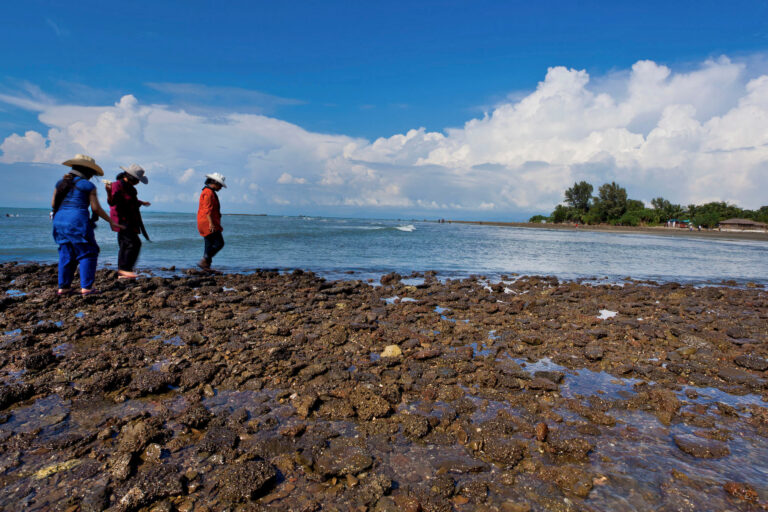
Banner image: Tourists on St. Martin’s Island. Image by Muhammad Mostafigur Rahman.
Bangladesh’s new government implements strong measures to eliminate single-use plastic
Citations:
Ara, S., Alif, M. A. U. J., & Islam, K.M.A. (2021) Impact of Tourism on LULC and LST in a Coastal Island of Bangladesh: A Geospatial Approach on St. Martin’s Island of Bay of Bengal. J Indian Soc Remote Sens 49, 2329–2345. doi:10.1007/s12524-021-01389-4
Das, J., Kabir, M. H., Taimur, F. M., Hossain, M., & Kumar. U. (2022). Evaluating governability challenges of Saint Martin’s Island (SMI) in Bangladesh. World Development Perspectives. Elsevier Vol-27. doi:10.1016/j.wdp.2022.100434
