
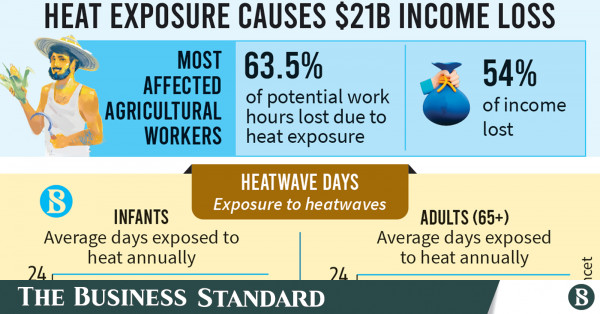
Agricultural workers were particularly impacted, accounting for 63.5% of potential hours lost and 54% of income losses related to extreme heat
Infographic: TBS
“>

Infographic: TBS
- Prevalence of extreme heat on the rise in Bangladesh
- Extreme drought and environmental challenges are common
- Nearly 172m faced sand and dust levels above WHO thresholds in 5 years
- In 2019-2023, 82% of the country had at least one month of extreme drought
- 41% experienced extreme drought for three months or more
- Nearly 25% endured extreme drought for six months or longer
Bangladesh faced significant economic losses due to heat exposure in 2023, with an estimated $21 billion lost in income due to reduced labour capacity, according to a report by The Lancet.
Agricultural workers were particularly impacted, accounting for 63.5% of potential hours lost and 54% of income losses related to extreme heat.
The 2024 report, “Lancet Countdown on Health and Climate Change: Facing Record-Breaking Threats from Delayed Action,” highlights alarming health and environmental risks associated with climate change in Bangladesh.
It underscores the urgent need for redirecting financial resources from fossil fuel investments towards health protection.

In Bangladesh, the prevalence of extreme heat is on the rise, posing increasing risks to public health. The report reveals that from 2014 to 2023, infants experienced an average of 8.6 heatwave days annually, while adults over 65 faced 8.1 days.
In 2023, these figures reached record highs of 20.9 and 20 days per year, respectively. Infants faced 2.3 times more heatwave days compared to 1986-2005, and older adults experienced 5.2 times more during the same period.
The Lancet study also found that people were exposed to moderate or higher heat stress risks for approximately 2,800 hours each year, equivalent to one-third of the year during light outdoor activities.
Air pollution is another critical issue, with 212,000 deaths in 2021 attributed to anthropogenic PM2.5 pollution. PM2.5 describes fine inhalable particles, with diameters that are generally 2.5 micrometres and smaller.
Fossil fuels, particularly coal and liquid gas, contributed to 40.4% of these deaths, with the economic impact of premature mortality from air pollution reaching $52.6 billion. The burning of solid fuels indoors led to approximately 74 deaths per 100,000 people in Bangladesh in 2020.
Climate change is also increasing the suitability for transmission of various infectious diseases, including dengue and malaria. Between 2014 and 2023, climatic conditions in Bangladesh’s lowlands supported malaria transmission for more than half of the year.
Additionally, the population living within 100 kilometres of coastal waters suitable for Vibrio transmission has grown by 32% since 1990-1999, now affecting 44.5 million people.
Extreme drought and environmental challenges are also prevalent in Bangladesh. Over the past five years, nearly 172 million people experienced sand and dust levels exceeding WHO thresholds at least once.
From 2019 to 2023, an average of 82% of the country experienced at least one month of extreme drought, with 41% facing three months and nearly 25% enduring six months or more.
Despite these critical findings, Bangladesh continues to invest heavily in fossil fuel subsidies, totalling a record $26.8 billion in 2022, surpassing carbon revenues. Coal accounted for nearly 5.5% of electricity generation, while low-carbon sources, including renewables, contributed less than 2%.
The report underscores the need for a transition to zero-emission energy sources. Although the proportion of biomass used for household energy declined from 81% in 2000 to 53% in 2021, investment in technology and financing for sustainable energy solutions remains necessary.
Marina Romanello, Executive Director of the Lancet Countdown, highlighted the urgency of the situation, stating, “The ongoing expansion of fossil fuels exacerbates health impacts linked to climate change, threatening to undo the limited progress achieved thus far.”
UN Secretary-General António Guterres has echoed the call for action, stressing the importance of reducing emissions, protecting vulnerable populations from climate extremes, and ending dependence on fossil fuels.