
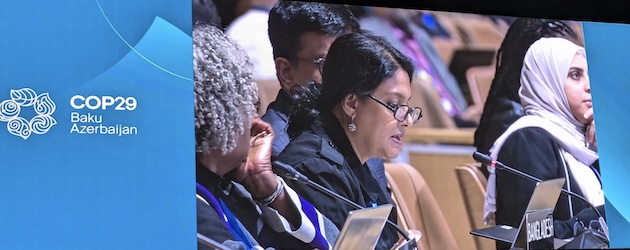

Syeda Rizwana Hasan, an adviser to the interim government of Bangladesh and Minister of Environment, Forest and Climate Change. Credit: X
– Syeda Rizwana Hasan, an adviser to the interim government of Bangladesh and as Minister of Environment, Forestry, and Climate Change, urged the global and regional leaders to prioritize ambitious, evidence-based climate targets in the climate negotiations.
Hasan, in an exclusive interview with IPS at COP29 in Baku, Azerbaijan, speaks in detail about Bangladesh’s efforts to address plastic pollution, empower women in climate action, and foster regional cooperation in South Asia while calling out global gaps in climate ambition.
COP29: Ambition and Disparities
On COP29’s progress, Hasan criticized the widening gap between scientific evidence and global climate action.
“Least developed and vulnerable countries base their demands on science. Yet, major polluters deny this evidence, sticking to exploitative fossil-fuel-based models,” she said.
Hasan also pointed out inconsistencies in proposed solutions. “The draft text on New Collective Quantified Goal (NCQG) funding talks about ‘innovative solutions,’ but why focus on unproven methods like market-based carbon trading when established solutions exist?”
While acknowledging the importance of participating in COP negotiations, Hasan expressed concern that global ambition is regressing.
“The last three years have seen us moving away from desired results. Countries must act on science-based targets to prevent catastrophic outcomes.”
“Maybe five years down the road, what we are saying will be said by the developed countries. Because of what Spain has faced today, if more and more European countries and American states start facing those sorts of calamities, then the stance of the developed countries may change,” she added.
Regional Cooperation in South Asia
Addressing the shared climate challenges in South Asia, Hasan stressed the need for collaboration in disaster management, water sharing, and renewable energy.
“South Asia has vast potential for regional cooperation, but political mistrust hinders progress. We need to move away from a ‘big brother-little brother’ dynamic and establish partnerships based on equality and trust,” Hasan said.
She proposed creating a regional energy grid leveraging Nepal and Bhutan’s hydroelectric potential, reducing reliance on coal and gas. Other areas of collaboration include agriculture, forestry, and transboundary early warning systems.
However, Hasan acknowledged the roadblocks.
“There are good models in South Asia that are being taught even in universities like Oxford. But we South Asian countries are reluctant to take lessons from these good practices. The thing is, you need to first build trust among the South Asian countries. We don’t need a big brother or a big sister in the region. We need friends. When you have a big brother and a small brother, they always fight.”
The Minister added: “A big fish would always like to eat up a small fish. But here we have to prove that we are on equal footing and that we are friends and not brothers and sisters. Once we set that political context and we do that trust-building process among the South Asian countries, I think there is huge potential in both adaptation, mitigation, loss, and damage. We can do early warning for disaster management and minimize the impacts of disasters. We can cooperate in the sector of agriculture.”
Hasan urged the global and regional leaders to prioritize ambitious, evidence-based climate targets. She stressed that countries like Bangladesh, which bear the brunt of climate impacts despite minimal contributions to emissions, need urgent support.
“Bangladesh remains committed to leading by example, from phasing out plastics to empowering women and fostering regional partnerships. But global action must match the scale of the crisis,” Hasan said.
Tackling Plastic Pollution: Reviving The 2002 Ban
Bangladesh made history in 2002 by becoming the first country to impose a ban on the manufacturing, selling, and use of polythene and plastic shopping bags. Yet Hasan acknowledges that enforcing the ban has been inconsistent over the past two decades.
“Between 2004 and 2006, we successfully removed polythene bags from markets,” Hasan explained. “However, enforcement efforts waned after a government change. Over the years, usage has resurged, making it an even bigger challenge today.”
The government is now reinitiating enforcement, starting with regulating plastic bag use in supermalls in Dhaka before expanding to other urban centers and eventually rural areas. Environmental groups are also campaigning in remote parts of the country to support the initiative.
Hasan said that efforts are being made to target polythene shopping bags first, with a broader plan to phase out all single-use plastics. “We aim to develop an action plan to transition from single-use plastics, except for items like ballpoint pens, where alternatives are not yet readily available. This will be implemented over two to three years.”
While concerns about the livelihood impact of such bans arise, Hasan dispelled misconceptions. “Producers of polythene shopping bags also manufacture other plastic products. They can pivot to legal alternatives, and we’re introducing sustainable options like jute and cotton bags in the market,” she said.
Women’s Role in Climate Mitigation
Hasan highlighted the significant yet underappreciated role of Bangladeshi women in climate resilience and sustainable development. She recounted how women-led seed banks became crucial during recent floods, supplying communities and the government with much-needed resources.
“Women in Bangladesh have preserved seed banks for decades. Scaling up this model can create decentralised, community-driven solutions,” Hasan said.
In terms of lifestyle changes and sustainable agriculture, women play a pivotal role. “Mothers transmit values to children, shaping habits like water conservation and reducing waste. Women farmers also prioritize safe, pesticide-free food for their families, making them key drivers of eco-friendly practices,” she said.
Hasan said that the government aims to integrate indigenous women’s knowledge into its policies on nature protection and food security.
Using Public Interest Litigations (PILs) for Climate and Women’s Rights
As a pioneer in using public interest litigations for environmental justice, Hasan discussed the potential of PILs in addressing women’s climate vulnerabilities.
“PILs come into play after setting the right policy and legal framework. For example, water and food security laws must reflect women’s unique needs. If these are ignored, PILs can hold the system accountable,” Hasan said.
She said there is a need for gender-sensitive climate policies to ensure women are protected and empowered in the face of escalating climate impacts.
“You have to first set the policies and the laws in the right direction. And if the policies and the laws are not respected, then you take the PILs.”
IPS UN Bureau Report