
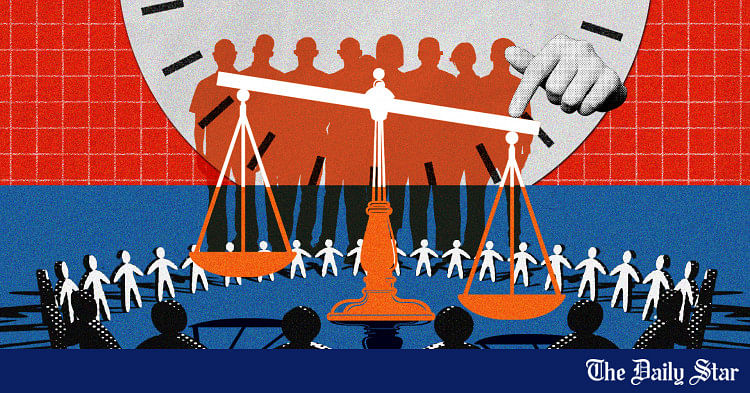
Today, Bangladesh aspires to build a society free from inequalities. This dream is not something new. Over the years, Bangladeshis have often faced discrimination on various fronts. As a result, they have fought during the Pakistan era, taken to streets in different movements and ultimately waged a Liberation War. After the independence of Bangladesh, questions of social justice, equality and equity have repeatedly emerged.
Issues of fundamental human rights violations, the destruction of social justice, and unjust biases remain central to inequalities and discrimination. Inequalities may manifest in economic, political, social-cultural and even in mental arenas. Discrimination occurs at home and outside, within a country, as well as at regional levels and globally. When assessing inequalities, we often focus on outcomes—such as income or wealth inequalities. But in today’s world, inequalities of opportunities—like access to education, health services and information and communication technologies (ICTs)—have become critical factors in overall societal inequalities. In many cases, inequalities in opportunities determine the inequalities in outcomes. Moreover, it is essential to differentiate between “equality” and “equity” in discussions about inequalities. Equality is absolute, while equity is proportional.
 For all latest news, follow The Daily Star’s Google News channel.
 In the economic realm, the existence of income and wealth inequalities is well-known. In fact, no data are necessary to understand such inequalities—a simple walk through the streets of Dhaka reveals these phenomena. At the same time, a look at defaulted bank loans or the cross-border money laundering amounting to thousands of crores of taka clearly indicates that money and wealth in Bangladesh are concentrated in a few hands. An analysis of overall data shows that while the bottom 40 percent of the population in Bangladesh receives 13 percent of the country’s GDP, the top 10 percent enjoys 38 percent.
Such disparities exist across various human development indicators as well. In Bangladesh, the under-five mortality rate among the bottom quintile of the population is 49 per 1,000 live births, while the rate among the top quintile is 25 per 1,000 live births. Similarly, 85 percent of childbirths among the top 20 percent of the population are attended by those trained in giving birth, whereas the comparable figure for the bottom 20 percent is only 32 percent. From a regional perspective, for example, the adult literacy rate in Barishal is 75 percent, while in Sylhet, it is only 60 percent. Compared to other districts, the incidence of various illnesses is higher in environmentally fragile districts, where about 45 percent of households suffer from different illnesses.
Disparities in the educational and health sectors are quite divergent. In education, the coexistence of public and private schooling—where schools serve wealthy versus poor children and English versus Bengali medium institutions—has created significant inequalities. Maintaining quotas for specific groups regarding school enrolment has further exacerbated these inequalities. Such disparities are reflected in educational achievements and, subsequently, in job opportunities and employment. Similarly, the three-tier health system in Bangladesh has erected a substantial discriminatory barrier in society. Consequently, public health facilities are inadequate and substandard. The general public, which relies on the public health system, often does not receive even the minimum acceptable services. Meanwhile, the wealthy take advantage of private hospitals and clinics, and the richest individuals seek medical treatment overseas.
In ICT services, while three-fourths of the top quintile households have access to the internet, only nine percent of the bottom quintile does. Fifty percent of urban residents use the internet, compared to only 35 percent of the rural population. In rural areas, just three percent of households own computers, and 78 percent of the rural population do not know how to use one.
In Bangladesh, there are also gender disparities in both outcomes and opportunities. For instance, the female enrolment rate at the tertiary level is 17 percent, while the male enrolment rate at the same level is 24 percent. The labour force participation rate among women stands at 36 percent, compared to 81 percent among men. The representation of women in senior and middle management positions is only 12 percent. The gender disparity in mobile telephone usage is 29 percent, with about 33 percent of men and 17 percent of women using the internet, respectively.
In the political landscape of Bangladesh, disparities are deeply rooted, a fact observed repeatedly in both the past and recent history. Any space for political discussion and discourse is monopolised by the ruling party, while all activities of the opposition are repressed. Through farcical elections, the scope for representation of opposition political parties in parliament is eliminated, allowing the ruling party to dominate completely. Regarding freedom of expression, the ruling party punishes any dissenting or alternative voices. The opinions of individuals associated with education, academia, other professions and civil society have been stifled.
There has been no meaningful participation of ordinary citizens in policy formulation at the national and sub-national levels. The process is clearly biased towards wealth and power, disregarding the aspirations and needs of the poor, marginalised and small ethnic groups. While there have been some attempts at participatory discussions, these have often been nominal, with little effective participation from these groups. Women’s groups have spoken on several occasions, but their views have not been given due importance.
In the political arena, the voices of the youth have been marginalised, and we have consistently regarded them as the future of the country, but have never allowed them to be its present. As a result, the country has failed to harness their creativity and innovativeness for societal evolution and social development. The underutilisation and misuse of the power and dynamism of youth represent a significant negative outcome of inequalities.
From a social perspective, disparities between the rich and the poor, between higher and lower castes, and between higher and lower classes still persist in our society. The poor and marginalised groups are deprived of educational and health services, resources, credit facilities and ICT services. Consequently, they have become victims of employment and income inequalities.
Socially, urban-rural disparities are well-known. Furthermore, religious disparities often become topics of public discourse in Bangladesh. At various times, different religious groups have expressed fears for their safety, and complaints about religious freedom have also been raised. It is important to remember that regardless of religious beliefs, socio-economic status, caste, or creed, all citizens of a state possess the same rights.
In the social arena, disparities exist not only at the macro level but also at the micro level. For example, within families, significant gender disparities remain in areas such as women’s rights, opportunities, food intake, freedom of expression, decision-making and financial autonomy. The views of younger family members are often disregarded.
A number of disparities are also observed in cultural areas. The state and government tend to prioritise the promotion of urban cultures over rural cultures. In many instances, undue efforts are made to mainstream the art and culture of small ethnic groups. Often, the medium of instruction in the schools of these groups is not their indigenous languages, but Bangla. The language and literature of these groups frequently lack state support and promotion, leading to cultural disparities among various groups.
Many people have also talked about mental disparities in the context of Bangladesh. Society often looks down on various groups, such as people with disabilities, resulting in discriminatory treatment. We seem insensitive to their needs, fail to treat them with compassion and do not adequately consider their issues. Furthermore, we often engage in discriminatory behaviour towards others, which diminishes basic human dignity.
To build an equitable society, both society and the state must assume social and macro responsibilities, but individuals also bear responsibility. If each of us respects equality in our thoughts, outlooks, behaviours and deeds, it can serve as a powerful force toward building an equal society. Building an equitable and non-discriminatory society in Bangladesh is a difficult task, but it is certainly not impossible.
Selim Jahan is the former director of UNDP’s Human Development Report Office at UNDP in New York.
Views expressed in this article are the author’s own.
Follow The Daily Star Opinion on Facebook for the latest opinions, commentaries and analyses by experts and professionals. To contribute your article or letter to The Daily Star Opinion, see our guidelines for submission.