
Infographic: TBS
“>

Infographic: TBS
Corruption and political influence have severely undermined the integrity of Bangladesh’s police force, distorting its original purpose and raising serious concerns among citizens.
The issue reached a tipping point during the July Uprising, marked by police brutality, including indiscriminate shootings and killings of protesters.
Following the fall of the Awami League government on 5 August, a powerful message from the public emerges: they want a police force that upholds the law impartially and without political interference.
But questions remain: what happened to a police system meant to safeguard the public? How did abuse and corruption transform the force into something far removed from its protective role – a force that now perpetuates fear and mistrust?

The answers can be traced back to the 15 years of the Hasina regime, during which the police force became heavily politicised. Recruitment, promotions, and postings were driven by political loyalty rather than merit.
Officers who served the interests of the regime operated with impunity, while human rights abuses – such as extrajudicial killings and electoral manipulation – became alarmingly widespread.
Following Hasina’s fall on 5 August, the police system collapsed, leaving it fractured and largely ineffective, unable to restore the trust it once held among the public.
During the mass uprising, more than three dozen police were killed in the clashes with protesters, many police stations were set ablaze and vandalised, and many arms were looted in an utter lawless situation.
A troubling global snapshot
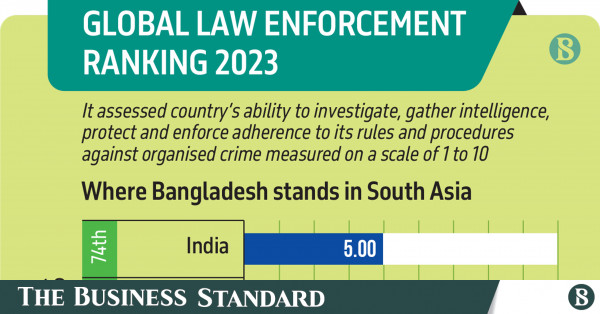
The Global Organised Crime Index 2023, published by the Global Initiative Against Transnational Organised Crime, reflected the grim scenario of the police force in Bangladesh.
Bangladesh ranked in the bottom third in South Asia in the law enforcement indicator of the index, published last year, with its law enforcement system reportedly plagued by corruption, politicisation, and the monopolisation of the police force for political advantage.
In South Asia, Bangladesh was only ahead of Afghanistan and Sri Lanka, while India led the region, followed by Bhutan, Pakistan, Nepal, and the Maldives.
Globally, Bangladesh ranked 123rd among 193 countries in the law enforcement indicator, scoring 4 out of 10.
The index highlighted concerns in its Bangladesh profile, stating, “Human rights violations committed by law enforcement agencies, including extrajudicial killings, torture, and enforced disappearances, have been widely reported, raising international concerns.”
Iceland and Singapore jointly secured the top position in the global law enforcement rankings, each earning the highest score of 9. Andorra, Austria, Finland, and Liechtenstein share third place, each with a score of 8.5.
At the other end of the spectrum, Venezuela, Somalia, Myanmar, Libya, South Korea, the Democratic Republic of the Congo, the Central African Republic, Burundi, and Afghanistan ranked at the bottom, each scoring just 1.5.
How the monster was created
The police administration was not perfect before. But the political crisis leading up to the 2014 parliamentary elections marked a significant turning point. The crisis stemmed from the Hasina government’s 2011 decision to abolish the caretaker government system, which worsened tensions and deeply impacted the police force’s functioning.
As the opposition parties led by the BNP refused to join the election, Hasina used the police to crush the protests by using excessive force, filing numerous cases against opposition leaders and putting them behind the bars through indiscriminate arrest.
After Hasina returned to power through the stage managed election on 5 January 2014, a number of top police officials then were heard boasting publicly with the claim that they brought Hasina to power.
Many officers both in police and civil administration got the reward with promotion and good posting for their contribution to manage the one-sided election.
In the years that followed under the Hasina regime, the situation worsened as the monster that had been created grew increasingly dangerous, unleashing brutal force against opposition voices.
Hasina provided various tools of repression to the police force, enabling it to silence dissenting voices. These included amending the ICT law to allow arrests without a court warrant if a case was filed under Article 57, and introducing the Digital Security Act.