
She urged the authorities to strictly enforce High Court directives prohibiting shipbreaking on tidal beach areas, asserting that these rulings must be integrated into national regulations
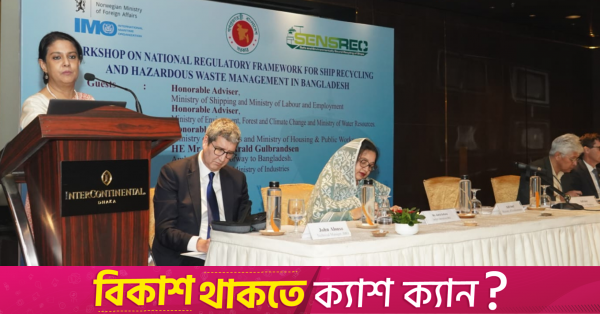
Environment, Forest, and Climate Change Advisor Syeda Rizwana Hasan Speaking at a workshop on the National Regulatory Framework for Ship Recycling and Hazardous Waste Management in Bangladesh, held today (16 February) at Hotel Intercontinental, Dhaka. Photo: TBS
“>

Environment, Forest, and Climate Change Advisor Syeda Rizwana Hasan Speaking at a workshop on the National Regulatory Framework for Ship Recycling and Hazardous Waste Management in Bangladesh, held today (16 February) at Hotel Intercontinental, Dhaka. Photo: TBS
Environment, Forest, and Climate Change Advisor Syeda Rizwana Hasan has called for stricter enforcement of environmental laws and greater accountability in Bangladesh’s shipbreaking industry.
Speaking at a workshop, on the National Regulatory Framework for Ship Recycling and Hazardous Waste Management in Bangladesh, at InterContinental Dhaka today (16 February), she warned that without urgent reforms, the country risks becoming a global dumping ground for hazardous waste.
Highlighting the human and environmental costs of the industry, the adviser stressed that shipbreaking must not continue at the expense of human lives, according to a press release.

She urged the authorities to strictly enforce High Court directives prohibiting shipbreaking on tidal beach areas, asserting that these rulings must be integrated into national regulations.
“We cannot justify keeping this industry alive if it fails to meet global safety and environmental standards. I am willing to work with the Ministry of Industry to develop regulations that protect Bangladesh from becoming a toxic waste dump and safeguard our workers from unknown hazards. The directives of the High Court, upheld by the Supreme Court, cannot and must not be ignored,” she stated.
In her speech, Syeda Rizwana Hasan drew attention to the dangerous working conditions in the shipbreaking industry, where workers are often exposed to life-threatening hazards without adequate protection.
She compared shipbreaking to Bangladesh’s garment sector, pointing out a stark difference, “In the garment industry, foreign buyers ensure that labour standards are met. In contrast, shipbreaking owners evade their legal responsibility for cleaning up hazardous waste, sending ships to Bangladesh under false certifications.”
She emphasised that the issue is not merely about ships carrying waste but about the toxic materials embedded in their structures—materials that Bangladesh lacks the capacity to safely manage.
The advisor also questioned why Bangladesh, which sources most of its iron demand through billets, must continue relying on shipbreaking for a fraction of its iron supply despite the severe risks involved.
She criticised weak regulations that allow hazardous waste to be dumped in Bangladesh, stating, “The effectiveness of legislation in global trade depends on how all stakeholders fulfil their roles. If exporters and shipowners do not adhere to international regulations, expecting a country with weak enforcement like Bangladesh to manage the consequences is unrealistic.”
She revealed instances where fraudulent waste declarations enabled illegal imports, with a single company issuing certificates from four different countries on the same day to facilitate shipbreaking in Bangladesh.
Syeda Rizwana Hasan underscored the need for credible legal regulations on waste declarations, warning that workers dismantling these ships remain unaware of the toxic risks they face. Shipbreaking yards should set signboards warn workers of cancer risks in multiple languages.
Emphasising the “polluter pays” principle, she argued that waste generators must be held responsible for their disposal. However, she noted that instead of enforcing accountability, the industry is being “greenwashed” and legitimized under weak regulations. Most vessels arriving in Bangladesh originate from small island states, though they were originally owned by European companies. Before being sent here, these companies change the ships’ registration in a practice known as “flag of convenience”, allowing them to evade legal responsibility.
“Would any European country allow shipbreaking on their own beaches? Why should the standards be different when workers’ lives are at stake?” she asked.
The adviser also criticised the Ministry of Industry for permitting shipbreaking despite ongoing environmental violations. She revealed that certain yards continue to operate without valid environmental clearance and noted that a serious worker injury was reported as recently as February 3rd. “Whose interests are we protecting when drafting regulations?” she questioned. “There are international laws holding polluters accountable, but in Bangladesh, shipowners and breakers control the narrative, often using regulatory loopholes to disguise hazardous practices.”
She concluded by reaffirming her commitment to ensuring that Bangladesh does not become a dumping ground for hazardous waste.
“We cannot allow an industry to thrive at the cost of human lives. Any legal framework for shipbreaking must align with global safety and environmental standards. The High Court’s directives, upheld by the Supreme Court, must be implemented in full. Our workers deserve protection, and our environment deserves better,” she said.
Adilur Rahman Khan, adviser to the Ministry of Industry; Zakia Sultana, secretary, Ministry of Industry and Håkon Arald Gulbrandsen, ambassador of Norway to Bangladesh also spoke on the occasion.