

By pinpointing the link between arsenic exposure, folic acid, and spina bifida, research from Harvard Chan School’s Maitreyi Mazumdar is helping the government of Bangladesh take action to prevent the often disabling spinal condition.
In her years as a Boston Children’s Hospital pediatric neurologist, Maitreyi Mazumdar had cared for children with many different neurological disorders. But she had rarely seen cases of spina bifida, a birth defect in which a baby’s spine doesn’t properly develop.
That changed in 2009, when she began working in Bangladesh on a study led by David Christiani, Elkan Blout Professor of Environmental Genetics at Harvard T.H. Chan School of Public Health, that was investigating the link between prenatal exposure to arsenic and the neurodevelopment of children. During the course of this research, Mazumdar frequently saw infants with the life-altering or life-threatening condition.
“I was surprised at how little experience I had with spina bifida given how common it is,” said Mazumdar, associate professor in the Department of Environmental Health at Harvard Chan School. “It depends on what corner of the world you’re in. There’s a stark difference in spina bifida prevalence between countries.”
Mazumdar hypothesized that rates of spina bifida were high in Bangladesh because the population was exposed to high levels of arsenic and had low levels of folate (or the vitamin’s synthetic version, folic acid) in their diets.
She was able to turn her hypothesis into research with funding from the Harvard Chan NIEHS Center for Environmental Health—and in so doing has uncovered new understandings of spina bifida that could help reduce the incidence of the condition in Bangladesh and elsewhere.
NIEHS Center grant seeds research
Previous research backed up Mazumdar’s hypothesis. Folate/folic acid is a known protector against spina bifida, and according to several animal studies, arsenic exposure might be a risk factor. Bangladesh is a country known to have extremely high levels of arsenic exposure. In the 1980s, it was discovered that Bangladeshis were suffering from mass arsenic poisoning from their drinking water and food staples like rice, the consequence of arsenic being released when millions of wells were dug in the 1970s and ’80s to improve sanitation and stem epidemics of cholera and other waterborne diseases.

“It’s the story of a public health intervention having unintended consequences and creating a new public health crisis,” Mazumdar said.
Scientists had examined the crisis’ impact on women’s reproductive health, but no one had yet studied its impact on spina bifida risk. Mazumdar became the first to do so thanks to a grant she received in 2012 from the Harvard Chan NIEHS Center. Each year, the Center receives funds from the National Institutes of Environmental Health Sciences (NIEHS)—part of the National Institutes of Health—and then issues grants to environmental health scientists within the Harvard ecosystem, with the goal of supporting scientists early in their research careers.
Mazumdar’s $25,000 grant specifically came through the Center’s Pilot Project Program, a funding stream dedicated to enabling research projects in their earliest stage.
“There aren’t a lot of good funding sources for researchers looking to get the preliminary data they need to then successfully apply for a larger grant from a larger funder,” said Sarah Unninayar, senior program manager for the Center. “That’s where the Pilot Project Program comes in—we actively try to fill that funding gap.”
“I pitched the study to multiple funders. It was hard to find the right fit—there are not many groups that are interested in population health and environmental exposure on the other side of the world,” Mazumdar added. “The Center provided the right amount of money at the right time to get the study done.”
On-the-ground data collection
To study the link between arsenic exposure, folate/folic acid intake, and spina bifida, Mazumdar and a local team from Dhaka Community Hospital started by working with district health officials, health centers, and midwives to identify children born with the condition, along with controls drawn from birth registries in the same areas. (Bangladesh lacked a national surveillance program formally monitoring the condition’s prevalence.) They administered detailed nutritional questionnaires, collected blood samples from mothers to ascertain their folate/folic acid levels, and collected samples of families’ drinking water to ascertain levels of arsenic exposure. Analysis of these data showed that women with higher arsenic exposures were less likely to experience the benefits of folic acid supplements in spina bifida prevention; Mazumdar published the study in April 2015 in Environmental Research. It was one of the first studies to show arsenic’s role in the development of spina bifida in humans.
The next year, Mazumdar received the NIEHS’ Outstanding New Environmental Scientist research award, which she used to expand her research in partnership with the National Institute of Neurosciences & Hospital, Bangladesh’s hospital dedicated to care for neurological disorders.
“We established a research program there,” Mazumdar. “We hired and trained research staff, built an office and a laboratory. We enrolled 300 children with spina bifida and, as a control group, another 300 children without the condition. Our goal was to examine possible gene-environment and gene-nutrition interactions that increase risk of the disease.”
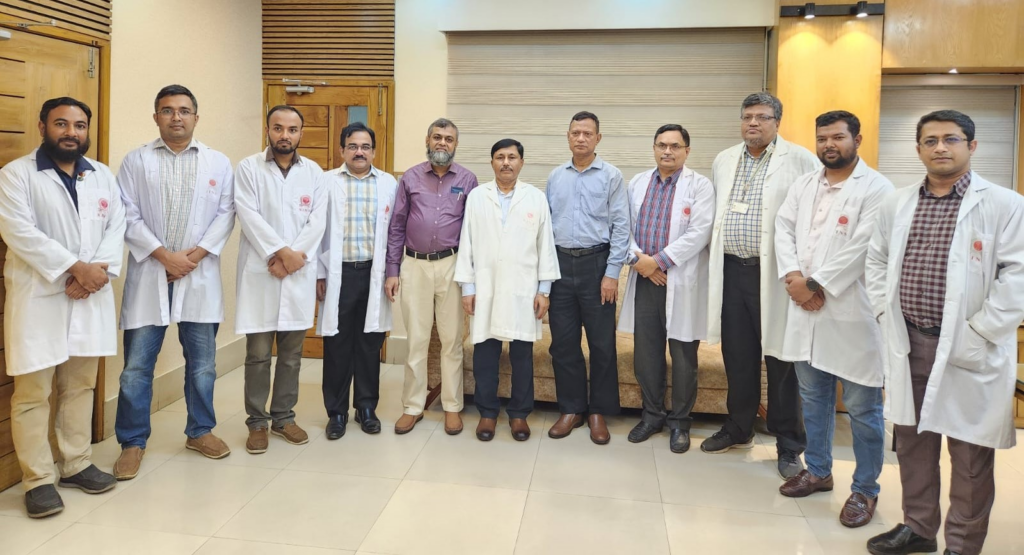
Mazumdar and her team have conducted several studies using blood, toenail, and tissue samples from the children and their mothers and fathers, plus samples of families’ drinking water. One study confirmed the link Mazumdar observed in the 2015 study between spina bifida and maternal arsenic exposure and folic acid use. Another found that paternal arsenic exposure was associated with higher risk of spina bifida.
“We were one of the first studies to consider fathers’ impact on risk of spina bifida. I think that’s particularly important in a place like Bangladesh, where mothers are often blamed for a child’s birth defect,” Mazumdar said. “It’s also important when considering interventions. We target folic acid to mothers, but our research opens up the possibility of targeting nutritional interventions to fathers, also.”
‘Precision environmental health’
Mazumdar’s current research aims to discover why and how arsenic increases spina bifida risk, and why and how folate/folic acid may help mitigate that risk. She and her team are using a variety of approaches: exposing stem cell organoid models to arsenic, in collaboration with scientists at the Baylor College of Medicine; using the blood and tissues samples they’ve collected over the years to examine the DNA methylation patterns and expression of genes associated with spina bifida; and conducting a trial among women to see how treatment with a high dose of folic acid affects DNA methylation patterns in their blood.
In the meantime, the government of Bangladesh is working to develop public health interventions based on the team’s findings. After meetings with Mazumdar’s team, in which they presented their research and shared its public health implications, officials moved to encourage flour millers to begin fortifying flour with folic acid—arguably the most effective way to help prevent spina bifida, said Mazumdar. Folic acid fortification in flour is required by the U.S. Food and Drug Administration and in many countries in Europe; according to Mazumdar, the government of Bangladesh had been ready and willing to adopt a similar strategy, pending country-specific data.
This is a shining example of the kind of work our NIEHS Center strives to promote. It combines mechanistic, clinical, and environmental health aspects to produce translational research that has direct, practical public health implications.
Marc Weisskopf, Cecil K. and Philip Drinker Professor of Environmental Epidemiology and Physiology and director of the Harvard Chan NIEHS Center
“Many Bangladeshi public health organizations and groups had been advocating for folic acid-fortified flour in order to help eliminate this nutritional deficiency,” she said. “Local data that was systematically collected and high quality was the missing piece for the government. We provided that data.”
So far, one flour company has heeded the government’s call, and in December 2024 made folic-acid-enriched flour available to consumers. The government has been promoting the flour. They’ve also been working to build a surveillance program to capture national-level data on spina bifida and developing campaigns to promote folic acid supplements.
Mazumdar’s research is proving to have implications beyond Bangladesh, spurring similar research in China and Turkey, two more countries with high levels of arsenic exposure.
“Our research suggests that higher doses of folic acid are needed in communities and countries where arsenic exposure is higher,” Mazumdar said. “It’s this idea of precision environmental health—that different places need different public health interventions depending on their unique environmental exposures. Just as individual patients need tailored treatments, so do populations.”
“This is a shining example of the kind of work our NIEHS Center strives to promote,” said Marc Weisskopf, Cecil K. and Philip Drinker Professor of Environmental Epidemiology and Physiology and director of the Harvard Chan NIEHS Center. “It combines mechanistic, clinical, and environmental health aspects to produce translational research that has direct, practical public health implications.”