
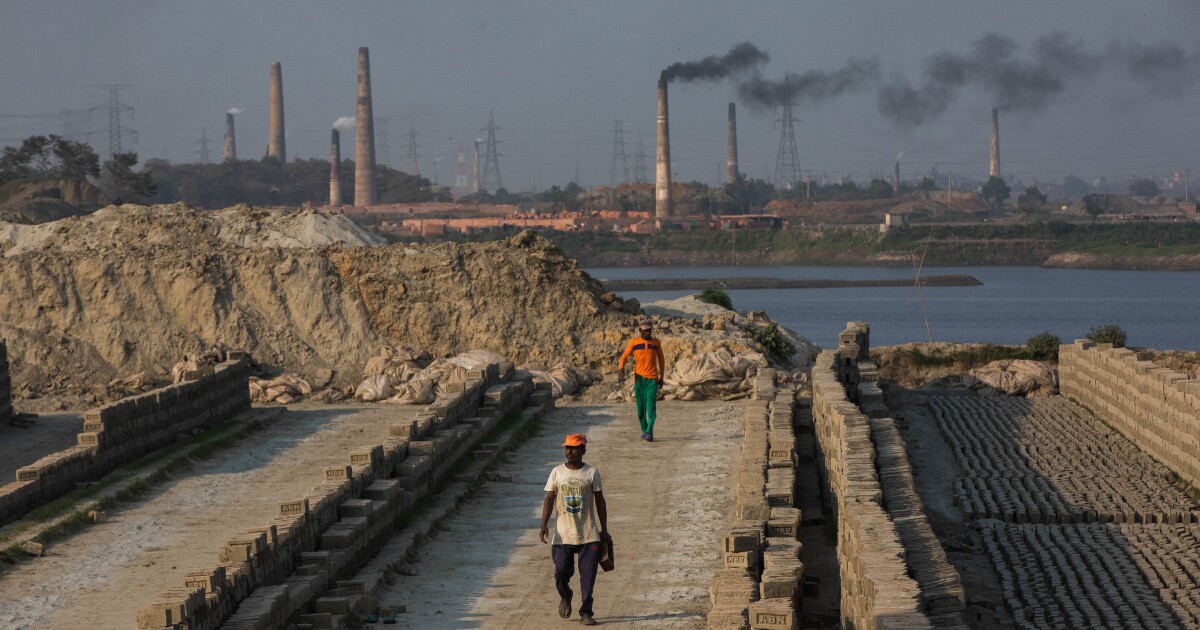
During the dry winter months in Bangladesh, thousands of workers shovel millions of tons of coal into kilns across the country. As columns of hand-packed bricks bake and harden, dark plumes of smoke pour out of more than 8,000 smokestacks that mark the skyline of both rural and urban areas.
“It’s a lot of black smoke, impacting the workers and nearby villagers, but also the overall air quality of the region,” said Sameer Maithel, an engineer with Greentech Knowledge Solutions, a consulting firm in Delhi, India.
Bangladesh’s air consistently ranks among the most polluted on Earth. Brick kilns contribute anywhere from 10 to 40% of the tiny particles that make up that pollution. Those particles can enter our lungs and even our bloodstream, causing health problems, including respiratory diseases, stroke and even cognitive problems.
But something as simple as stacking the bricks a different way could put a significant dent in that pollution, according to a new study of over 275 kilns published in Science by Maithel and his colleagues.
“This is wonderful evidence of how simple low cost interventions can have a big impact on energy use,” said William Checkley, an epidemiologist at Johns Hopkins University who wasn’t involved in the study. “If we can implement these, we could have a significant impact in energy use and emissions, improving air quality throughout southeast Asia.”
The necessity of brick
Bricks are the main building block for Bangladesh. The densely populated and rapidly urbanizing country produces nearly 30 million bricks a year – more than 90% from loosely regulated, coal-burning kilns.
“It’s quite simple and inexpensive to set up traditional-style brick kilns, so they’ve just proliferated,” said Nina Brooks, a global health researcher at Boston University.
The process goes something like this: First, dun-colored clay bricks are molded with a wooden box and stacked in the sun to dry. Next, hundreds of thousands of bricks are stacked in the firing chamber and covered with ash. Then, workers shovel lots and lots of coal as the bricks fire, firming them up.
“The combustion efficiency of these brick kilns is really low,” said Brooks, meaning they end up burning a lot more coal than they need to, “Which is why they’re so heavily polluting here.”
Each kiln can employ up to 200 workers. They’re the most directly impacted by the smoke, with one study finding nearly 80% report some kind of respiratory problems. But they’re not the only ones. Kilns are often close to densely populated areas, adding to the smog that comes from city life.

Zakir Hossain Chowdhury/Anadolu Agency/Getty Images / Anadolu
/
Anadolu
While there are regulations on where kilns can and can’t operate, they’re not always followed, said Brooks. “We found that 77% of brick kilns are illegally located too close to a school.”
Modern, high-tech kilns produce substantially less pollution, but they’re up to 25 times more expensive to build and operate. “They’ve not really taken off,” said Brooks.
Instead, the team looked for solutions that would be easier and cheaper for the average brick producer to adopt.
Simple interventions
In his decades of working with brick kiln owners in India as a consulting engineer, Maithel has noticed questionable practices.
Many kiln operators pack too many bricks in the kiln too tightly, he said. That tight spacing chokes out oxygen flow, which is needed for efficient burning. It also means hot coals get stuck at the top of the stack instead of falling to the bottom, leading some bricks to be overbaked and others not fired enough.
He’s also noticed that workers often shovel coal in bouts, working hard in teams of two or three, and then all taking breaks together. That results in uneven fueling, which can stymie efficiency too.
As an energy systems engineer, Maithel knew that a few simple changes could really help. Simply stacking the bricks in a zig-zag pattern that increases airflow and ensuring coal gets delivered more consistently should help the kilns operate more efficiently, he said.”The better you are able to provide fuel and air mixing, the probability of black smoke will be less.”
To see if such simple interventions could help reduce air pollution and boost profits, the team planned a massive experiment across 276 kilns. One group of kiln owners and workers were taught how to implement these interventions. Another group got the same training plus info on how the changes would save money. The control group got no training.
Then, during firing season in the winter, the researchers measured various aspects of kiln performance, including fuel use.
So, did it work?
The results were promising.
Kilns that adopted these measures saw significant benefits. On average, fuel use dropped by about 23 percent, the study found. The researchers estimate that would reduce the carbon dioxide and particulate matter coming out of the kilns by about 20%.
“We showed that simple, low-cost interventions can really reduce pollution,” said Mahbubur Rahman, an environmental health researcher at the International Centre for Diarrhoeal Disease Research, Bangladesh.
And the changes improved both worker conditions and the bottom lines for kiln owners. Over the season, they had saved close to $40,000 each because of reduced fuel use, said Brooks. Brick quality went up as well.
In fact, kiln owners were so impressed that a year later, those that had adopted the new practices were still practicing them.
But to really make a dent in Bangladesh’s air pollution, many more kilns need to sign on. The research team, which includes scientists from the U.S., India and Bangladesh, are now working with the Bangladeshi government to expand this training.
“It’s a hopeful story,” Brooks says, “of a place where solutions are quite feasible.”
Copyright 2025 NPR