
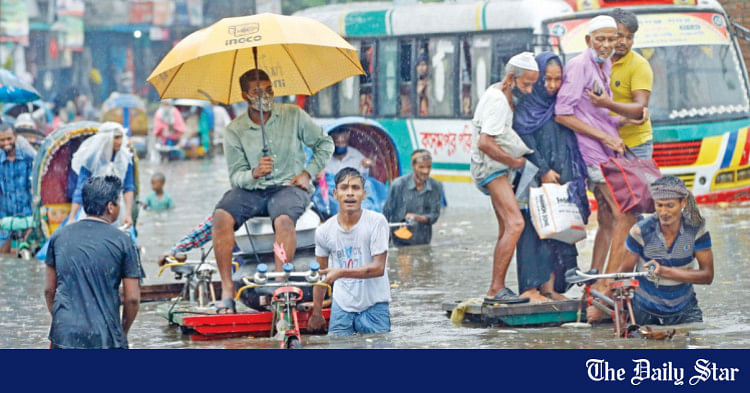

The drainage blueprints still in use were designed decades ago for a different climate and a far smaller population. FILE PHOTO: FIROZ AHMED
“>
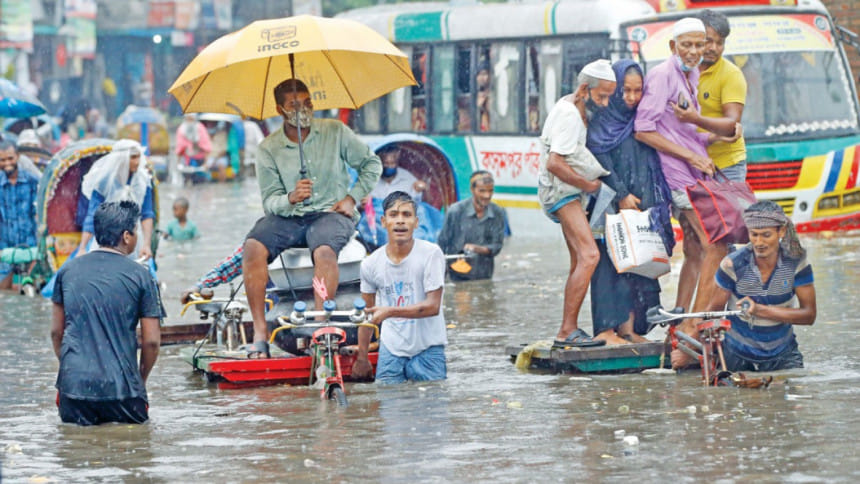
The drainage blueprints still in use were designed decades ago for a different climate and a far smaller population. FILE PHOTO: FIROZ AHMED
The sky rips open, and within an hour, Dhanmondi is knee-deep—not just in puddles, but in a murky, swirling current that transforms familiar streets into treacherous rivers. The roar of car engines gives way to the slosh of water, and the vibrant life of Dhaka grinds to a halt. Just a few hours of rain, and our cities become aquatic ghost towns. Students, their hopes for exams drowned by the rising tide, stare despondently from waterlogged apartments. Rickshaw-pullers, their livelihoods quite literally afloat, huddle under makeshift shelters. Small businesses—the lifeblood of our communities—watch helplessly as their inventory succumbs to the invasive floodwaters. What happens when the monsoon truly peaks? More critically, what is the actual, agonising state of our drainage systems?
This recurring nightmare is no accident—it is the by-product of Bangladesh’s rapid, unplanned urbanisation, where drainage infrastructure has failed to keep pace with city expansion. In Dhaka, Chattogram, Sylhet, and Barishal, even moderate rain now triggers widespread waterlogging. The roots of this crisis are threefold. First, rampant encroachment on canals, floodplains and wetlands—nature’s own drainage systems—has throttled water flow, turning once-broad channels into clogged trickles. Second, the drainage blueprints still in use were designed decades ago for a different climate and a far smaller population. Today’s intense rainfall and relentless concrete sprawl quickly overwhelm systems built for 25–30 mm per hour, while actual downpours often double that. Third, overlapping mandates among key agencies—WASA, city corporations and RAJUK—have created a maze of fragmented responsibilities. No one is fully accountable, and coordination is virtually absent. This toxic mix of encroachment, outdated design, and bureaucratic disarray turns every rainstorm into a disaster, drowning infrastructure and livelihoods alike.
 For all latest news, follow The Daily Star’s Google News channel.
 The relentless urban flooding we witness today is not merely a consequence of poor planning—it is the unmistakable, undeniable face of climate change manifesting as urban chaos. Beyond the widely discussed threats of rising sea levels and coastal erosion, Bangladesh is now grappling with erratic rainfall patterns, sudden cloudbursts, and increasingly extreme weather events that overwhelm city infrastructure within minutes. Our metropolises, already strained by haphazard growth, are now confronting a new, intensified hydrological reality. Yet, despite Bangladesh consistently ranking among the most climate-vulnerable nations on the Global Climate Risk Index, national adaptation discourse remains disproportionately focused on rural resilience and coastal defences. Urban centres—dense with population and economic assets—remain dangerously under-prioritised. This blind spot in planning and policy is no longer just an oversight; it is a critical vulnerability that leaves millions exposed to cascading climate risks. Recognising the urban flood crisis as part of the climate emergency is not optional—it is long overdue.
If climate change is the accelerant, then poor governance is the kindling. Beneath the rising waters lies a tangle of institutional dysfunction and impunity that sabotages effective action. When Dhaka North goes underwater, blame ricochets from WASA to the City Corporation to RAJUK—yet no agency is held accountable. This bureaucratic merry-go-round ensures that drainage failures are met not with reform, but with finger-pointing. Despite ballooning budgets for drain cleaning and flood prevention, there is little transparency about where the money goes—and even less public trust in how it is spent. Meanwhile, unregulated construction continues to encroach on canals, wetlands and stormwater routes with near-total impunity. Developers routinely fill up vital water bodies, and legal enforcement is either toothless or non-existent. This systematic erasure of natural drainage not only worsens flooding—it cements it as a feature, not a flaw, of urban life. Until we fix who governs water, we will continue drowning in the consequences.
The grim reality demands not just recognition of the problem, but a swift and transformative shift towards comprehensive solutions. Crucially, this involves embracing nature-based solutions that work with, rather than against, our natural hydrology. This means aggressively reviving and restoring our choked canals, turning them back into functioning arteries for water flow instead of stagnant waste receptacles. Furthermore, we must actively pursue the creation of urban retention ponds and expand green spaces that can absorb excess rainfall, acting as vital sponges during deluges. Innovations such as green roofing and permeable pavements must become standard practice in urban development, allowing water to infiltrate the ground naturally rather than overwhelm drainage systems.
We do not need to reinvent the wheel; successful models exist globally. Singapore’s ABC Waters Programme—which integrates water bodies into the urban landscape for both drainage and recreation—offers a powerful blueprint. What Bangladesh desperately needs is a Drainage Master Plan 2.0: a forward-looking strategy that not only updates archaic designs but fundamentally integrates the latest climate data and rigorously enforces wetland zoning laws. This cannot be a top-down directive. It requires active, regular dialogue and collaboration among urban planners, climate scientists, engineers and local communities—the very people who live and breathe these challenges. Only by working together can we design and implement a resilient drainage system capable of facing the climate realities of tomorrow.
The choice before us is stark. If we fail to fix our urban drainage systems now, the floods of the future will not merely damage property and disrupt daily life—they will systematically drown opportunity. They will wash away the entrepreneurial spirit of our small businesses and stifle economic growth. They will erode public health, fostering outbreaks of waterborne diseases. Most tragically, they will extinguish hope, leaving our citizens trapped in a cycle of despair and vulnerability. The time for action is not tomorrow, but today. Our collective future, and the very liveability of our cities, depends on it.
Nahian Rahman is research associate at Bangladesh Institute of Governance and Management (BIGM).
Views expressed in this article are the author’s own.
Follow The Daily Star Opinion on Facebook for the latest opinions, commentaries, and analyses by experts and professionals. To contribute your article or letter to The Daily Star Opinion, see our guidelines for submission.