
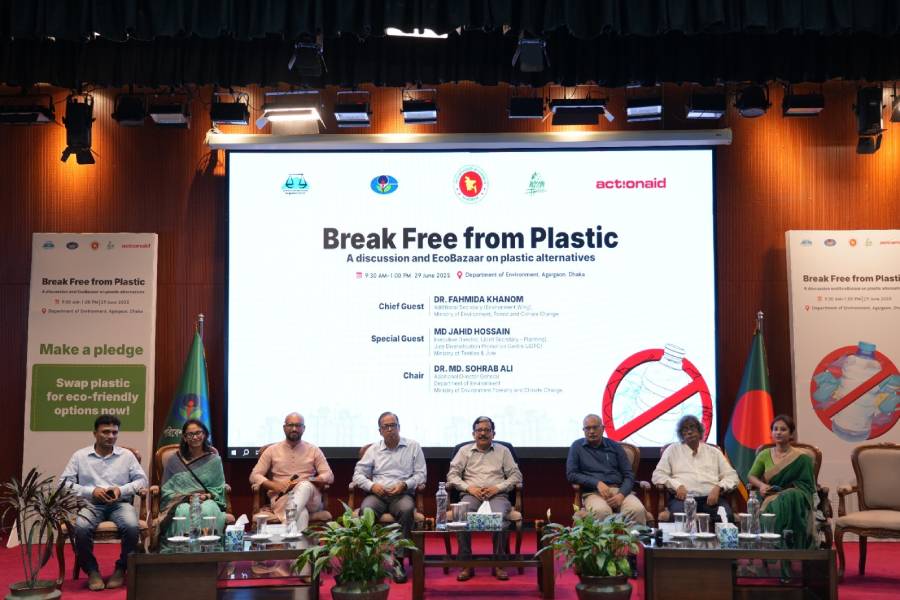
To raise awareness about the alarming impact of plastic pollution and the urgency of adopting sustainable alternatives, a national-level event titled ‘Break Free from Plastic – A Discussion and EcoBazaar on Plastic Alternatives’ was held on Sunday in Dhaka.
The event was organised to inspire collective commitment to reducing plastic dependency and showcased innovative, eco-friendly materials and products as viable solutions, according to a press release.
Organised jointly by the Department of Environment of Bangladesh Government, ActionAid Bangladesh, Nature Conservation Management (NACOM) and Centre for Climate Justice Bangladesh (CCJ-B), the event was held today (Sunday) at Agargaon, Dhaka, as part of the observance of World Environment Day 2025.
The ‘EcoBazaar: Plastic-Free Fair’- was formally inaugurated by Dr. Fahmida Khanom, Additional Secretary, Ministry of Environment, Forest and Climate Change. Community-based and small to medium-sized enterprises exhibited and sold creative alternatives to plastic, including jute-based products, bamboo furniture, and biodegradable items. Visitors and invited guests visited the stalls and engaged with the participants to learn more about sustainable consumption options.
The inaugural session was chaired by Dr Md Sohrab Ali, Additional Director General of the Department of Environment. Opening remarks were delivered by S.M. Munjurul Hannan Khan, Executive Director of NACOM. A keynote presentation titled “From Ban to Beyond: Addressing Plastic Pollution through Policy, Innovation, and Inclusion” was jointly delivered by Azka Touhida Daiby (Research Associate, NACOM), Tanzia Anjum (Deputy Manager, ActionAid Bangladesh), and M. Hafizul Islam Khan (Director, CCJ-B). The session was moderated by Kazi Morshed Alam, Head of Programme and Engagement at ActionAid Bangladesh.
A panel discussion followed with participation from experts including Dr Mubarak Ahmad Khan (Scientific Adviser, Bangladesh Jute Mills Corporation), Shamima Akhter (Director, Unilever Bangladesh Ltd.), Jannatul Munia (Director-Strategy, RedOrange Communications), and Dr. Neaz Al Hasan (Assistant Professor, Gopalganj University of Science and Technology). An Open Discussion was also held, allowing diverse stakeholders to share insights and ideas on addressing plastic pollution.
The discussions highlighted the escalating crisis of plastic pollution in Bangladesh. Recent studies reveal that between 2023 and 2025, the country generated nearly 87,000 tonnes of single-use plastic annually, with 96% ending up as waste. Urban per capita plastic consumption increased from 3 kg in 2005 to 9 kg in 2020, while in Dhaka, it soared to 22.25 kg – a threefold rise. Nationwide, more than 646 tonnes of plastic waste are produced daily, much of which flows into rivers and landfills, causing severe environmental damage.
Alarmingly, research has detected high levels of microplastics in rivers and municipal water systems in Dhaka, with an average of over 30 particles per litre. Coastal regions have been found to contain approximately 46,000 pieces of plastic per square mile—posing a serious threat to marine biodiversity and human health.
Speakers stressed the need to adopt sustainable alternatives such as jute, bamboo and other biodegradable materials. They called for greater investment and policy support from both government and corporate sectors to nurture innovation and scale up alternatives.
Dr. Fahmida Khanom reiterated the government’s commitment to tackling plastic pollution said, “Plastic pollution is now a global crisis. The government has undertaken various policies and initiatives to ban single-use plastic and promote reusable alternatives. We are strengthening Extended Producer Responsibility (EPR) and encouraging domestic recycling for potential export. The solution lies in collaborative action.”
Md Jahid Hossain, Executive Director of the Jute Diversification Promotion Centre (JDPC), under the Ministry of Textiles and Jute, said “Bangladesh produces around 1.7 to 2 million metric tonnes of jute annually—an ideal alternative to plastic. Laws alone are not sufficient; enforcement and grassroots awareness are essential. Local governments must promote sustainable habits, and educational institutions should instil eco-conscious values from an early age. Small innovators must be incentivised to ensure a sustainable future for the next generation.”
Tanjir Hossain, Global Resilience Advisor at ActionAid International’s IHART, said, “Collaboration and innovation are key to combating plastic pollution. Youth leaders and local entrepreneurs must drive the change for a greener, safer environment.”
The event brought together policymakers, regulators, researchers, environmentalists, entrepreneurs, youth leaders and media representatives dedicated to sustainable development and ecological justice.